
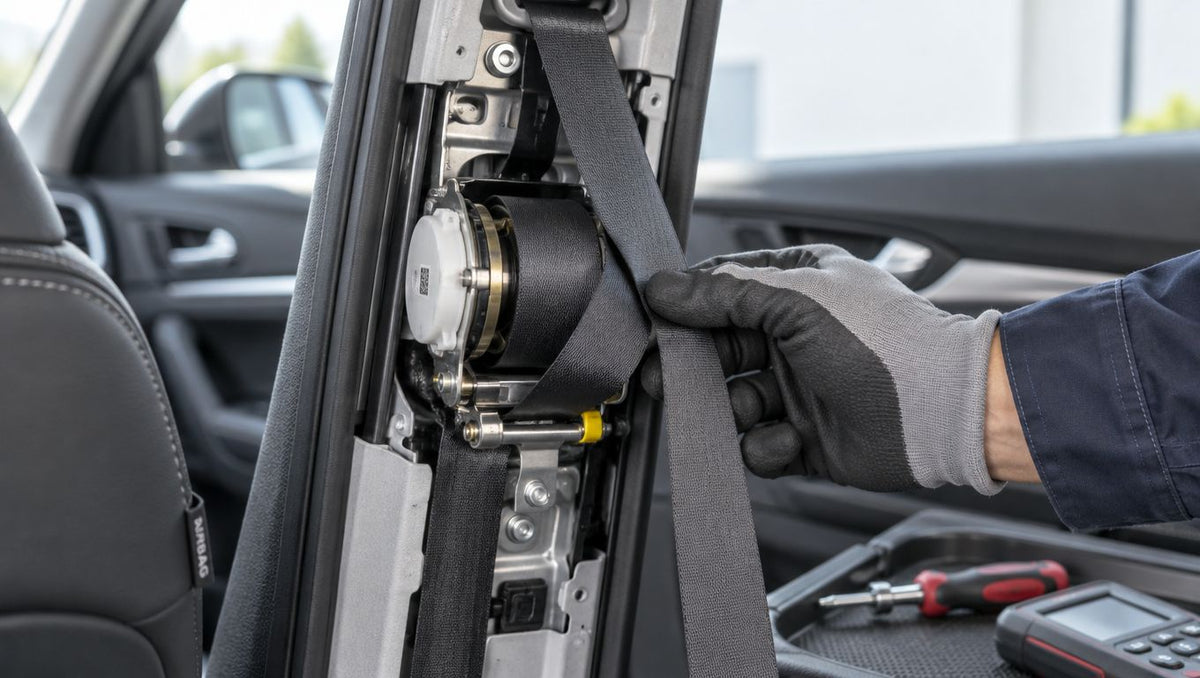
A belt that will not retract is usually not just a tired spring. It usually points to webbing friction from contamination or twists, a crash-deployed pretensioner, or a recall-grade component fault, and federal testing ties retraction performance directly to occupant protection.
Your belt might be hanging from the pillar right now, leaving the car drivable in the driveway and unsafe in the same moment. That's the part most owners miss, because the symptom looks small while the failure can sit inside the restraint system itself.
Table of Contents
- Why a Seat Belt That Will Not Retract Deserves Immediate Attention
- How a Retractor and Pretensioner Actually Work
- Common Mechanical and Contamination Causes
- When a Locked Belt Means the Pretensioner Deployed
- A Safe Diagnostic Sequence Before Touching the Belt
- Repair Versus Full Assembly Replacement
- Safe Removal and What to Send for Repair
- Putting It All Together and Knowing When to Stop
Why a Seat Belt That Will Not Retract Deserves Immediate Attention
You buckle in, the latch clicks, and the shoulder belt stays slack against the door pillar. That is a safety-component symptom, not a trim annoyance. Under NHTSA's interpretation of FMVSS No. 210, the retractor can be part of the restraint system's structural anchorage when a failure could let the belt separate from the vehicle during a crash (NHTSA interpretation).
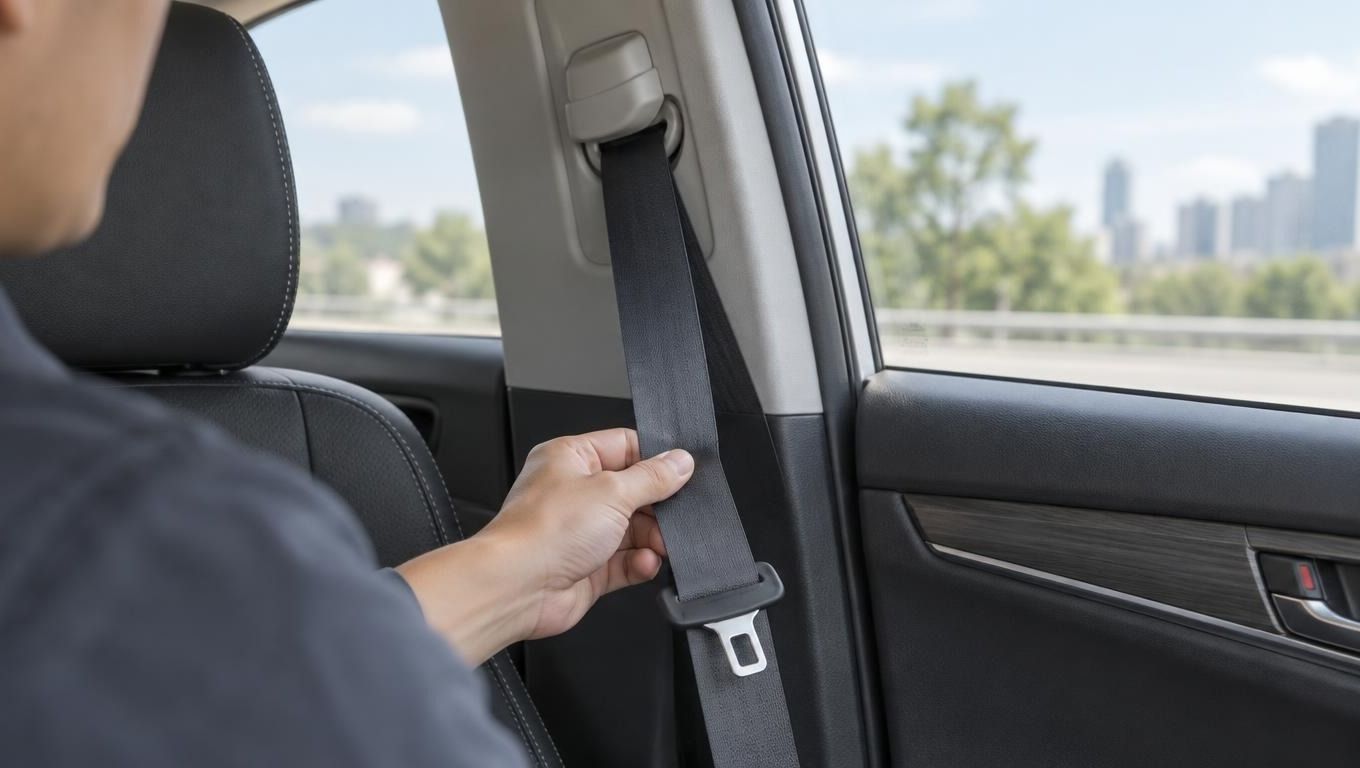
A belt that stays slack or hangs from the pillar can point to contamination in the webbing path, a spring that has lost force, or a deeper retractor fault that keeps the belt from managing crash loads correctly.
Practical rule: if the belt will not return on its own, treat it like a safety-component issue until proven otherwise.
The same federal framework ties retraction to emergency locking, webbing management, and the belt's ability to stay connected to the vehicle structure in a collision. It also addresses emergency-locking retractors that return webbing under controlled conditions and subjects the unit to repeated cycling and force application during durability testing. That is why a slow rewind, a hard lock, or a belt that only moves partway should be taken as a real restraint-system warning, not a minor inconvenience.
A driver does not need the lab language to act on the result. If the belt will not rewind normally, the restraint system is no longer behaving the way it was designed to behave.
How a Retractor and Pretensioner Actually Work
A seat belt has two separate jobs that can look similar from the driver's seat. The retractor is the spring-loaded spool that pulls webbing back in, while the pretensioner is a separate crash device that tightens the belt when impact begins.
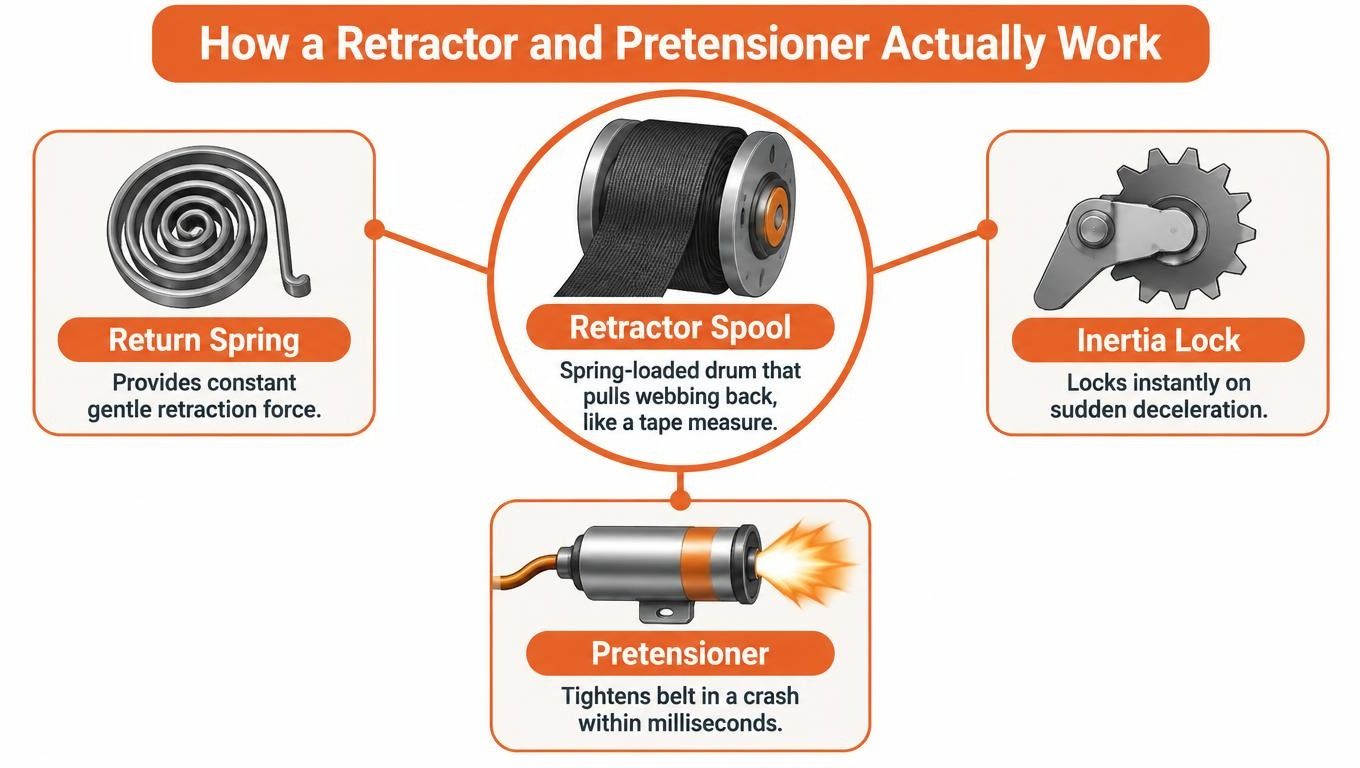
The retractor works like a tape measure that wants to roll back into its case. The pretensioner works more like a drawer latch that snaps shut the instant a crash starts, so the belt cannot keep feeding out.
Under FMVSS No. 209, an upper-torso retractor must generate a retractive force between 1 and 5 N, and after ten full extension and retraction cycles it still has to retract under the specified withdrawal-force test (49 CFR 571.209). The same standard defines a locked retractor at a belt-load tension of at least 35 N.
That difference matters in the driveway. A slow belt may be fighting friction or weak rewind force. A locked belt may be doing exactly what a pretensioner was designed to do after a crash. A belt that hangs from the pillar may be blocked by twisted webbing, crushed trim, or misaligned guides.
The geometry matters too. Federal testing requires acceleration-sensitive retractors to lock when tilted more than 45 degrees from their installed orientation, which is why a removed unit tested at the wrong angle can look bad even when the installed system is fine. Bench testing has to match the original mount position.
A belt can look fine at a glance and still fail for three different reasons, weak rewind force, mechanical lock, or crash deployment.
Once those categories are separate, the symptom is no longer mysterious. It becomes a clue.
Common Mechanical and Contamination Causes
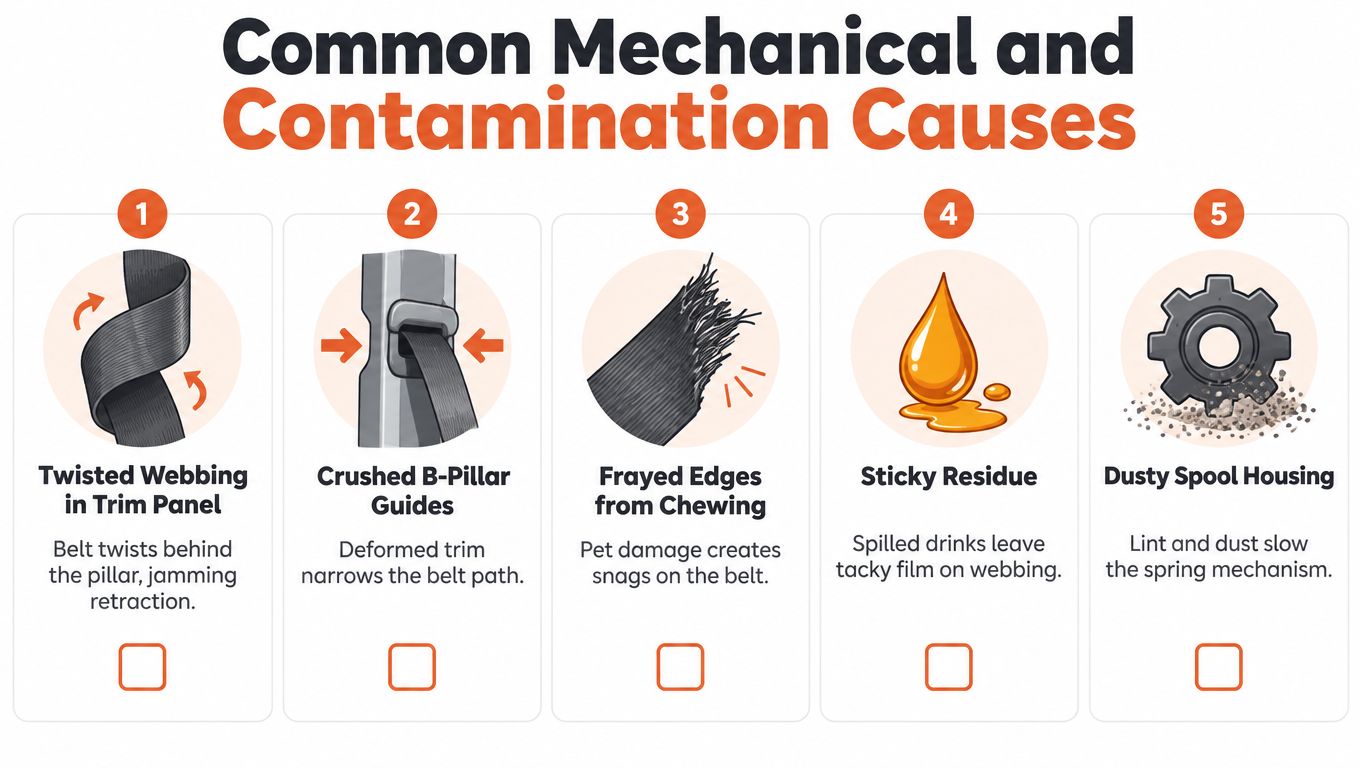
Sometimes the answer is boring, and that's good news. Twists in the webbing, dirty belt fibers, crushed trim, or a tired spring can all make the belt behave badly without any crash event at all.
What to look for first
Start with the webbing itself. Pull it all the way out and look for a twist hidden inside the trim, a fold near the shoulder guide, or a section that feels stiff where it passes your fingers. A twisted belt can look normal from the seat but bind like a ribbon caught in a curtain track.
Then check the path. If the belt rubs hard at the D-ring, drags through a pinched pillar opening, or shows crushed trim marks, the belt has friction where it should glide. That kind of resistance can make the spring seem weak even when the spring still has life.
Everyday damage can mimic a failed retractor
Food spills, drink residue, pet chewing, lint buildup, and frayed edges all create drag. The belt doesn't need to be shredded to misbehave, it only needs enough contamination or edge damage to stop sliding cleanly through the system.
A weak spool spring can also happen on its own. Over time, the belt may not have enough rewind force to overcome normal friction, and the result is the same from the driver's seat, a strap that doesn't disappear back into the pillar.
Home check: with the car parked, unload the shoulder-height adjuster, pull the belt out slowly, then let it go. If it rewinds better with the guide under less load, the belt path deserves attention before you blame the retractor.
The main point is simple. If the webbing is clean, untwisted, and guided correctly but still drags, the issue has moved beyond ordinary dirt or trim interference and deserves a more careful look.
When a Locked Belt Means the Pretensioner Deployed
After a collision, a belt that will not retract is often locked by design because the pretensioner fired. NHTSA describes a pretensioner as a device that retracts belt webbing during certain frontal impacts, and once it has fired, the belt can stay short, resist rewinding, or trigger an SRS warning condition (NHTSA interpretation).
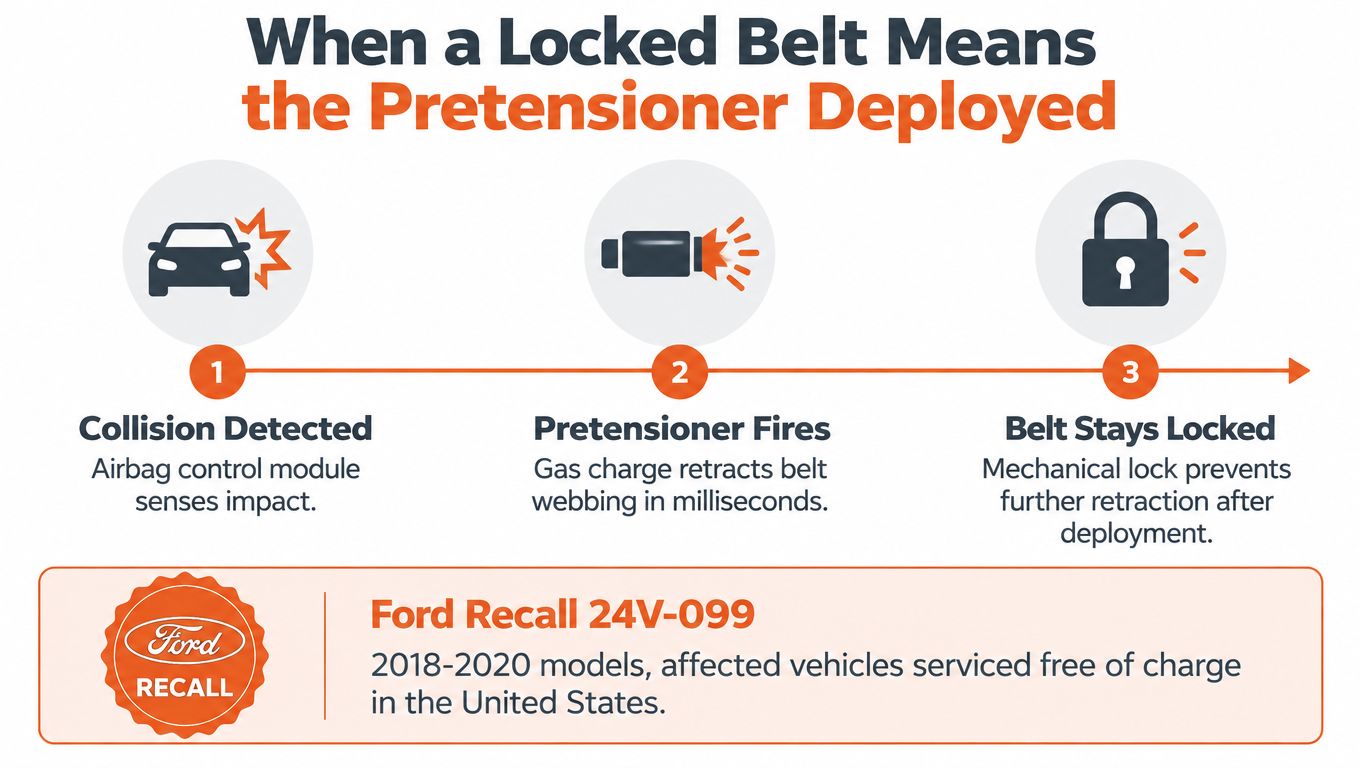
Recall records show the same pattern in real vehicles. In a 2024 NHTSA investigation involving certain Ford models, the agency recorded reports that a crash event may have deployed the pretensioner system and left the seat belt locked afterward. The record also notes Ford safety recall 24V-099 on February 9, 2024, covering 2018–2020 Ford Expedition vehicles (NHTSA investigation PDF). The point is simple. A belt can still look intact while its internal locking parts have already been spent.
A locked belt can be the correct post-crash result, but it is no longer a normal reusable restraint until the affected parts are repaired or replaced. The webbing may still move a little by hand, yet the retractor can remain set like a spring that has already been released.
The SRS lamp helps narrow that down. If the airbag or seat belt warning light is on, the vehicle may be storing crash faults or signaling deployed components that need professional diagnosis. Connector integrity and system checks matter alongside the mechanical inspection, since a deployed unit can store SRS faults. For a plain-language explanation of that failure mode, see seat belt pretensioner repair and locking behavior.
A Safe Diagnostic Sequence Before Touching the Belt
Start with the vehicle record, not the trim panel. A locked belt can point to a recall or another restraint-system event, so check the VIN before you start pulling parts apart.
A safer order for the first checks
- Check recall status first. If there is an open restraint-related recall, treat that as your first clue.
- Turn the ignition on and read the SRS lamp. A light that stays on points you toward a restraint-system fault rather than simple grime.
- Inspect the belt path. Look for twists, crushed trim, and rub marks at the shoulder guide.
- Unload the D-ring. Let the belt retract with less tension at the guide, then see whether movement improves.
- Keep the retractor in its installed orientation. A removed unit tested at a random angle can mislead you, because as covered above, acceleration-sensitive retractors lock beyond 45 degrees from their mounted position.
The next rule is simple. Do not lubricate, disassemble, or electrically probe the pretensioner connector. A collision-deployed unit can stay mechanically locked and can also hold SRS faults, so force and guesswork can turn a recoverable part into a bigger repair.
If the belt path is clean, the shoulder adjuster is unloaded, the unit is mounted where it belongs, and the SRS lamp is off but the belt still will not rewind, the fault has moved into safety-component territory. That is the point where hands-off diagnosis is safer than improvised fixes.
Repair Versus Full Assembly Replacement
The right fix depends on what failed inside the belt. A belt that is contaminated, twisted, or otherwise blocked by a rebuildable retractor can often be handled through mail-in repair, which keeps the original assembly in service. A belt tied to a confirmed recall remedy, or one with a housing and webbing that no longer pass inspection, points toward full assembly replacement.
| Factor | Mail-in Repair | Dealer Assembly Replacement |
|---|---|---|
| What gets repaired | Rebuilds the existing retractor or pretensioner with OEM components | Replaces the full assembly with new OEM parts |
| Best fit | Locked or non-retracting belt where the core hardware is rebuildable | Recall remedy, cracked housing, or severe damage |
| Turnaround | Typically returned within 24 hours of receipt and shipped inside a 24–48-hour window | Depends on parts availability and dealer scheduling |
| Systems covered | Single-, dual-, and triple-stage belts | New factory assembly matched to the vehicle |
| Installation | Customer or local shop handles reinstall | Dealer installs during service visit |
That same decision pattern appears in other repair work. The choice between fixing versus replacing power tools depends on whether the core mechanism can be rebuilt or whether the whole unit has already crossed into replacement, as outlined in fixing versus replacing power tools.
A mail-in service fits best when the belt structure is still sound and the retractor or pretensioner needs internal work. That is the model Seat Belt Repair uses, with OEM components and a bench-tested return path. Dealer replacement makes more sense when the vehicle's condition or recall status calls for a full factory assembly, and it aligns with the way repair decision guides rank a stuck seat belt by cause and repair path.
Follow standard campaign procedure before disconnecting any pretensioner. Remove the ignition key, disconnect the battery, and wait one minute before handling the pretensioner connector. That is the same kind of safety margin used across restraint work, where a small step protects you from turning a serviceable part into a bigger problem.
A simple rule helps here. If the belt is mechanically recoverable, repair keeps more of the original assembly. If the webbing, housing, or recall status makes the unit unfit for service, replacement is the cleaner choice.
Safe Removal and What to Send for Repair
Removal starts with the vehicle de-energized, as outlined in the diagnostic sequence above. Once the belt is out, the key is documenting what the repair shop needs to see before anything gets shipped.
What to identify before packing
- Connector count: Note the connector layout so the belt stage can be identified correctly.
- Visible damage: Record cuts, heat marks, abrasion, or failed stitching on the webbing.
- Lamp status: Note whether the SRS warning light is on.
- Vehicle fitment: Write down the exact seating position and side. These parts are not interchangeable like a trim clip.
What to ship
Send the belt assembly and any related module or component the repair provider asks for. Pack it so the connectors cannot bend or scrape in transit. Do not add lubricant, do not force the belt free, and do not probe the pretensioner connector with a test light or meter.
If the webbing is cut, burned, or heavily frayed, that calls for a separate decision from the locked mechanism itself. A retractor can still be rebuildable internally and still need webbing replacement before it is safe to return to service.
Mail-in providers do not reinstall parts, so final fitment belongs to you or a local shop. That boundary matters because the reassembled system still depends on correct mounting, proper torque, and vehicle-side checks after the repaired unit comes back.
Putting It All Together and Knowing When to Stop
The decision rule is straightforward. If the belt path is clean, the shoulder adjuster is unloaded, the retractor sits at its original angle, and the SRS lamp is off, but the webbing still won't rewind, the problem has moved past a simple nuisance and into a restraint-system fault.
A stuck belt usually falls into one of three buckets. It's either contamination or twist, pretensioner deployment, or a recall or load-limiter event that needs the vehicle identified before parts are ordered. A deployed pyrotechnic pretensioner can also leave crash data in the airbag control module, so the belt fault and the SRS fault may need to be handled together.
For the diagnostic side, this guide on functional testing requirements for repaired seat belts shows why the final check matters just as much as the repair itself. A belt that passes the bench but fails once mounted was never fixed.
Stop troubleshooting when the symptom points to the restraint system itself. At that point, the safer move is professional service with OEM components, proper testing, and a repair path that matches the failure instead of guessing at it.
If your seat belt won't retract after the belt path is clear, Seat Belt Repair can repair the pretensioner, replace damaged webbing, and reset SRS modules through a mail-in process. Visit Seat Belt Repair to match the symptom to the right service and send in the component before driving with a compromised restraint system.

Leave a comment
This site is protected by hCaptcha and the hCaptcha Privacy Policy and Terms of Service apply.