
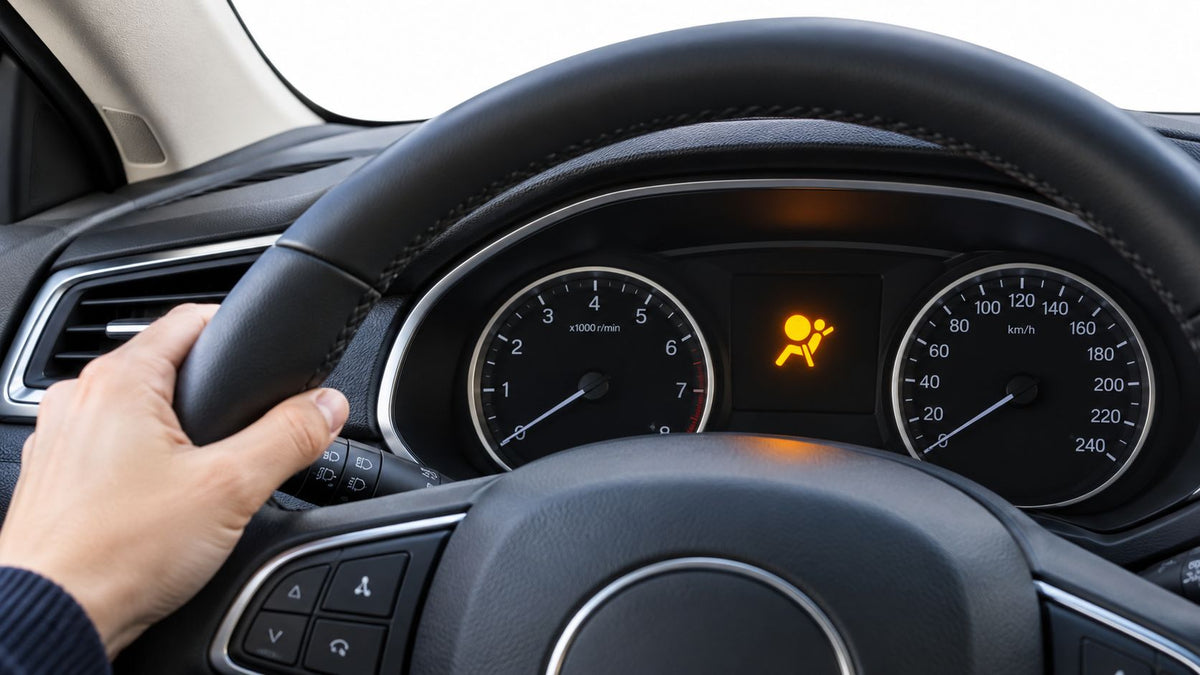
No. Frontal airbags reduce driver fatalities in frontal crashes by 29%, so an illuminated airbag light is a serious safety fault, not a harmless dashboard annoyance. Drive only the minimum distance needed to reach a qualified repair facility, and avoid carrying passengers when possible.
You notice the light after a minor parking-lot tap. The bumper barely shows a mark, the engine starts normally, and the car brakes and steers exactly as it always has. That combination tricks people into continuing their commute.
Don't. A vehicle can drive normally while its crash-protection system has a fault. The airbag warning light means the restraint system has detected a problem that requires diagnosis before you return to ordinary driving. The right question isn't, “Is it safe to drive with airbag light on?” The right question is, which restraint function has failed, whether a recall applies, and whether the vehicle should be towed rather than driven?
Table of Contents
- What the Airbag Light Actually Means When It Stays On
- How the Supplemental Restraint System Works Behind the Scenes
- The Risk of Driving With the Light Illuminated
- What to Do Right Now Before You Drive Anywhere
- Diagnosing the Cause From a Code Pull to a Dealer Scan
- Mail-In SRS Module Reset as a Repair Option
- Repair and Replacement Costs Compared by Path
- Common Shortcuts That Do Not Fix the Problem
What the Airbag Light Actually Means When It Stays On
A driver leaves a supermarket after a low-speed fender-bender and sees the airbag symbol glowing steadily. There may be no deployed bag, no cracked dashboard, and no obvious damage inside the cabin. The light still matters because the SRS controller has detected a fault in a system designed to protect occupants during a crash.
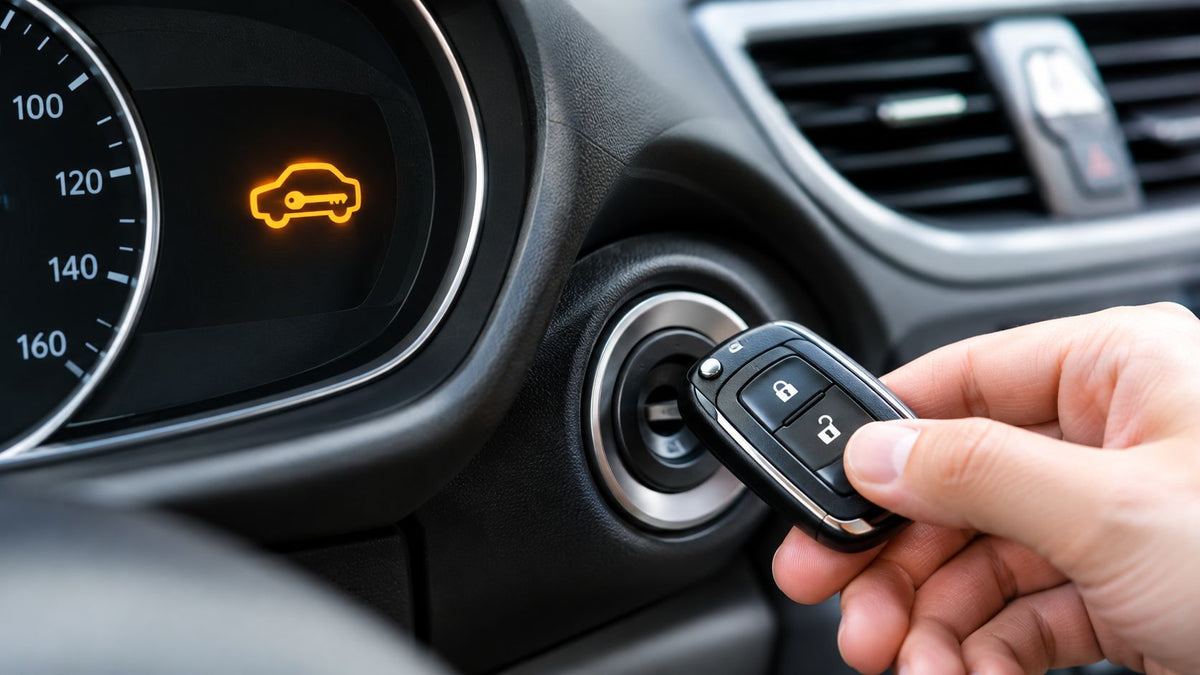
During a normal ignition cycle, the warning lamp illuminates briefly while the vehicle performs its self-check. It should then turn off after a few seconds. If it stays on, or fails to illuminate during the check, one or more restraint components may not operate as designed. Manufacturer guidance treats a lamp that remains lit after the normal startup check as a reason to arrange inspection as soon as possible. Hyundai's owner guidance explains the significance of an SRS malfunction.
The light is not a maintenance reminder
The warning can involve a driver airbag, passenger airbag, side airbag, curtain airbag, knee airbag, seat-belt pretensioner, impact sensor, wiring circuit, or occupant-detection equipment. It doesn't prove that every airbag is disabled, but it does prove that the system can't confirm normal operation.
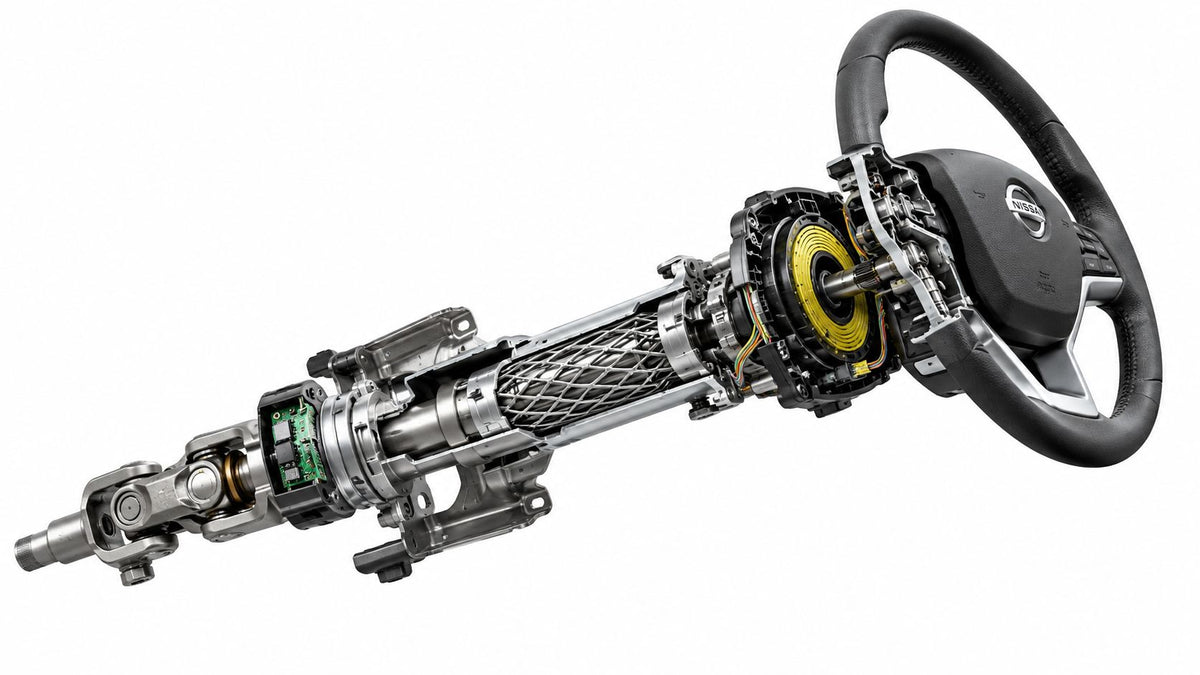
NHTSA recall documentation describes faults in which an illuminated lamp accompanied disabled front, side, curtain, knee, or passenger airbags. One Lexus recall connected an electrical fault with a warning light and the possible failure of several airbags to deploy. Another recall involved a steering-column connection that could deactivate the driver's airbag, with non-deployment increasing injury risk. The NHTSA recall notice documents these restraint-system failure conditions.
Practical rule: If the airbag or SRS lamp stays on, assume the vehicle's supplemental restraint protection is reduced until a compatible scan identifies and repairs the fault.
Don't confuse the SRS warning lamp with the separate PASSENGER AIRBAG OFF indicator. The latter can appear normally when the vehicle detects a child restraint or a passenger who doesn't meet the system's deployment conditions. But if it remains on with an adult correctly seated, or appears alongside an SRS warning, the passenger-occupant detection system needs diagnosis.
The bottom line is blunt. Engine operation doesn't certify airbag operation. Normal brakes and steering don't compensate for a restraint fault. Limit driving, keep passengers out when feasible, check the VIN for recalls, and get a professional SRS diagnosis.
How the Supplemental Restraint System Works Behind the Scenes
Think of the SRS as a household smoke-detector network connected to one control panel. Each detector reports its condition, and the panel decides whether the alarm system is ready. In a vehicle, the SRS control module performs a similar supervisory job for crash sensors, airbags, belt pretensioners, seat-belt circuits, occupant classification equipment, and related wiring.
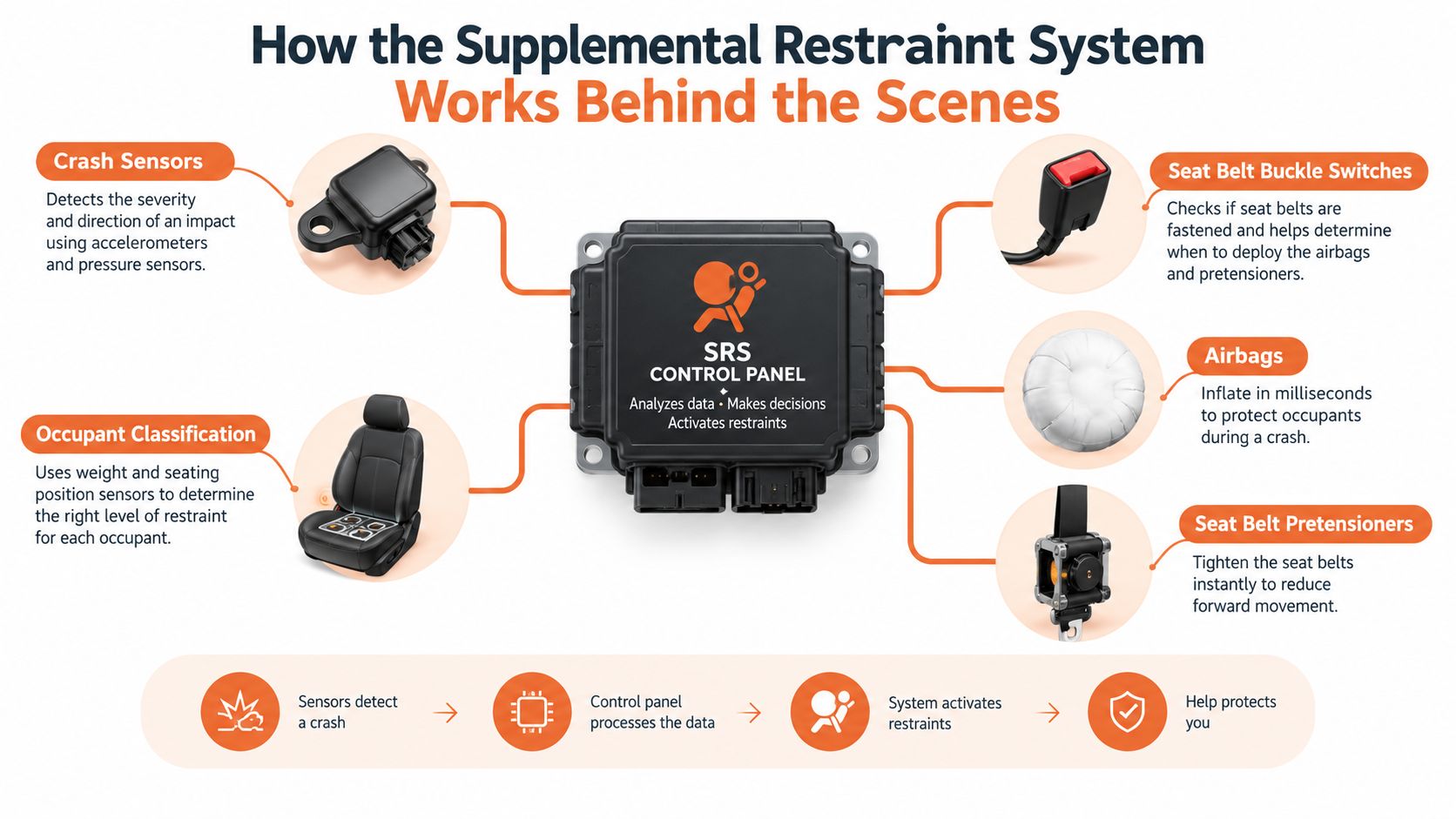
Why one fault can affect several functions
The controller checks whether each monitored circuit falls within its expected electrical and communication range. A loose connector under a seat, damaged harness, failed occupancy sensor, clockspring problem, crash sensor fault, or deployed pretensioner can make the system report a failure.
That doesn't mean the vehicle has one universal “airbag switch.” It means the controller may disable a particular restraint function, or several related functions, because it can no longer verify that deployment would occur correctly. The light is therefore a system-level warning, not a precise diagnosis.
Seat belts remain essential, but they aren't a substitute for properly functioning airbags and pretensioners. Drivers who work around commercial vehicles can also use this truck driver seat belt violation guide to review the separate compliance risks associated with belt use.
A compatible scan matters because ordinary engine-code readers may not communicate with the restraint module. The restraint control module guide provides useful context on the component that stores and manages SRS information. Don't probe pyrotechnic circuits casually or test them with improvised electrical equipment. Airbag and pretensioner circuits require vehicle-specific procedures.
The Risk of Driving With the Light Illuminated
An illuminated SRS light is a triage problem, not a simple yes-or-no driving question. First check for a recall, then identify which restraint function may be unavailable, then decide whether the vehicle should move at all.
Airbags are supplemental, but that does not make them optional. They work with properly worn seat belts to manage occupant movement during a crash. The Insurance Institute for Highway Safety reports that frontal airbags reduce driver fatalities in frontal crashes by 29% and fatalities among front-seat passengers aged 13 and older by 32%. IIHS explains the measured protection provided by airbags.
NHTSA estimates that a frontal airbag combined with a lap-and-shoulder belt reduces fatality risk in frontal crashes by 61%, compared with 50% for belts alone and 34% for airbags alone. The agency also estimates that frontal airbags saved 4,330 lives in 2019 and more than 70,000 lives cumulatively through 2019. NHTSA's airbag safety information provides those estimates.
Those figures do not mean an illuminated light guarantees injury. They show what could be unavailable when a fault prevents deployment or disables related sensors, pretensioners, or control circuits. A pretensioner may tighten the belt during a collision, while a failed occupant-classification system can affect passenger-airbag deployment.
Protection Lost When SRS Light Is On
| Crash Type | With Full SRS | With SRS Light On | Protection Lost |
|---|---|---|---|
| Frontal crash involving the driver | Frontal airbag and belt system can provide intended supplemental protection | Deployment cannot be assumed | Possible loss of frontal airbag or related restraint functions |
| Frontal crash involving a front passenger | Passenger restraint operation depends on occupant detection and system readiness | Passenger-airbag status requires diagnosis | Possible loss or incorrect control of passenger protection |
| Side impact or rollover | Side and curtain restraints may operate as designed | The affected circuit may be disabled | Side, curtain, or related protection may be unavailable |
| Crash after a prior collision | Repaired and verified SRS components can be ready | Stored crash data or damaged parts may remain | Pretensioner, sensor, module, or airbag function may be reduced |
Treat any Takata Do Not Drive recall as an immediate stop. Do not drive the vehicle until the recall remedy is confirmed. If the PASSENGER AIRBAG OFF indicator appears with an adult seated normally, keep that person out of the seat until the fault is diagnosed.
A short trip to a repair facility can be reasonable when no Do Not Drive recall applies and the route cannot be avoided. Do not resume normal use, and do not accept a cleared code as proof of a repair. A reset can hide an active fault until the system is scanned again.
What to Do Right Now Before You Drive Anywhere
A glowing airbag light is not a shrug-and-keep-going problem. Start with what happened right before it came on. A collision, curb strike, bodywork, seat removal, battery failure, water intrusion, or interior repair can leave crash data, damaged wiring, or a failed sensor behind even when the car looks normal.
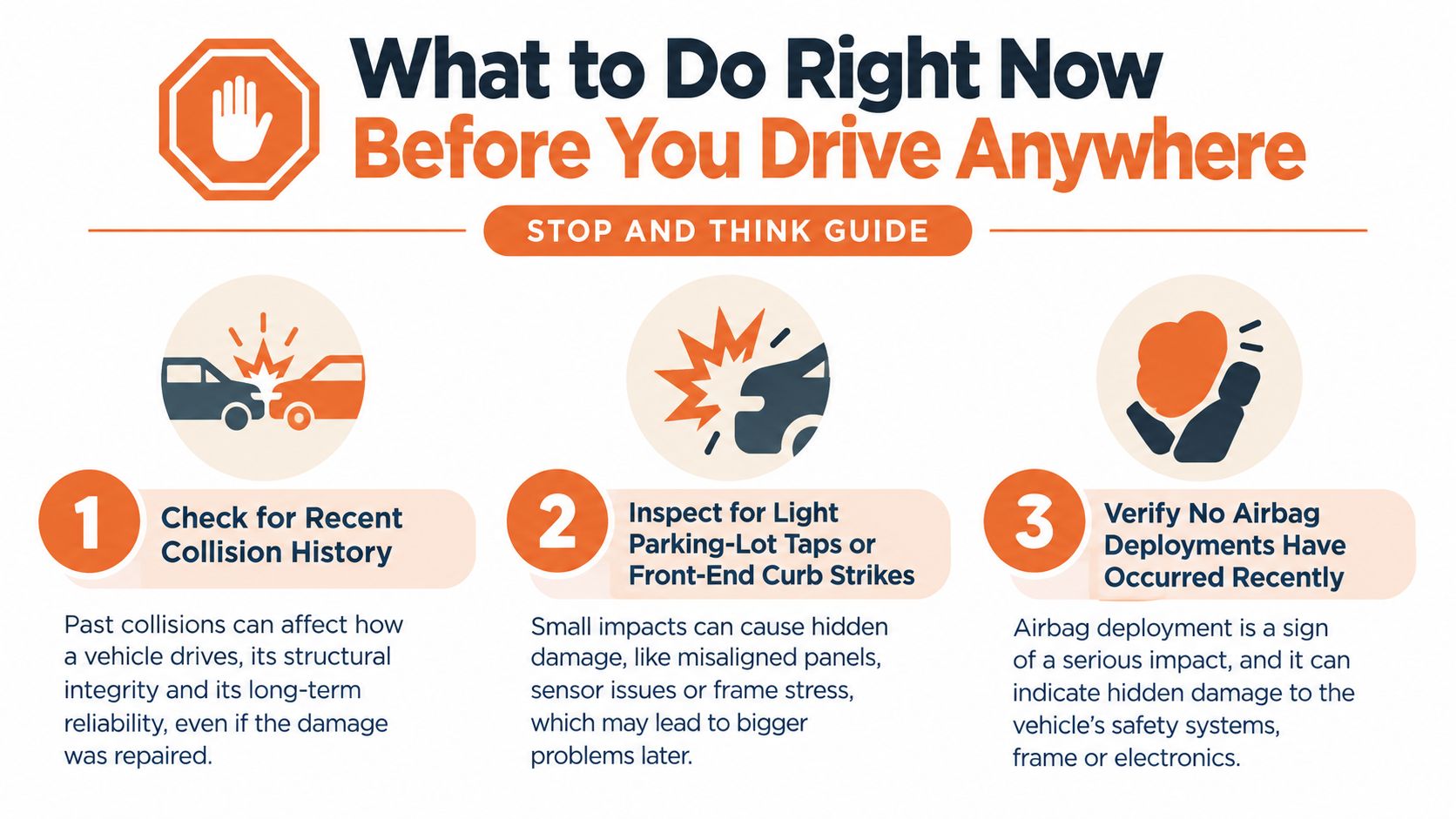
Follow the triage sequence
- Check the collision history. Do not focus only on major crashes. A parking-lot hit, deployed pretensioner, salvage repair, or front-end impact can leave the SRS controller faulted.
- Check the VIN for recalls. Use NHTSA's official recall lookup and safety information and verify whether there is an open airbag campaign. If the notice says Do Not Drive, the car stays parked.
- Identify the exact indicator. A steady airbag or SRS lamp means a fault. A separate PASSENGER AIRBAG OFF lamp can be normal with a child restraint, but it is a real problem when the system misreads an adult passenger.
- Remove passengers from the decision. If the passenger airbag is being shut off by mistake, no one should sit there. Keep children and child restraints away from a seat whose occupant-detection status is unknown.
Takata recalls demand immediate attention. NHTSA states that approximately 67 million Takata airbags have been recalled, and some vehicles carry Do Not Drive warnings. If your VIN falls under that warning, do not limp to a shop and hope for the best. Follow the manufacturer or NHTSA instructions for towing or mobile repair.
Use this decision path:
- Do Not Drive recall: Stop using the vehicle and arrange the required remedy.
- No recall, steady SRS lamp: Drive only straight to a qualified repair facility, and keep passengers out when possible.
- Incorrect passenger-off status: Avoid the affected seat and get it diagnosed before normal use.
- Unclear indicator or recent crash: Choose towing, not guesswork.
Diagnosing the Cause From a Code Pull to a Dealer Scan
A diagnostic scan is not the repair. It's the evidence that tells you whether the fault involves a connector, sensor, pretensioner, occupancy system, crash data, or control module. Don't authorize parts replacement based on the dashboard symbol alone.
Choose the scan that can actually access SRS
A basic parts-store code pull may identify a starting point, but many inexpensive readers only access powertrain systems. Ask directly whether the tool can communicate with the vehicle's SRS or airbag module before relying on the result.
An independent repair shop with a manufacturer-capable scan tool can usually read restraint codes, inspect live data, identify the affected stage, and determine whether the module has stored crash information. This is often the most practical route when the vehicle isn't under a recall or warranty restriction.
A dealer scan becomes more important when the vehicle needs module programming, manufacturer-specific calibration, warranty work, or investigation of a complicated post-collision fault. The dealer isn't automatically the only answer, but the scan must match the vehicle and the system.
| Diagnostic Path | Typical Cost | What It Covers | Best For |
|---|---|---|---|
| Basic code pull | Varies by retailer and tool | May read engine codes, with SRS access uncertain | An initial check, only after confirming SRS compatibility |
| Independent SRS scan | Varies by shop and vehicle | SRS codes, system data, affected circuits, and repair direction | Most ordinary warning-light faults |
| Dealer-level scan | Varies by manufacturer and repair need | Brand-specific diagnostics, programming, and recall or warranty handling | Module programming, complex faults, and manufacturer support |
Reset versus replacement
A stored crash event may require module service after every physically damaged restraint component has been replaced. A failed clockspring, seat sensor, pretensioner, harness, or impact sensor requires work on that component. Clearing a code before repairing the cause only hides the evidence temporarily.
Use an SRS-capable process described in this airbag-light diagnosis guide to keep the scan, code description, and affected circuit together. That record prevents a repair shop from guessing and helps you distinguish a legitimate module reset from an incomplete fix.
Mail-In SRS Module Reset as a Repair Option
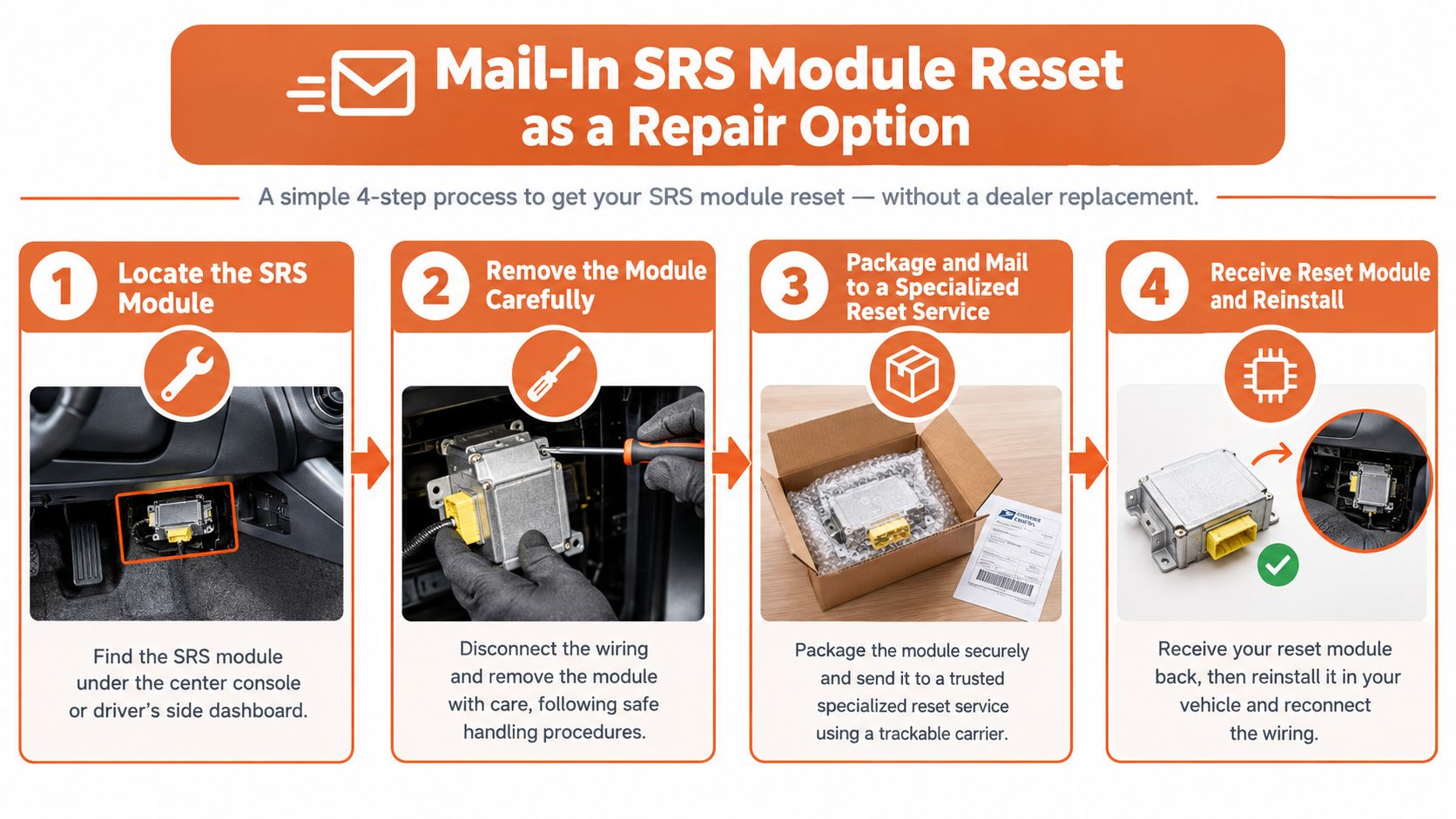
A mail-in reset can make sense when the scan confirms crash data or a resettable hard code, the physical restraint components have been repaired or replaced, and the module itself is serviceable. It isn't a shortcut around diagnosis. It addresses the module only.
The process
- Locate the module. Depending on the vehicle, it may sit under the center console, behind a kick panel, beneath the dashboard, or behind the glovebox. Use vehicle-specific removal instructions.
- Disconnect and remove it safely. Follow the manufacturer's battery-disconnection and restraint-system procedures. Don't unplug or probe pyrotechnic components casually.
- Send complete information. Include the vehicle identification details and the SRS codes. A clear description of the collision or fault helps the service identify the requested work.
- Reinstall and rescan. After the module returns, reinstall it correctly, reconnect every harness, and perform a full SRS scan. The warning lamp must complete its normal startup check and turn off before regular use.
What the reset cannot do
A reset won't repair a deployed airbag, fired pretensioner, damaged clockspring, broken impact sensor, corroded connector, or failed occupant-classification component. Those parts still need replacement, repair, calibration, or inspection under the vehicle-specific procedure.
It also won't cure a module with a genuine internal failure. If the controller has water damage or an electronic defect, the service may need to repair it or recommend replacement. Ask what testing is performed, what warranty applies to the module work, and whether the service covers only the controller.
Use this option after a proper code pull, not before. A returned module can be perfectly serviced while the SRS lamp remains on because another fault is still active.
Repair and Replacement Costs Compared by Path
There is no honest universal price for an airbag light. The cost depends on the failed component, whether a collision occurred, whether a recall covers the repair, and whether the vehicle needs programming or calibration. Anyone quoting a repair before reading the SRS codes is guessing.
Recall verification comes first because an eligible manufacturer repair may be provided without the owner paying for unrelated module work. If the recall doesn't apply, match the repair path to the documented fault.
| Repair Path | Typical Cost | Typical Turnaround |
|---|---|---|
| Recall remedy | Governed by the manufacturer campaign | Depends on parts and appointment availability |
| Connector or wiring repair | Varies with access and damage | Often tied to inspection and parts availability |
| Pretensioner, sensor, or clockspring replacement | Varies by component and vehicle | Depends on parts and calibration requirements |
| Module reset | Varies by service and module condition | Depends on shipping and bench testing |
| Module replacement and programming | Often the most expensive route | Depends on module supply and manufacturer procedures |
A module reset is a poor choice if a pretensioner has fired or an airbag remains deployed. Conversely, replacing an expensive controller when the scan shows a loose connector wastes money and leaves the actual fault unresolved.
Post-collision decisions should follow the evidence. The guide to what must be replaced versus what can be reset after a crash can help separate physical restraint damage from stored module data, but it doesn't replace a vehicle-specific scan.
Do not buy parts from the warning symbol. Buy parts from the diagnostic code and the inspection.
Tow the vehicle when a Do Not Drive recall applies, a major collision damaged the restraint system, or you can't identify the fault. Limited direct driving may be reasonable only when recalls are clear, the vehicle remains controllable, and the destination is a qualified repair facility.
Common Shortcuts That Do Not Fix the Problem
Disconnecting the battery is not an SRS repair. It may interrupt power, but it doesn't restore a failed sensor, replace a fired pretensioner, repair damaged wiring, or prove that the controller is ready. Hyundai specifically warns against treating an illuminated SRS lamp as something to ignore, and its owner guidance directs drivers toward prompt inspection rather than a battery reset.
Cheap code clearers create the same false confidence. If a device can access the SRS module at all, clearing the fault without fixing the cause only removes the visible warning until the controller detects the problem again. If it can't access SRS, the driver learns nothing about the restraint system.
The shortcuts that create risk
- Disconnecting the battery: This doesn't establish that the crash sensors, inflators, pretensioners, or occupant-detection system work.
- Clearing codes before recording them: You lose diagnostic evidence and make the next technician's job harder.
- Replacing the passenger seat sensor by guesswork: Similar symptoms can come from the buckle circuit, harness, control module, or connector.
- Installing a used module without verification: The replacement may contain incompatible programming or stored crash data.
- Taping over the lamp or bypassing it: Hiding a safety warning deceives the next driver and leaves the fault active.
- Assuming belts make the problem irrelevant: Seat belts remain essential, but they don't replace the intended protection of airbags and pretensioners.
Don't work on yellow SRS connectors with improvised test equipment. Follow the vehicle's service procedure, use the correct scan tool, and let a qualified technician inspect circuits that contain pyrotechnic devices.
The correct order is short:
- Scan first.
- Record every SRS code and affected stage.
- Check recalls, including Do Not Drive status.
- Repair or replace the failed physical component.
- Reset or service the module when the diagnosis supports it.
- Rescan and confirm that the warning lamp completes its self-test and turns off.
Seat Belt Repair offers mail-in SRS module resets and seat-belt pretensioner repair for customers who have identified the failed components and need an off-vehicle service option. If your light came on after a crash, stop guessing, get the system scanned, and visit Seat Belt Repair to review the available mail-in service before returning the vehicle to normal use.

Оставить комментарий
Этот веб-сайт защищается hCaptcha. Применяются Политика конфиденциальности и Условия использования hCaptcha.