
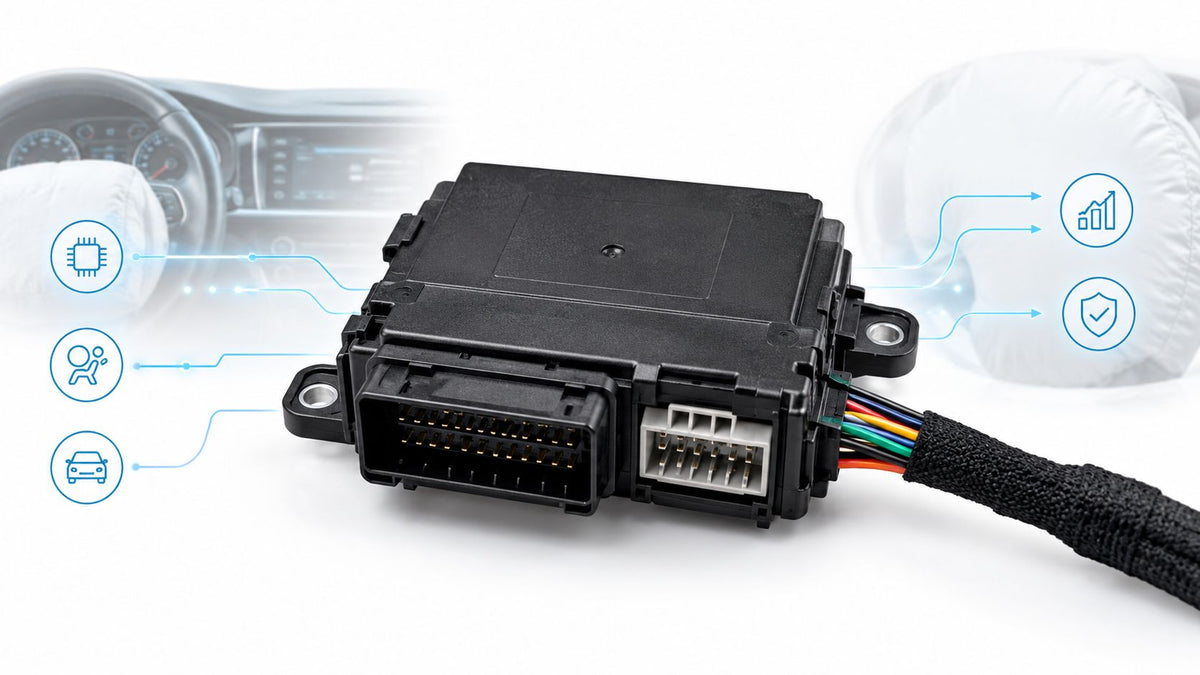
You've had a collision, the airbags deployed, and now the seat belt is locked against your chest. The warning light remains on, while the repair estimate lists airbags, belts, sensors, and a restraint control module. It's easy to look at that list and assume the module is just another part to replace.
It isn't. The restraint control module, or RCM, is the decision-maker at the center of the supplemental restraint system. It records what happened, checks whether the remaining components are ready, and determines whether the vehicle can trust its airbags and pretensioners in another crash. Understanding that role helps you separate a stored crash record from a damaged component, and a resettable module from one that must be replaced.
Table of Contents
- Why Your Airbag Light Stays On After an Accident
- What a Restraint Control Module Actually Does
- How the Module Talks to Airbags and Pretensioners
- Crash Data, EDR Records, and Why the Module Remembers
- Identifying Your Restraint Control Module
- Common Failure Modes and What They Really Mean
- Reset, Repair, or Replace the Module
- Getting Your Restraint System Back to a Safe State
Why Your Airbag Light Stays On After an Accident
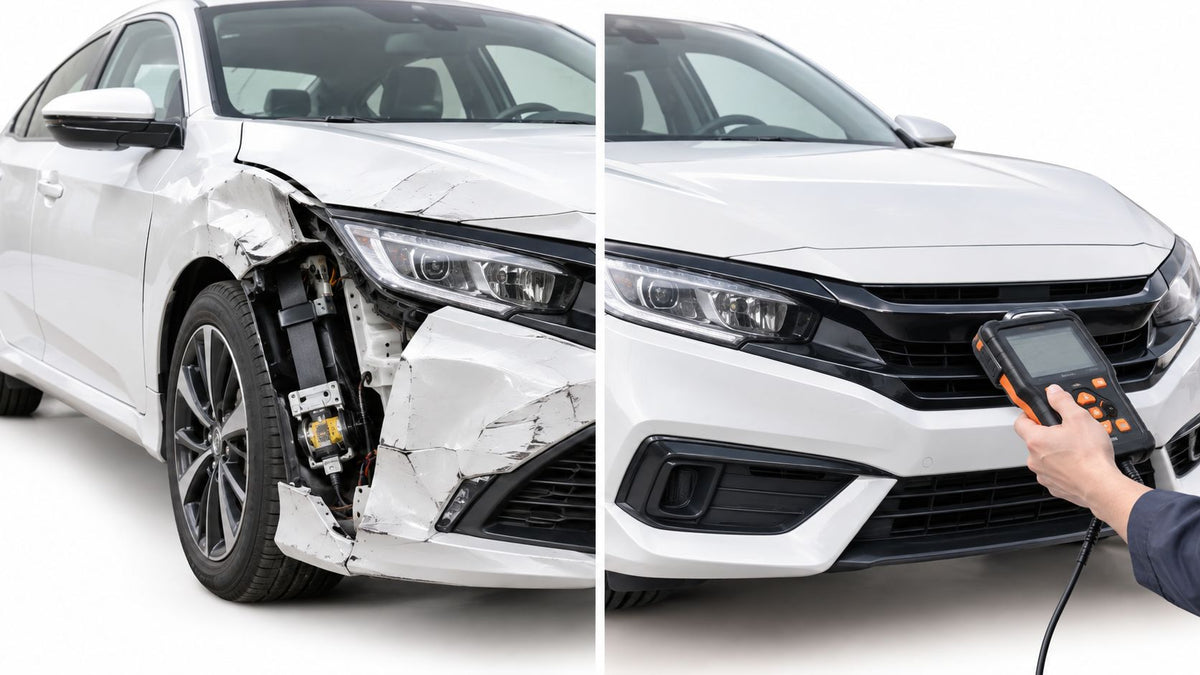
A low-speed parking-lot collision can leave a surprisingly complicated repair behind. The airbags may deploy, the belt pretensioners may pull the occupants firmly into position, and the airbag warning light may stay illuminated after the vehicle is restarted. The dealer's estimate might then recommend replacing the airbags, seat belts, and RCM together.
That warning light is a symptom, not a diagnosis. Each time you switch on the ignition, the restraint control module runs a self-check of its circuits, sensors, communication links, and stored event status. If it finds a crash record, an electrical fault, or a component that no longer responds within its expected range, it keeps the SRS light on because it can't confirm that the system is ready.
What changes after deployment
The collision can affect several parts at once:
- Crash memory: The RCM may retain a crash event that a normal code-clearing function can't remove.
- Pretensioners: A seat-belt pretensioner may fire and leave the belt locked, even when the webbing looks undamaged.
- Airbag circuits: Deployed inflators must be replaced, and their wiring and connectors must be checked.
- Vehicle power and communication: A damaged connector, weak connection, or network fault can prevent the module from communicating correctly.
The light therefore doesn't tell you which item failed. It tells you that the RCM has found a condition it can't approve.
Practical rule: Don't treat an SRS light as a maintenance reminder. Treat it as a request for a complete restraint-system diagnosis.
A scan tool can identify stored diagnostic trouble codes, but the code is only the starting point. The technician still needs to inspect the airbags, belts, impact sensors, wiring, and module itself. A useful overview of the first diagnostic checks appears in this guide to diagnosing an airbag light.
The right repair may involve resetting the original RCM, repairing or replacing a pretensioner, replacing a deployed airbag, or installing another module and programming it to the vehicle. Clearing the visible warning without repairing the cause can leave the system unable to protect occupants properly.
What a Restraint Control Module Actually Does
Think of the RCM as a 24-hour safety referee. It watches the signals coming from the vehicle's crash sensors and occupant-protection components, compares those signals with its programmed deployment logic, and authorizes a response only when the conditions make sense.
The module has several jobs that happen continuously.
The RCM's core responsibilities
First, it monitors inputs. Those inputs can include acceleration data, pressure information, occupant classification signals, battery status, and feedback from restraint circuits. The module also watches for electrical problems, such as an open circuit, a short, or an unexpected resistance value.
Second, it evaluates crash information. A sudden change in vehicle motion or lateral movement must meet the vehicle's deployment logic before the module commands an airbag or pretensioner. The system isn't designed to fire every time the vehicle experiences a bump.
Third, it sends the firing command. The RCM doesn't physically inflate an airbag. It applies the required electrical energy to an inflator or pretensioner initiator, commonly called a squib. That initiator starts the gas-generating process that inflates the airbag or tightens the belt.
Finally, it records information and reports problems. The vehicle's diagnostic system can read the RCM's fault status through the vehicle network, while the instrument cluster uses that information to illuminate the SRS warning lamp.
A GM description of the restraint module identifies the same central functions, including airbag deployment control, collision-data storage, sensor input, and communication with other vehicle systems through the vehicle's electronic network. The module is separate from the engine ECU, body control module, and infotainment computer, even though those systems may exchange information with it through the network. See the GM description of a genuine restraints control module for an example of how manufacturers position the unit within the vehicle.
The RCM is narrow in purpose, but its responsibility is critical. It doesn't make decisions based on one sensor alone. It combines information, checks its own circuits, and preserves the evidence needed to diagnose what happened.
How the Module Talks to Airbags and Pretensioners
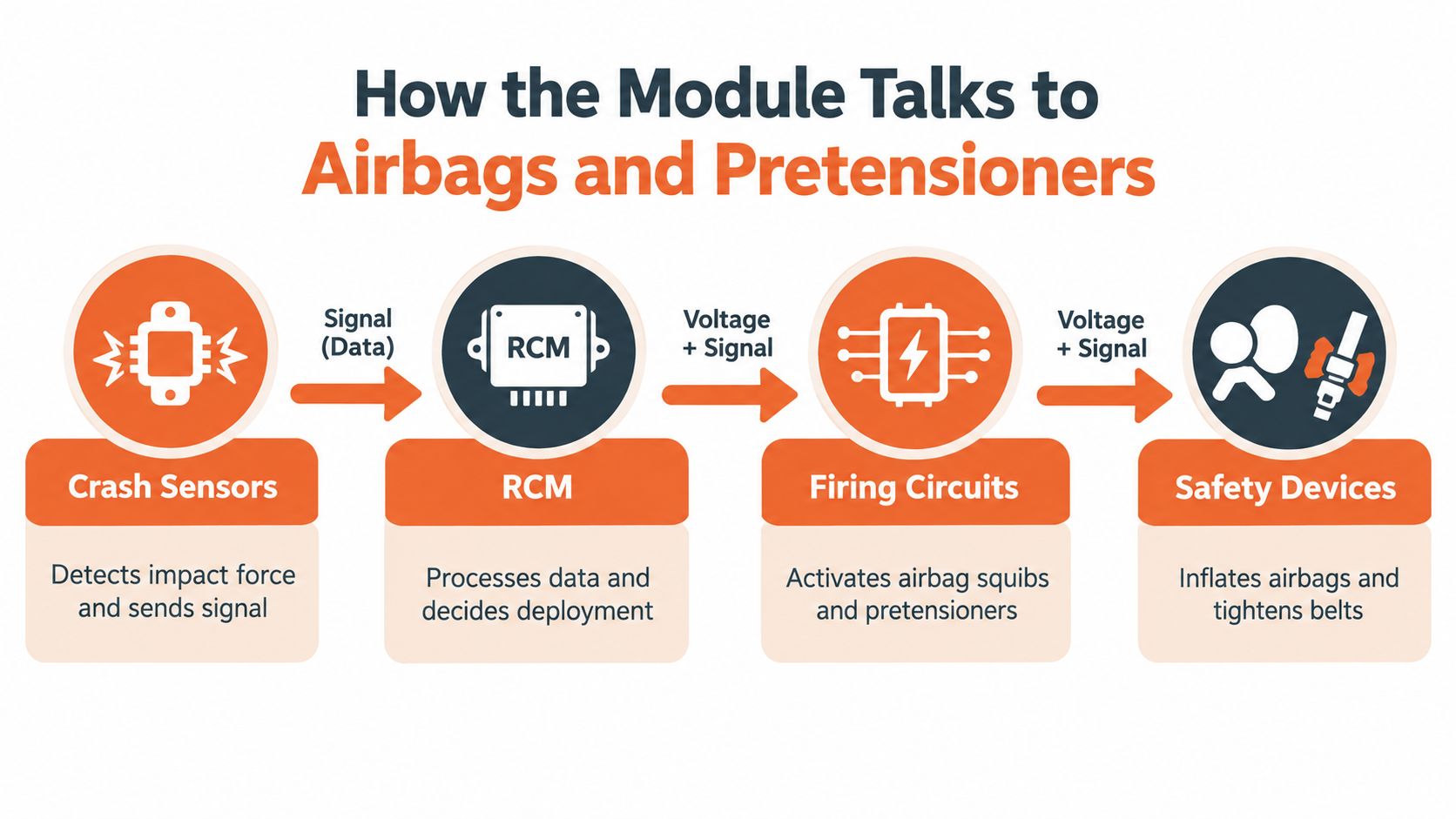
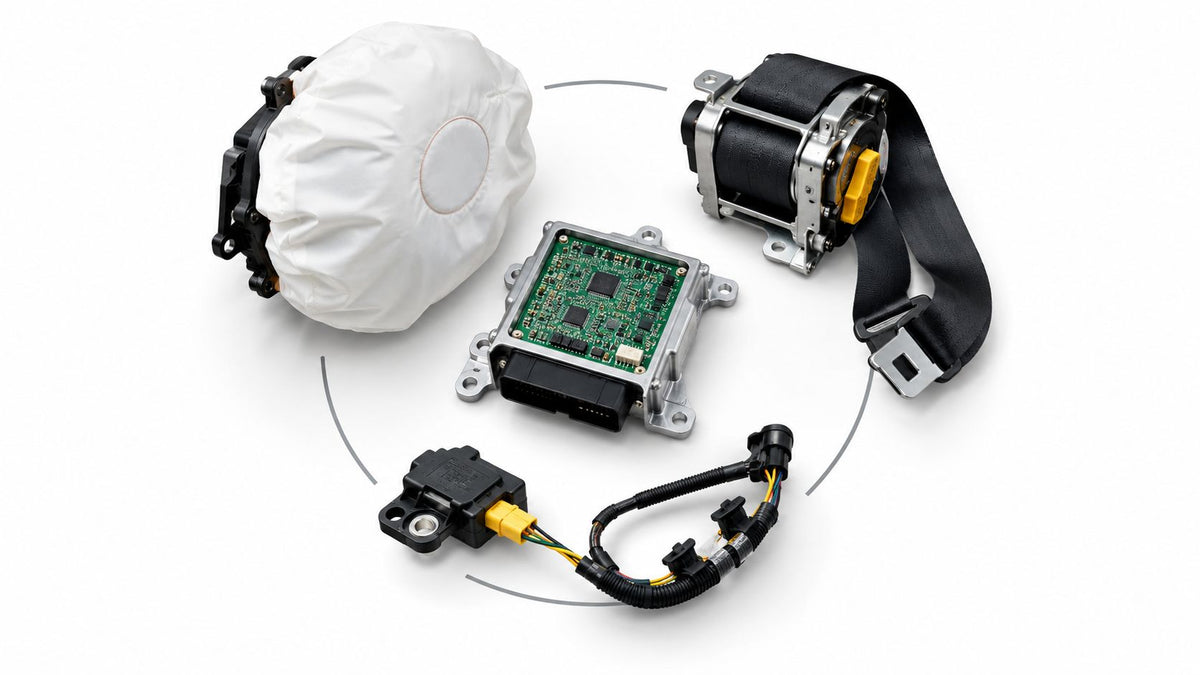
The restraint system becomes easier to understand when you separate it into four blocks. Each block has a different role, and a failure in any one of them can keep the SRS warning light on.
The four parts of the chain
Crash sensors detect changes in acceleration, deceleration, or pressure. Some sensors sit inside the RCM, while others are mounted around the vehicle. Their signals give the module information about the direction and severity of an event.
The RCM receives those signals and checks them against its deployment logic. It also considers information from occupant classification and other control modules. If the inputs support deployment, the RCM arms the appropriate firing circuits.
Firing circuits carry the command to individual airbag inflators and belt pretensioner initiators. The RCM monitors these circuits during normal operation, allowing the system to identify conditions such as an open connection, a short, or an electrical value outside the expected range. The exact circuit design varies by vehicle.
Safety devices perform the physical work. An airbag inflator generates gas to fill the cushion, while a pretensioner uses its own initiator and mechanism to remove slack from the belt. Both devices depend on the RCM's decision, but they're separate components that must be inspected independently.
A pretensioner can therefore be part of the same deployment event as an airbag without being the same part or sharing the same repair outcome. If the belt fired, resetting the module alone won't restore the belt's operating condition. This explanation of seat-belt pretensioners shows why the belt needs its own inspection.
The RCM also communicates system status over the vehicle network, often called CAN. A scan tool reads the module's diagnostic information through that communication path. A clean network connection doesn't prove that every restraint component is safe, but a communication fault can prevent the technician from evaluating the system correctly.
The following video provides another visual explanation of how airbag control systems interact with vehicle safety components.
Crash Data, EDR Records, and Why the Module Remembers
The RCM remembers because deployment is not an ordinary electrical event. Once the module authorizes a restraint, technicians need to know what happened, which circuits responded, and whether the unit can be returned to service. Retained information also helps investigators and repair professionals understand the sequence surrounding a collision.
Bosch traces its restraint-control work to a 1976 patent application for a triggering apparatus used in an inflatable bag. Its electronic control unit for passive restraints entered series production in 1980 and first appeared in the Mercedes-Benz S-Class in 1981. Bosch says that early unit had three ignition outputs, enough to operate a driver airbag and a two-step passenger airbag, or the same number of belt tensioners. Its latest generation can process data from up to 18 external acceleration and pressure sensors while controlling up to 48 restraints. These details show how the RCM has always been designed as a coordinator for multiple devices, not as a switch for one airbag. Read the Bosch history of airbag control units for that development.
Deployment depends on severity
A restraint module doesn't respond to impact presence alone. It evaluates crash severity and direction through acceleration and other sensor inputs. In NHTSA research using 164 cases from NASS/CDS 2002–2006, the reported driver-airbag deployment probability reached 50% at a longitudinal delta-V of 9 mph, while both inflator stages reached 50% probability at 26 mph. Those figures illustrate calibration behavior, not a promise that every vehicle will deploy at the same conditions. The vehicle design, occupant position, impact direction, and sensor inputs all matter. The NHTSA report on advanced air-bag deployment provides the source context.
The Event Data Recorder, or EDR, is related to the crash-information process but shouldn't be treated as identical to every item stored by the RCM. NHTSA guidance says airbag ECUs can record pre-crash and post-crash information for frontal, rear, side, and rollover events. The guidance describes two recording pages for pre-crash data and two pages per accident type for post-crash data.
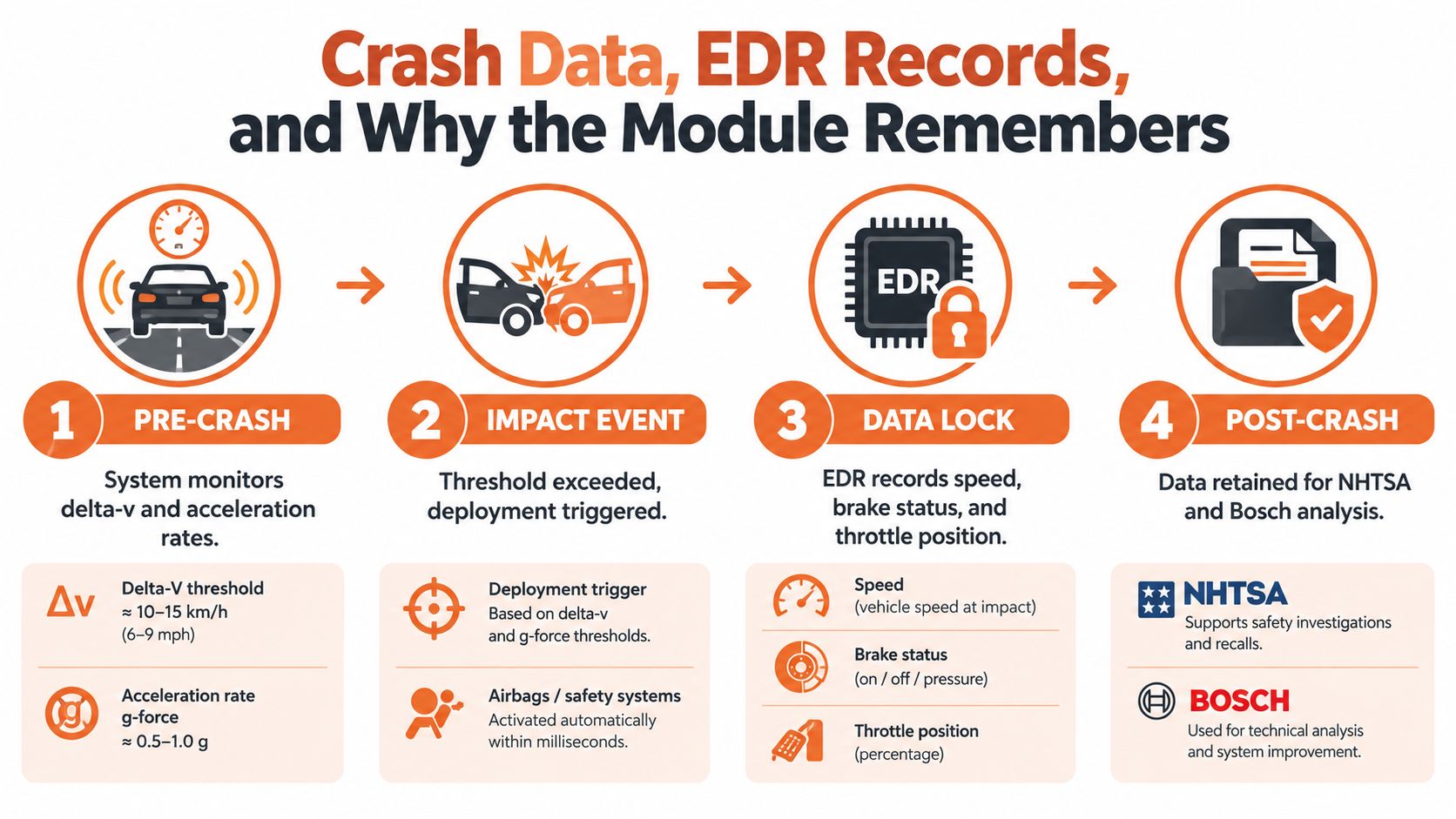
A crash record is not the same as a dashboard code. A scan tool may clear a visible diagnostic message while the underlying crash memory remains in the module. That's why a reset decision must follow a physical inspection, not come before it.
Identifying Your Restraint Control Module
Before ordering a replacement or sending a unit for service, identify the exact module. A vehicle can have several electronic boxes with similar labels, and the wrong part can create programming, connector, or communication problems.
Start with the VIN. Use it with an OEM parts catalog or a reliable vehicle-specific lookup to confirm the expected restraint module family and part number. Don't rely on a photograph from another vehicle that merely looks similar.
A practical identification routine
- Locate the unit safely. Depending on the vehicle, the RCM may sit beneath the center console, under a front seat, or behind a dashboard kick panel. Follow the manufacturer's de-energizing and removal instructions before touching the module or its connectors.
- Read the label. Record the complete part number, suffix, hardware revision, software information, and any barcode or serial information. A single letter at the end of a part number can identify a different application.
- Inspect the connectors. Note the number of plugs, connector shape, terminal arrangement, and locking features. Never force a connector because the housing appears close enough to fit.
- Compare the physical unit. Check mounting holes, housing shape, orientation, and bracket position against the catalog information. A module from the same vehicle family may still require different configuration.
- Match the repair path. The identification details tell a specialist whether the original unit is a candidate for reset, whether a replacement needs programming, and which diagnostic procedure applies.
Published OE listings show why this care matters. Current RCM examples can use 74 to 82 terminals and compact housings around 3.6 to 6.6 inches in length, as shown in the Tesla service information for airbag and restraint components. Those dimensions aren't universal specifications. They're a reminder that connector density and packaging can be highly vehicle-specific.
If you're unsure whether the box in front of you is the RCM, stop before removal. Confirm the location and part identity with the service manual or a qualified repair professional.
Common Failure Modes and What They Really Mean
An illuminated SRS warning light isn't a minor electronic nuisance. It means the vehicle has identified a problem in a system that may need to react immediately during a collision.
The most common categories follow different diagnostic paths:
- Stored crash data: The module recorded a deployment or qualifying event. A standard scan-tool command may not remove the underlying memory, so the unit may need a compatible reset or replacement after the rest of the system is repaired.
- Internal module fault: The RCM's internal electronics, memory, sensing element, or power supply may have failed. Manufacturer service information may classify some internal faults as non-repairable, making replacement the required option.
- Water intrusion or corrosion: Moisture around a module or connector can create intermittent signals, resistance changes, or permanent circuit faults. The source of the moisture must be corrected before another module is installed.
- Physical or solder damage: Collision forces, vibration, or previous handling can damage the housing or internal connections. A visual inspection alone may not reveal every fault.
- Network communication failure: A CAN or LIN communication problem can stop the RCM from exchanging information with other controllers. In that case, replacing the RCM without checking power, ground, and network wiring may leave the warning light unchanged.
Common RCM failure modes at a glance
| Failure Mode | Typical Symptom | Realistic Fix |
|---|---|---|
| Stored crash event | SRS light remains on after deployment or collision repair | Verify all deployed components, then use a compatible reset or replace the module |
| Internal RCM fault | Module-specific fault returns after proper wiring checks | Replace the module when the manufacturer classifies the fault as non-serviceable |
| Water or corrosion damage | Intermittent warning, connector corrosion, or unstable communication | Repair the moisture source, inspect wiring, and evaluate the module for replacement |
| Circuit or connector fault | Fault changes when a harness or connector is moved | Repair the connector, terminals, wiring, or affected restraint component |
| Network communication fault | The scan tool cannot communicate reliably with the RCM | Test power, ground, CAN or LIN wiring, and network termination before condemning the module |
A generic scanner may read some codes, but it often can't perform manufacturer-specific reset, configuration, or calibration functions. Clearing a lamp is not the same as restoring the module's crash memory or repairing a pretensioner.
A warning light can disappear while an unverified restraint component remains damaged. The repair is complete only when the entire chain passes its checks.
Reset, Repair, or Replace the Module
Once diagnosis identifies the RCM, most owners face three possible paths. The cheapest-looking option isn't automatically appropriate, and the most expensive option isn't automatically necessary.
Resetting the original unit
A mail-in reset service removes the module from the vehicle, examines its condition, clears compatible crash memory, and returns the original unit for reinstallation. Keeping the original module can preserve vehicle-specific configuration, but reset is appropriate only when the hardware is sound and the related airbags, pretensioners, sensors, and wiring have already been repaired.
Turnaround depends on shipping, inspection, module type, and the provider's process. Ask whether the service includes functional testing, what happens if the unit has an internal fault, and what warranty applies.
Repairing an internal fault
A specialist may be able to repair an RCM with a serviceable electronic or connection fault. This route requires more than erasing memory. The provider must determine whether the housing, circuit board, sensing hardware, and power supply remain suitable for use.
A repair service should explain its testing process rather than promise that every module can be restored. If the manufacturer states that an internal RCM fault requires replacement, follow that requirement.
Replacing the module
A new or approved replacement may be necessary when the original unit is physically damaged, internally failed, contaminated, or incompatible with the vehicle. The replacement may need programming, configuration, or calibration before the SRS system will accept it. Ford service information, for example, notes that programmable module installation can be required after RCM replacement.
The guide to what needs replacement after a crash can help separate the RCM decision from the condition of the other restraint parts.
Choosing by situation
| Service Option | Typical Cost | Downtime | Best For | Key Limitation |
|---|---|---|---|---|
| Reset | Usually lower than complete OEM replacement | Depends on shipping and inspection | A physically sound original module with compatible crash data | Won't correct damaged hardware or unrepaired SRS components |
| Repair | Varies with the internal fault and testing required | Depends on diagnosis and bench work | A serviceable module with a repairable electronic or connection fault | Not every internal fault is repairable |
| Replace | Usually the highest parts and programming expense | Depends on parts availability and vehicle programming | A damaged, incompatible, or non-serviceable module | May require configuration, coding, or calibration |
Make the decision from the diagnostic evidence. A module reset cannot repair a locked belt, a damaged sensor, or a broken harness. Conversely, replacing a good original module may add unnecessary programming and parts expense.
Getting Your Restraint System Back to a Safe State
The final stage starts after the RCM, airbags, belts, and sensors are back in place. A vehicle that starts normally is not necessarily a vehicle with a verified restraint system.
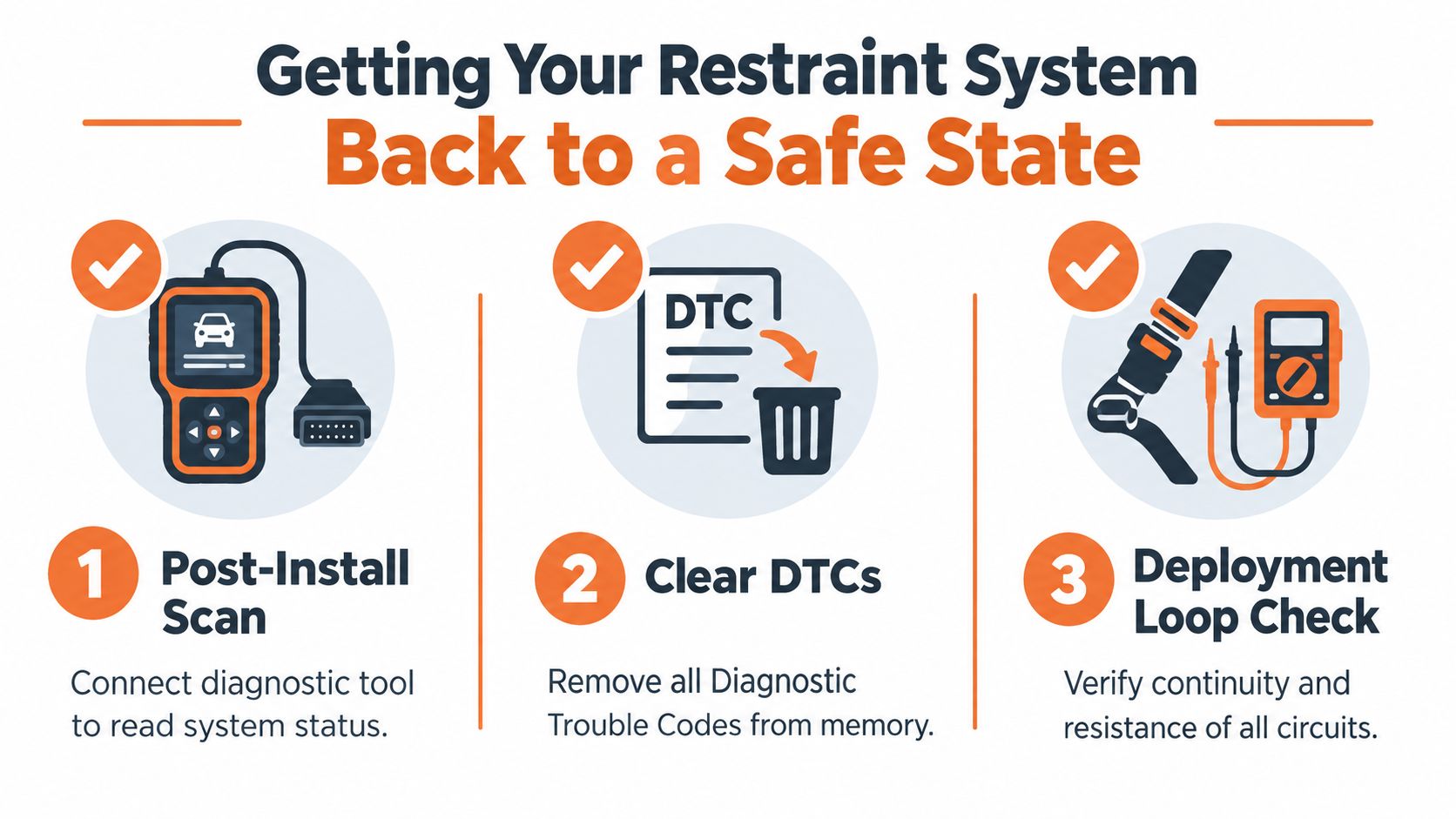
A technician should connect a compatible diagnostic tool and read the complete SRS system, not only the engine computer. The scan should confirm communication with the RCM, identify remaining diagnostic trouble codes, and verify that the module's configuration matches the vehicle.
Three checks that matter
Post-install scan: Confirm that the module communicates and that the vehicle recognizes the correct configuration. If the replacement requires programming or calibration, complete that process before judging the repair.
DTC review and clearing: Read every SRS code, record the findings, and clear codes only after the underlying faults have been repaired. A code that returns immediately needs diagnosis, not repeated clearing.
Deployment-loop verification: Check the airbag and pretensioner circuits for proper continuity and resistance using the manufacturer's approved procedure. Inspect connectors, clock springs, sensors, belt mechanisms, and harness routing as part of the same review.
A clean scan is important, but it isn't the only evidence. A belt can remain locked, a connector can be marginal, or a sensor can be installed incorrectly even when the module has been reset. The warning light should remain off through the ignition self-check, and the vehicle should receive a controlled road test only after the stationary checks are complete.
Keep the diagnostic report, repair or reset receipt, replaced-part records, and documentation showing when the crash memory was cleared. Share those records with your insurer and future repairers so later work doesn't begin with an incomplete history.
Seat Belt Repair provides mail-in pretensioner repair, seat-belt webbing replacement, and SRS airbag control module reset services, with customers or local repair facilities handling removal and reinstallation. If your post-collision diagnosis points toward a serviceable module or belt component, visit Seat Belt Repair to review the available service and submit the correct part for evaluation.

Leave a comment
This site is protected by hCaptcha and the hCaptcha Privacy Policy and Terms of Service apply.