
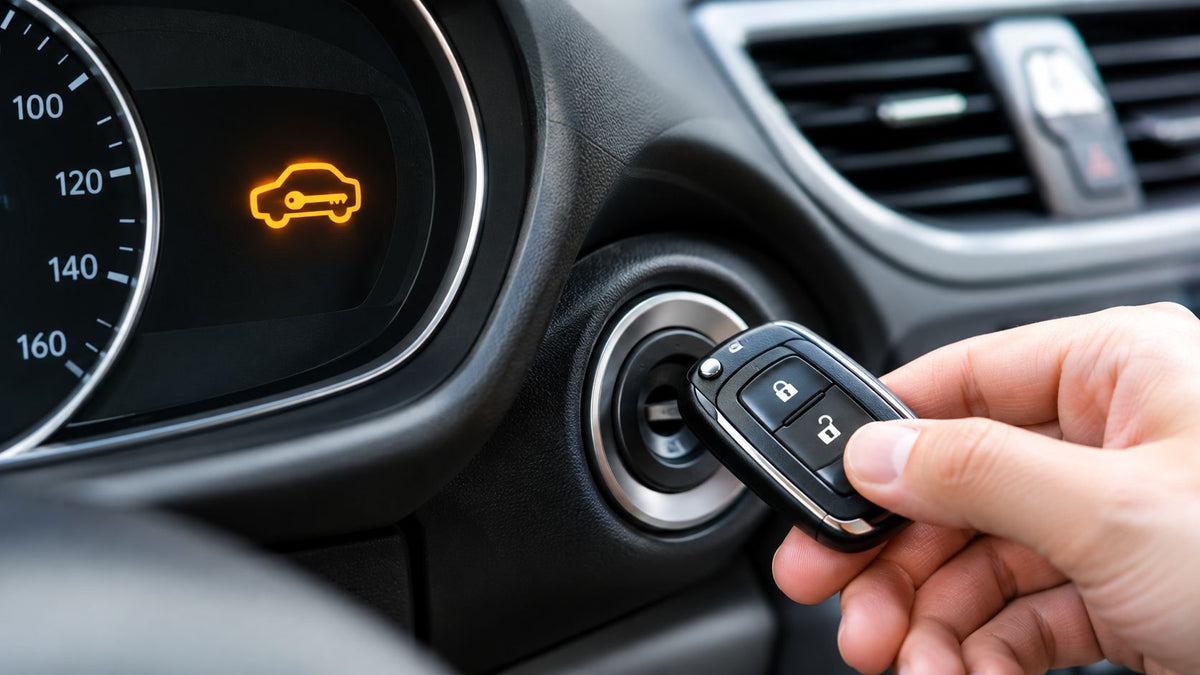
The car with a key symbol is the electronic engine immobilizer indicator, not a seat-belt or airbag warning, and it lights up when the vehicle can't authenticate a coded key or detects a security-system fault. Immobilizers were installed in 86% of new passenger cars sold in the United States by 2009, according to data cited in U.S. regulatory materials.
You turn the key, the starter spins normally, and the engine either refuses to run or starts briefly before dying. At the same time, a small car-and-key symbol stays lit on the dashboard. Your first thought may be a weak battery, a failed fuel pump, or damage from a recent collision.
Sometimes those are the right suspects. But the symbol often points to a different problem: the vehicle's security system hasn't granted permission for the engine to keep running. A car can have a healthy battery, a working starter, and an engine capable of running, yet remain electronically unauthorized to start.
The sections below show how to identify a normal startup check, read the timing of a genuine fault, try sensible driveway checks, and separate an immobilizer issue from an airbag or seat-belt fault. You'll also see why replacing control modules without checking security pairing can make a no-start problem harder to solve.
Table of Contents
- Why a Tiny Key Icon Can Stop Your Car Cold
- What the Car With a Key Symbol Actually Means
- Normal Self-Check or a Real Fault
- Common Causes Behind the Warning Light
- Quick Diagnostics You Can Try Yourself
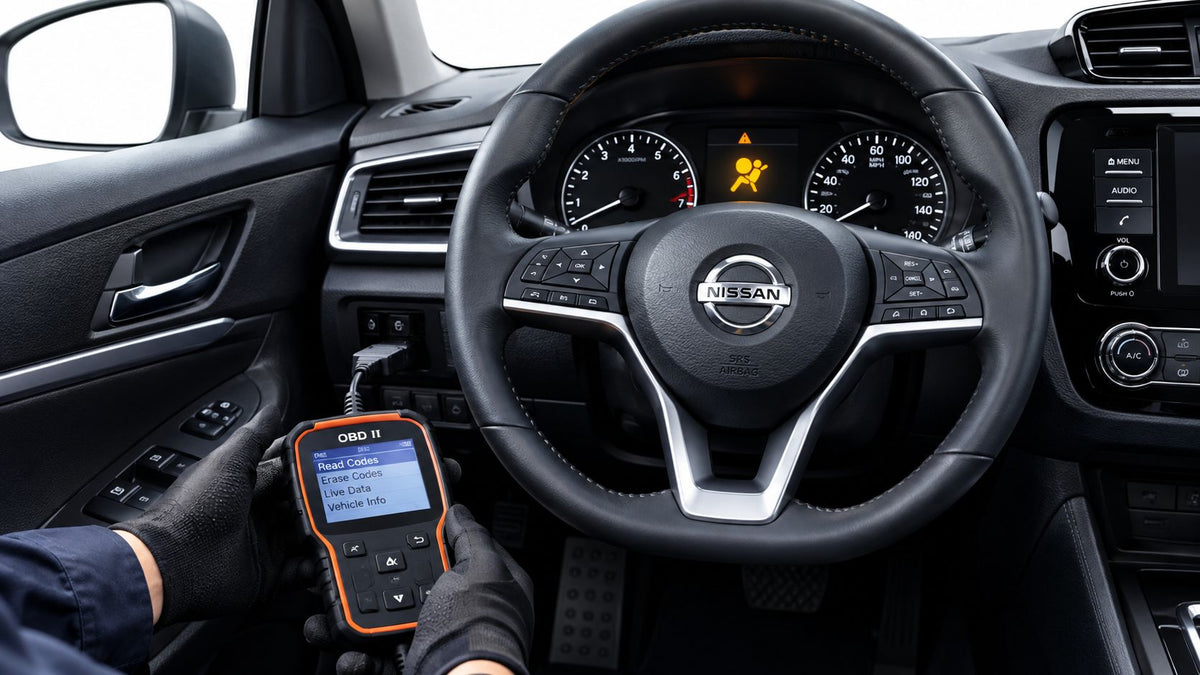
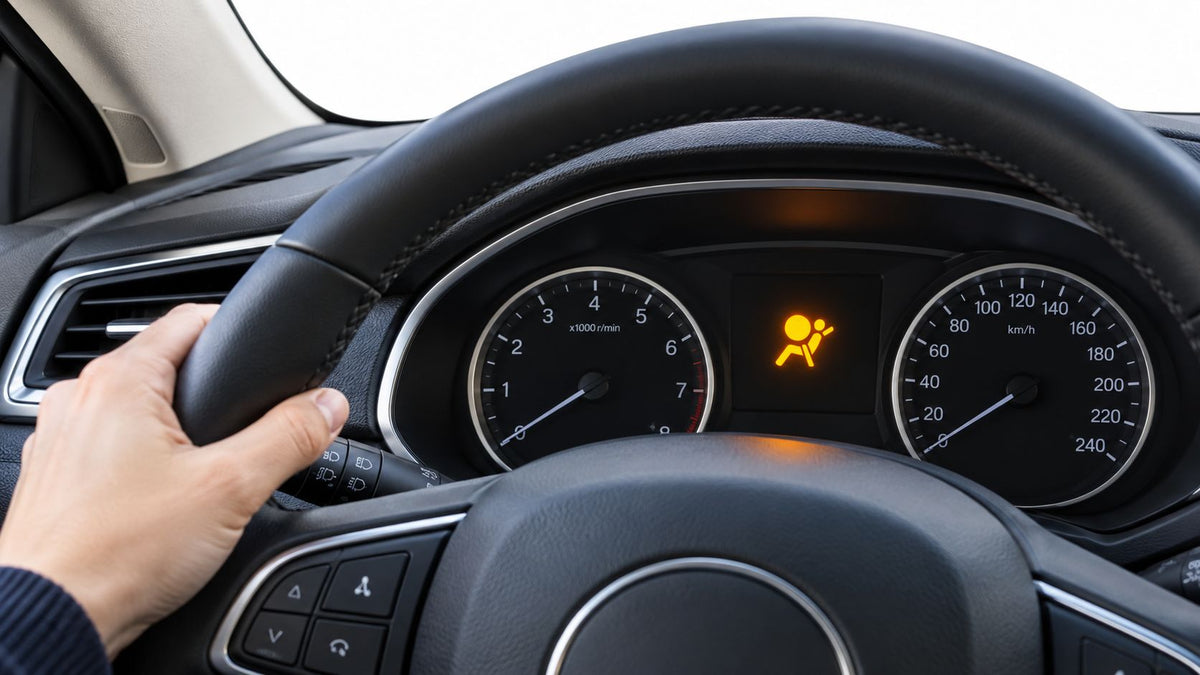
- Telling Immobilizer Faults From SRS Faults
- When to Escalate and Your Next Steps
Why a Tiny Key Icon Can Stop Your Car Cold
A worried owner usually notices the pattern before understanding the symbol. The engine cranks, the car-with-key light remains illuminated, and the vehicle won't start. In another common pattern, the engine catches, runs briefly, and then shuts off as if someone turned off an invisible switch.
That invisible switch is close to the truth. An engine immobilizer is designed to prevent unauthorized starting by blocking critical engine functions unless the vehicle recognizes the correct coded key or fob. NHTSA describes immobilizing devices as systems that prevent ignition bypass and can disable engine electricity or fuel, which is why the agency's vehicle theft prevention guidance treats them as a meaningful part of vehicle security.
The starter motor may still operate because cranking and authorization are separate stages. Think of the starter as turning the engine's mechanical crankshaft, while the immobilizer acts as a security gate that decides whether the engine-control system may continue normal operation.
What the timing tells you
A brief start followed by a stall is particularly useful information. In one documented Chrysler Sentry Key implementation, an invalid key could allow approximately two seconds of engine operation before the system disabled it, as described in federal vehicle-security documentation. That timing doesn't prove the fault on every make and model, but it strongly supports checking key authorization before replacing fuel or ignition parts at random.
A persistent or rapidly flashing symbol during an attempted start deserves attention. It can indicate that the key's identity wasn't accepted, the vehicle can't communicate with a security module, or an antenna or receiver isn't reading the key correctly.
Practical rule: If the engine cranks but won't run, or runs briefly and stalls while the key icon stays active, record that sequence before buying parts.
This light isn't a verdict that the key-fob battery is dead. The fault may be in the key, the antenna, wiring, the body-control module, the engine-control module, or the communication path between them. The next step is to understand what the icon represents and how the vehicle decides whether a key is legitimate.
What the Car With a Key Symbol Actually Means
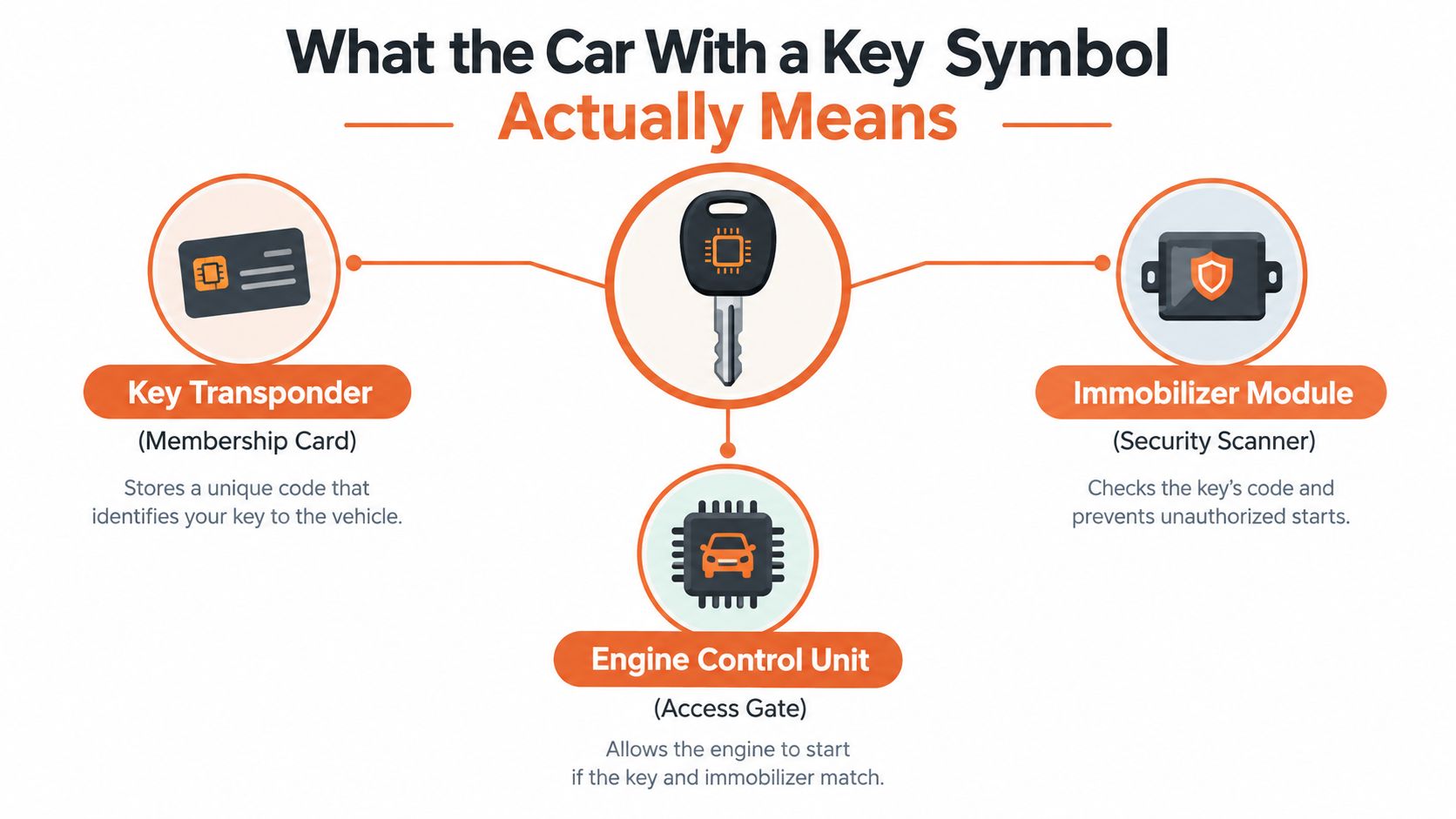
Imagine a bouncer checking an electronic membership card at a private entrance. The card doesn't need to start the building's lights or move the doors by itself. It only needs to prove that the person presenting it has permission to enter.
Your vehicle's immobilizer works in a similar way. A transponder inside the key or fob carries a coded identity. An antenna near the ignition switch, or a receiver in a push-button-start system, reads that identity. The body-control module then works with the engine-control module to compare the key and vehicle security information before allowing continued engine operation.
The authorization path
The process is easier to follow as a chain:
- The key presents its code. The transponder or smart key sends identifying information.
- The antenna receives it. The vehicle's antenna or receiver detects the signal.
- The body-control module checks it. The BCM acts as the security system's decision point.
- The engine-control module grants operation. If the stored identifiers match, the ECM allows normal running.
A failure at any point can produce the same dashboard symbol. That doesn't mean every failure has the same repair. A damaged key, an antenna fault, a BCM power problem, and a mismatched replacement ECM require different tests.
The familiar shape exists because ISO 2575 establishes standardized symbols for vehicle controls, indicators, and telltales. The standard allows telltales to communicate correct operation, malfunction, or a device condition, but individual manufacturers still determine the exact timing and behavior used by their vehicles.
What this symbol is not protecting
The car-and-key icon primarily concerns theft deterrence and starting authorization. It isn't the seat-belt reminder, and it isn't the SRS or airbag warning lamp. Those systems may share the dashboard and vehicle wiring, but they perform different jobs and store different fault information.
An immobilizer is intended to stop ignition bypass, including traditional “hot-wiring,” by withholding electrical or fuel delivery unless the coded key is accepted. For a separate explanation of a lock-related dashboard indicator, see this guide to the lock light on the dash. The important point is simple: a physical key may fit the ignition, but the vehicle still needs to recognize its electronic identity.
Normal Self-Check or a Real Fault
The most useful diagnostic tool may be a clock. Don't only ask whether the car-with-key symbol is illuminated. Ask when it illuminates, how long it remains visible, and what the engine does at the same moment.
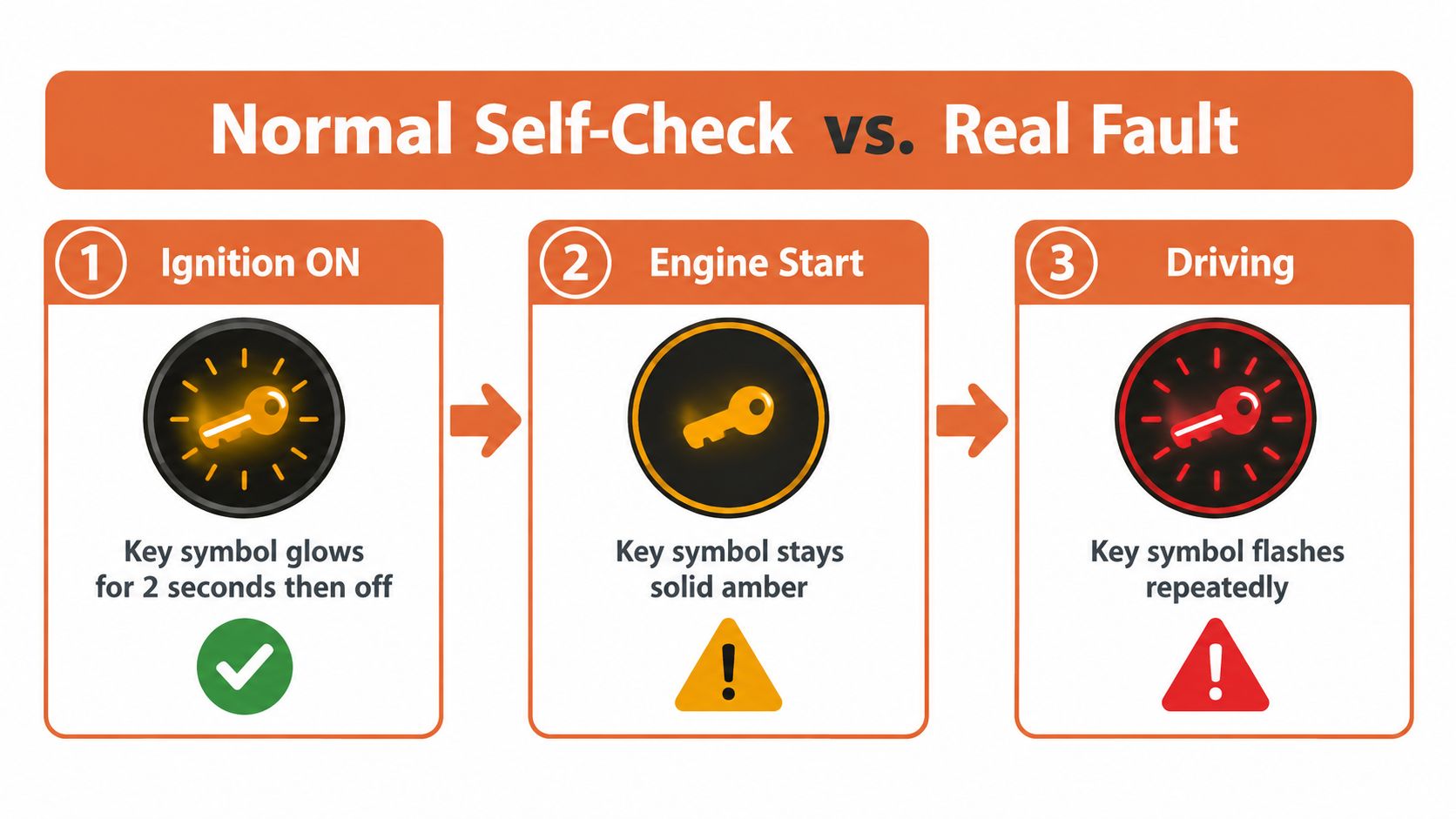
Many vehicles briefly illuminate the symbol when you switch the ignition on. The instrument cluster is performing a self-check, and the security system is authenticating the key. If the light goes out after authorization and the engine starts and continues running, that behavior is generally normal.
A flashing lamp while the vehicle is locked can also be normal. In that situation, the light may be advertising that the anti-theft system is armed. It isn't necessarily reporting a failed component.
A driveway decision path
Use this quick classification before touching any parts:
- Brief light, then off: The lamp appears during ignition startup, disappears after authentication, and the engine runs normally. Treat this as a normal self-check.
- Flashing while parked and locked: The vehicle is indicating an armed security state. Treat it as normal unless the owner's manual describes a different behavior.
- Light remains on during cranking: The vehicle may not be accepting the key or may have a security communication fault. Treat it as an active problem.
- Light flashes continuously or rapidly during starting: Check the spare key and interference first, then arrange a proper immobilizer diagnosis if the condition remains.
- Engine starts and dies shortly afterward: Authorization may have failed after the initial engine start. Avoid assuming that the fuel system is at fault.
This pattern is more informative than a generic statement that the key battery needs replacement. NHTSA documentation identifies a broader authentication network involving access keys, antennas, receivers, and control modules. A coin-cell battery can explain some smart-key problems, but it can't explain every car-with-key warning.
What you should write down
Before calling a repair shop, note whether the engine doesn't crank, cranks normally, starts briefly, or runs continuously. Record whether the symbol is solid, slow-flashing, or rapidly flashing, and whether the behavior changes with a spare key.
Those details help a technician distinguish a key-recognition problem from a low-voltage condition or a broader network fault. They also prevent an expensive conversation based only on “the key light is on.”
The following video provides another visual reference for interpreting dashboard warning-light behavior:
Common Causes Behind the Warning Light
Immobilizer faults often fall into four groups: the key, the signal path, the vehicle's wiring and power supply, or the security data stored in its modules. Start with the simplest category, but don't stop there if the symptoms point elsewhere.
Key and fob problems
A weak smart-key battery can reduce the fob's ability to communicate with the vehicle. A damaged transponder, water intrusion, or a key that was never registered to the vehicle can create a similar result. A lost-key situation may require a new key to be programmed rather than merely cut to match the door lock.
Trying the spare key is valuable because it changes one variable without disturbing the vehicle. If the spare works and the original doesn't, the primary key becomes the leading suspect. If both keys produce the same warning, look more closely at the vehicle-side system.
Antenna and interference faults
The immobilizer antenna may sit around the ignition cylinder or in a designated detection area for a push-button vehicle. A damaged antenna, a loose connector, or wiring disturbed during interior or collision work can prevent the system from reading a valid key.
Signal interference can also confuse a diagnosis. Keep other RFID keys, access badges, and electronic devices away from the ignition or start-button area during testing. This is a quick check, not proof that interference is the root cause.
Module, power, and communication faults
The body-control module needs suitable power and grounds, and it must communicate with the engine-control module. A damaged harness, poor connection, network fault, or module failure can interrupt authorization even when the key itself is good.
A replacement BCM or ECM introduces another risk. The stored key, body, and engine identifiers may not match, and many vehicles require manufacturer-level pairing or key registration after a module change.
A brief-start-then-stall pattern can support an authorization diagnosis, but it doesn't identify the failed component by itself. A capable scan of the immobilizer, BCM, and ECM is still needed.
Don't swap modules blindly. A replacement control unit may need security-ID matching, OEM-level programming, or key registration. Installing several unmatched modules can create an additional no-start condition and erase the useful trail left by the original fault.
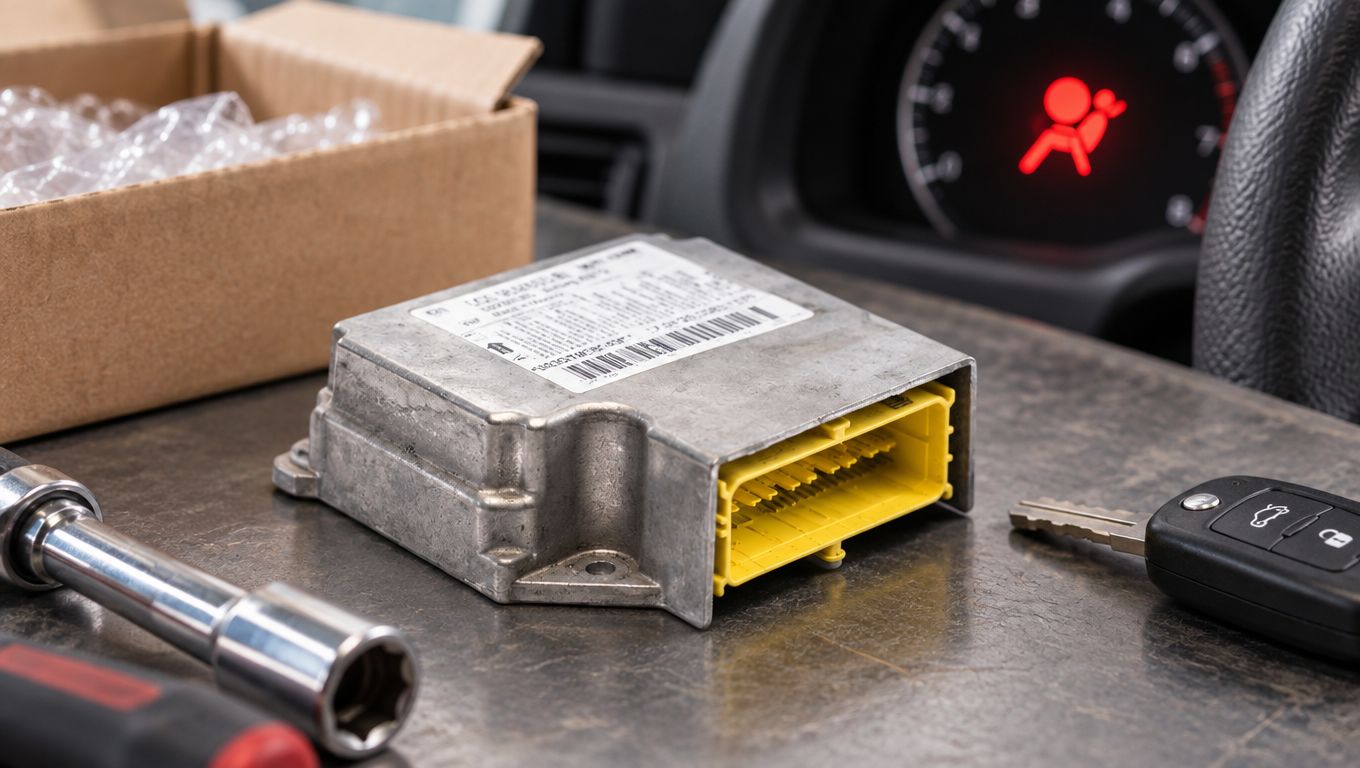
Post-collision owners should keep the systems separate. If the airbag warning remains after an accident, the Airbag Light Reset - Mail in Your SRS Airbag Module After Accident service concerns the SRS control module, crash data, and airbag-related codes. It doesn't authorize a key or repair an immobilizer antenna.
Quick Diagnostics You Can Try Yourself
You can perform a few safe checks without a scan tool. The goal isn't to repair every immobilizer fault in the driveway. The goal is to identify whether the problem follows the key, disappears when interference is removed, or remains a vehicle-side authorization issue.
- Try the spare key. Use the spare exactly as you would the primary key. If the engine starts normally, the original key's transponder or fob function deserves testing. Don't assume the metal blade is the whole key, since the immobilizer reads the electronic identity.
- Replace the fob battery when the symptoms fit. A low-key-battery message or a clear loss of remote range supports this check. Use the battery type specified for the vehicle and make sure the fob is reassembled correctly.
- Clear the start area. Move other keys, building-access badges, cards, and electronic devices away from the ignition cylinder or push button. Then try the start sequence again with only the intended key.
- Use the backup detection location. Push-button vehicles often provide a designated place to hold a weak smart key while starting. The exact location varies, so use the vehicle's manual rather than guessing.
- Record the result. Note whether the symbol turns off, stays solid, flashes, or changes when you use the spare key. Also record whether the engine cranks, starts briefly, or never fires.
A general automotive resource such as the Mai & Associates blog can provide broader maintenance context, but immobilizer faults still depend on the exact make, model, and security architecture.
These checks can solve a weak-battery or interference problem. They can't pair a replacement BCM, register a new key, repair a broken antenna circuit, or confirm communication between the BCM and ECM.
Stop the DIY process when the symptom repeats. Persistent key-symbol activity with a no-start or brief-run condition calls for module-level diagnosis, not another round of parts replacement.
If the vehicle also displays an airbag light, keep that complaint separate and document it independently. A guide to diagnosing an airbag light can help you identify the SRS side of the problem without confusing it with key authorization.
Telling Immobilizer Faults From SRS Faults
A collision can leave several warning lights active at once, especially in a salvage or rebuilt vehicle. That creates a costly temptation: clear one stored fault and expect every dashboard symbol to disappear.
Use the symptom rather than the repair history to identify the system.
| System | Typical dashboard clue | Vehicle behavior | Common diagnostic direction |
|---|---|---|---|
| Immobilizer | Car-with-key symbol remains on or flashes during starting | No-start, or starts briefly and stalls | Key, antenna, BCM, ECM, security IDs, and network communication |
| SRS | Airbag warning symbol remains illuminated | The engine may run normally | Crash data, deployment records, pretensioners, sensors, wiring, and SRS module faults |
An immobilizer problem concerns whether the engine is authorized to operate. An SRS problem concerns restraint-system readiness, including airbags and seat-belt pretensioners. Clearing crash codes from an airbag module won't correct failed key recognition, a damaged antenna, a BCM fault, or an ECM authorization problem.
For a deeper explanation of the restraint warning side, see why the SRS light may remain on. The diagnostic principle is the same for a recovered theft vehicle and a collision rebuild: identify the module reporting the fault before choosing a service.
Why repaired vehicles can still show the key icon
A recovered theft vehicle may have damaged wiring, replaced security components, or lost its original key. A salvage vehicle may have a replacement body-control module that hasn't been paired with the engine-control module. Collision repairs can disturb connectors or power grounds near modules and antennas.
Mechanical repairs don't automatically restore electronic authorization. A repaired starter, replacement battery, or functioning engine can't compensate for security identifiers that don't match.
If module replacement is being considered, it helps to understand the difference between copying or transferring electronic module data and installing a used part. This overview of how ECU cloning works offers useful background, but the correct procedure remains specific to the vehicle's manufacturer and immobilizer system.
When to Escalate and Your Next Steps
DIY checks have reached their limit when the car-and-key light stays on or flashes during starting, the engine cranks without running, or the engine starts and stalls within seconds. Those symptoms call for a diagnostic scan that can access the immobilizer, BCM, and ECM, rather than a basic scan that reads only generic engine codes.
Ask the technician to provide the actual fault information and the authorization status. A useful diagnosis may involve checking the spare key, antenna signal, module power and grounds, network communication, stored security identifiers, and whether the vehicle needs key registration or module pairing.
Don't approve expensive parts based only on the dashboard symbol. A professional should confirm the failed circuit or component first, because replacing an antenna, BCM, or ECM without verifying the security relationship can create another no-start problem.
Post-collision safety work is separate
If the same vehicle has locked seat belts or an airbag warning after a crash, treat those as SRS concerns. National mail-in services can reset eligible SRS airbag control modules and repair seat-belt pretensioners, while immobilizer programming must be performed by a shop with manufacturer-capable equipment.
One mail-in provider states that it uses OEM components and offers 24-hour turnaround after receipt with lifetime warranty coverage for its restraint-system services. Those claims apply to the provider's seat-belt and SRS work, not to immobilizer diagnosis or key programming.
Take a photo of the symbol, write down its timing, try the spare key, and keep the results for the technician. If the light behaves normally, you can continue monitoring it. If it remains active with a starting problem, arrange the right scan before buying another part.
For post-collision restraint issues connected to this diagnosis, Seat Belt Repair offers mail-in seat-belt pretensioner repair, seat-belt webbing replacement, and SRS airbag control-module reset services. Visit the service page to review the correct mail-in option for your vehicle, while having the immobilizer fault diagnosed separately with manufacturer-level tools.

Оставить комментарий
Этот веб-сайт защищается hCaptcha. Применяются Политика конфиденциальности и Условия использования hCaptcha.