
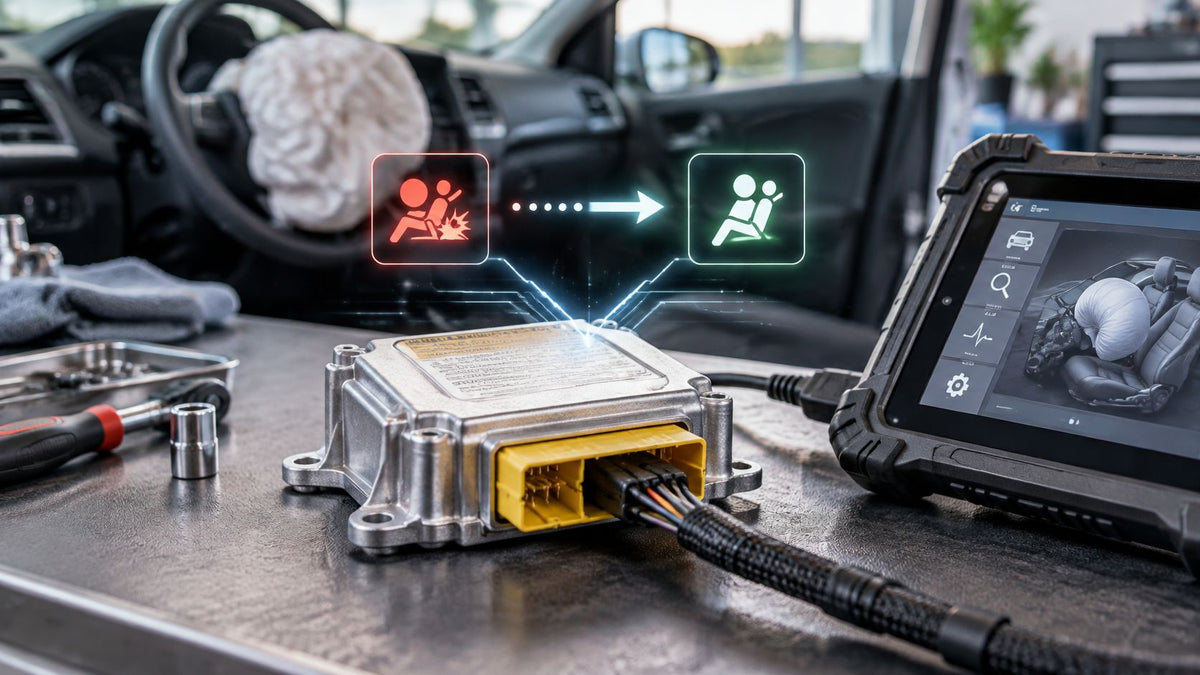
The most popular advice after a collision is also the most misleading. People tell you to plug in a scanner, clear the codes, and watch the airbag light go out. That's not a repair. Crash data removal is the reprogramming of your original SRS airbag control module so it can operate again after an event, and it only works when the deployed hardware around it is fixed first. A dark lamp by itself doesn't prove your belts, airbags, sensors, or wiring will protect anyone.
Table of Contents
- What Crash Data Removal Clears and What It Leaves
- How an Airbag Module Records a Crash
- When Shops and Owners Need a Module Reset
- Legal and FMVSS Limits on Clearing Crash Records
- How a Mail-In Module Reset Is Done
- What Shops Check When the Module Returns
- How to Verify the Whole Restraint System
- Send the Module After the Hardware Is Right
What Crash Data Removal Clears and What It Leaves
If your scan shows permanent crash or hard SRS codes and you're replacing the deployed parts, plan on crash data removal. Don't buy it to chase a live wiring fault, and don't expect it to erase every record of the collision from the vehicle.
What Each Option Actually Does
| Method | What it removes | Original module kept | Best used when |
|---|---|---|---|
| Basic OBD or code reader | Soft codes it can display, not stored crash event data | Yes | A quick check, not a repair |
| Professional SRS module reset | Crash data, hard codes, and airbag and pretensioner deployment records | Yes | The original module is sound and event memory is the fault |
| New dealer airbag module | Prior event memory, because the unit is new | No | The module is damaged, missing, or will not accept a reset |
| EDR download before repair | Nothing; it saves a copy of recorded data | Yes | Insurance, litigation, or an investigation still needs the record |
A basic reader is useful for reading what's there. A standard OBD scanner or code reader cannot erase the crash data stored in the SRS system, even if it can show you SRS faults on screen. Once the controller has written a deployment event, clearing a soft code from the code list doesn't touch that stored record.
A professional reset is different work. The original unit is reprogrammed so airbag deployment codes, seat-belt pretensioner deployment codes, and stored deployment records are cleared and the module returns to a factory-ready state. Because your original module stays in service, its pairing to the vehicle stays intact. That's the practical advantage over replacement when the unit itself is electrically sound.
A new dealer module also starts without event memory, but you're throwing away a computer that often works fine. You may also add VIN coding, programming time, and a parts wait. I'd reserve replacement for a module that's physically damaged, waterlogged, missing, or unable to accept a reset.
The Line Between an SRS Reset and EDR Evidence
An EDR download removes nothing. It saves a copy, and that distinction matters before anyone touches the module.
The NHTSA EDR final regulatory impact analysis defines an EDR as a device or function that captures time-series vehicle dynamics immediately before or during a crash, including speed, delta-V, restraint use, and airbag deployment status. Federal specifications require standardized recording characteristics for 15 essential data elements and permit up to 30 additional elements when supported by the vehicle.
Deployment and near-deployment are separate event types, and some systems record multiple events. So resetting the SRS controller after you've replaced deployed hardware doesn't mean all crash evidence throughout the vehicle is gone, and nobody should describe a module reset as destruction of EDR data.
Shop rule: Restore the controller so the restraint system can function. Don't sell the job as erasing the crash.
Before a salvage repair, write down the module identification and fault state. Decide whether insurance, litigation, or a regulatory file still needs a download. Repair the physical restraints first, then validate module configuration, sensor communication, pretensioner stages, airbag circuits, and warning-lamp behavior with a vehicle-compatible scan procedure.
How an Airbag Module Records a Crash
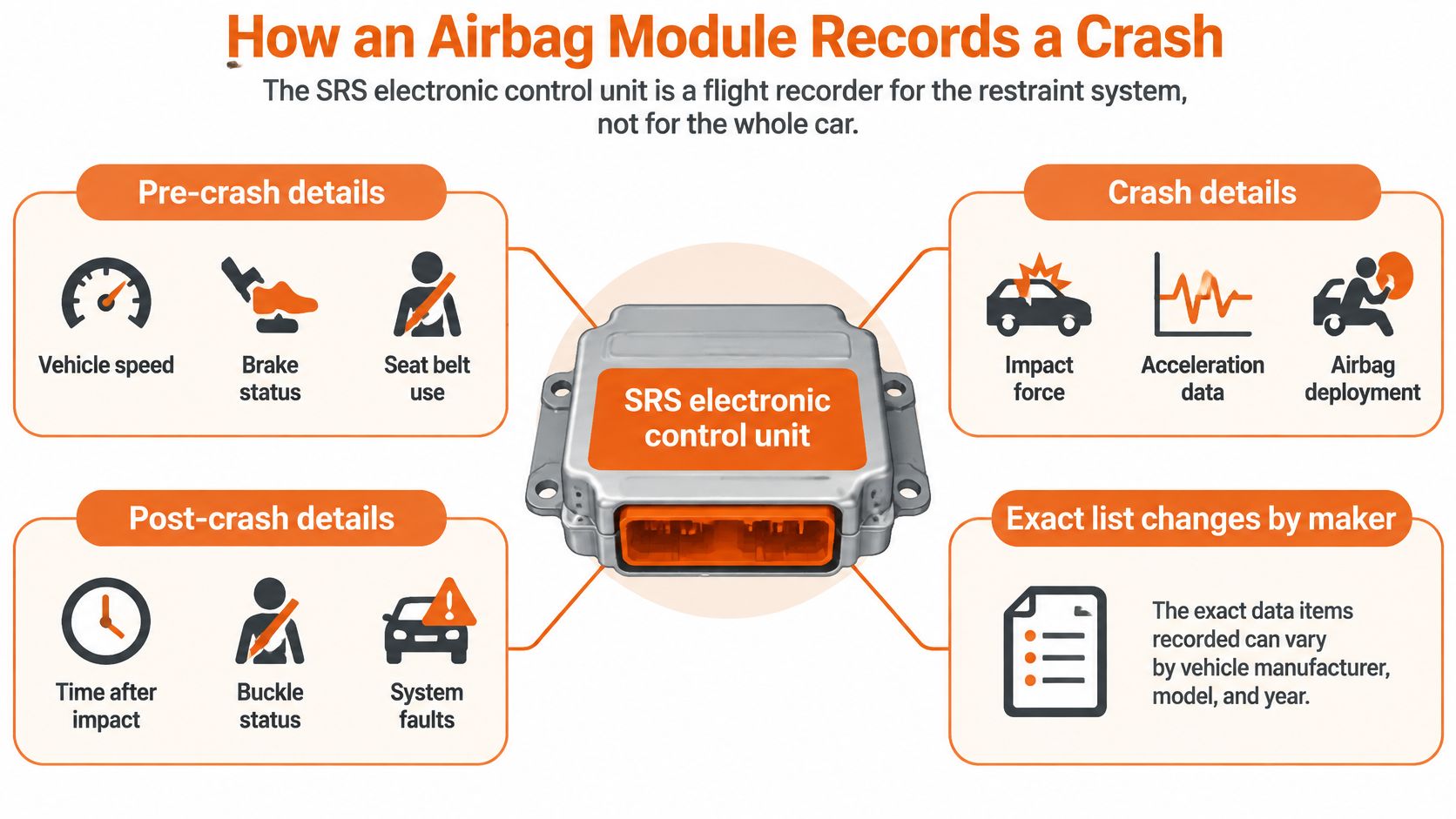
Think of the SRS electronic control unit as a flight recorder for the restraint system, not for the whole car. It decides whether to fire airbags and pretensioners, and it keeps a record of what it saw and what it commanded.
Say a car takes a moderate frontal hit in a parking lot exit. The bumper cover cracks, a pretensioner fires, and no airbag cloth appears in the cabin. The owner assumes nothing was recorded because the bags stayed in. The module may disagree, and the lamp stays on until someone reads it properly.
What Can Be in the Record
The exact list changes by maker and module design. The NHTSA crash data publication identifies recorded or reportable data such as vehicle speed, engine speed, brake and throttle status, seat-belt switch state, airbag deployment timing, diagnostic trouble codes, ignition-cycle count, crash-sensing activation, and maximum change in velocity (ΔV).
Depending on the vehicle and event, that record can cover frontal, side, rear, or rollover information. It's event data tied to the restraint decision, not a generic error message you can wave away.
- Pre-crash details: Speed, brake, and throttle status leading into the event
- Crash details: Delta-V, sensing activation, and deployment timing
- Post-crash details: Trouble codes and ignition-cycle information after the event
Why a Record Exists When No Bag Deployed
A non-deployment event can be recorded when longitudinal or lateral velocity changes by at least 8 km/h over 150 milliseconds, or when a non-reversible restraint device such as a seat-belt pretensioner is commanded to deploy. That threshold explains the parking lot example. The hit was enough for the controller, even if it didn't look dramatic from the driver's seat.
Contrast that with an ordinary check-engine code. A generic reader is built to clear many of those. Stored crash event data is written differently, which is why the cheap tool leaves you with the same lamp on the next key cycle.
There's a limit in the other direction too. If electrical power is lost during the collision, some or all information may not be recorded. A missing record isn't proof nothing happened, and a partial record isn't a complete story.
Post-collision crash data removal is a technical reset of stored restraint-system information, not deletion of a dashboard warning. Match your symptoms to that reset before you spend money on parts you don't need.
When Shops and Owners Need a Module Reset
Read the codes first, then use the situation in front of you. The same lamp can mean stored event memory, a live circuit fault, or both.
When Crash Data Removal Is the Right Next Step
| Situation | Crash data likely | Reset the module | Do this first |
|---|---|---|---|
| Frontal or side airbags deployed | Yes | Yes, after the hardware | Replace spent airbags; do not reuse them |
| Pretensioners fired and bags stayed in | Often yes | Yes, if hard codes are stored | Repair or replace the fired belts |
| SRS lamp still on after new airbags | Yes, if event memory remains | Yes | Confirm sensors and wiring are sound |
| Copart or IAAI salvage from a prior collision | Usually yes | Yes, for a road-ready SRS | Save an EDR image if a claim is still open |
| Failed inspection only because of the airbag light | Only if codes say so | Only for crash or hard SRS codes | Rule out live circuit faults |
| No deployment command and no SRS codes | Unlikely | No | Diagnose ordinary electrical faults |
Deployed frontal or side airbags almost always leave event memory. Spent airbags must be replaced and can't be reused, so the controller reset comes after that hardware, not instead of it. Our guide to what needs to be replaced versus what can be reset after a crash lays out that split part by part.
The Two Situations That Cause Wrong Orders
Pretensioner-only events surprise people. The belts lock or stop retracting, the bags never came out, and hard codes still sit in the SRS unit. If you only fix the belt and ignore the module, or only reset the module and leave a fired belt in the car, the lamp wins.
Salvage rebuilds are the other common case. A Copart or IAAI car often arrives with a deployment or near-deployment already stored, sometimes with parts already swapped by a previous owner. Don't assume a fresh-looking steering wheel bag means the controller is clean. Scan it.
A lamp that stays on after new airbags are installed usually means the original crash record is still there, provided sensors and wiring are sound. A failed inspection, by contrast, is only a reason to read codes. Current circuit faults are a different job, and a reset won't repair a cut wire.
Keeping a sound original module also matters on cost. According to CCC Intelligent Solutions' 2025 Crash Course report, the average total cost of a collision repair exceeded $4,730 in 2024, increasing about 3.7% year over year. In a repair that size, not replacing a working controller is one of the few electronics lines a rebuilder can avoid.
If there's no restraint command and no SRS codes, don't buy a reset. Diagnose the electrical fault you actually have.
Legal and FMVSS Limits on Clearing Crash Records
A reset is not a way to hide a crash. It's a repair decision you make after any needed evidence is saved, and it doesn't tidy a claim, a branded title, an auction listing, or a police report.
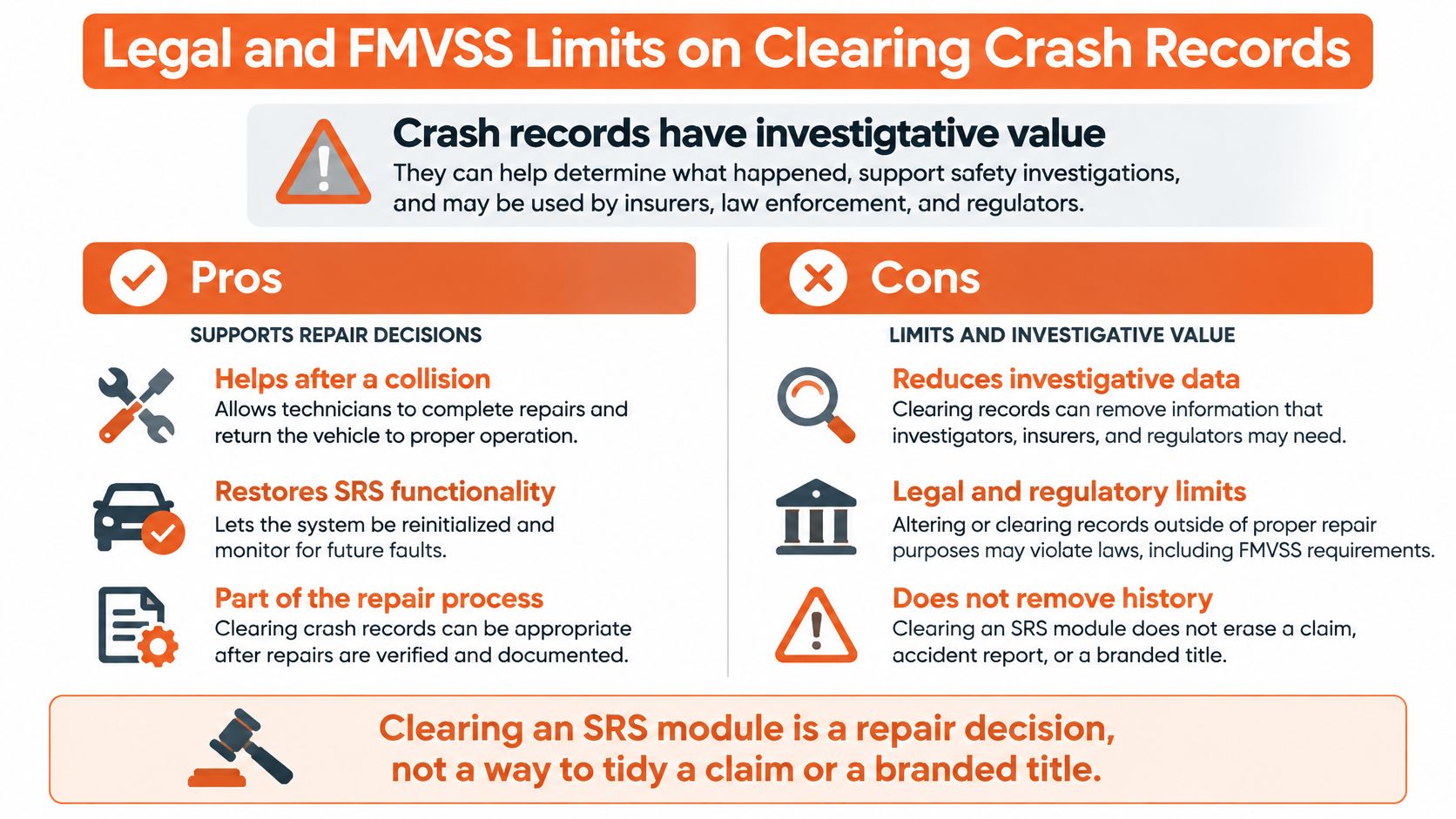
Crash records have measurable investigative value. In the NHTSA study on recording automotive crash event data, an analysis of 225 crash cases in which investigators could determine seat-belt usage found event-data-recorder results agreed with crash-investigator findings in 70% of cases, 105 buckled and 43 unbuckled occupants.
That same work is candid about limits. Compromised vehicle electrical systems were the most frequent reason recordings failed, so the data is useful but not universally recoverable. Retrieval through the diagnostic link connector works when the vehicle's electrical system remains intact, and crash damage can prevent it.
What to Document Before Anyone Reprograms the Unit
The airbag control module can help determine why an airbag did or did not deploy, and it can record collision information for safety research. It may also retain diagnostic trouble codes associated with pretensioner activation after the visible parts have already been changed. A stored deployment or near-deployment record can remain in the controller after physical components are replaced or repaired, which is why the paperwork matters as much as the part swap.
- Open insurance file or lawsuit: Download and file the record before reprogramming
- Module identity: Note the part number and fault state on the repair order
- Hardware list: Name each replaced restraint part before the controller is reset
The FMVSS Standard in Plain Language
Tie the job to FMVSS No. 208 occupant crash protection requirements, which cover the airbag system and its warning lamp. A restored system must work as designed, not merely show a dark lamp. That means bringing restraints back to manufacturer specification with proper components, not patching circuits so the bulb goes out.
Deployed airbags are not reusable. Resistors and bypass tricks don't restore protection, and they don't belong in a car you're putting back on the road.
The honest sentence for a repair order is simple. The controller is being restored so the supplemental restraint system can function, after any needed evidence image is saved. If a seller promises more than that, don't use them.
How a Mail-In Module Reset Is Done
The bench work is only one step. Most failed mail-ins go wrong before the box is taped shut.
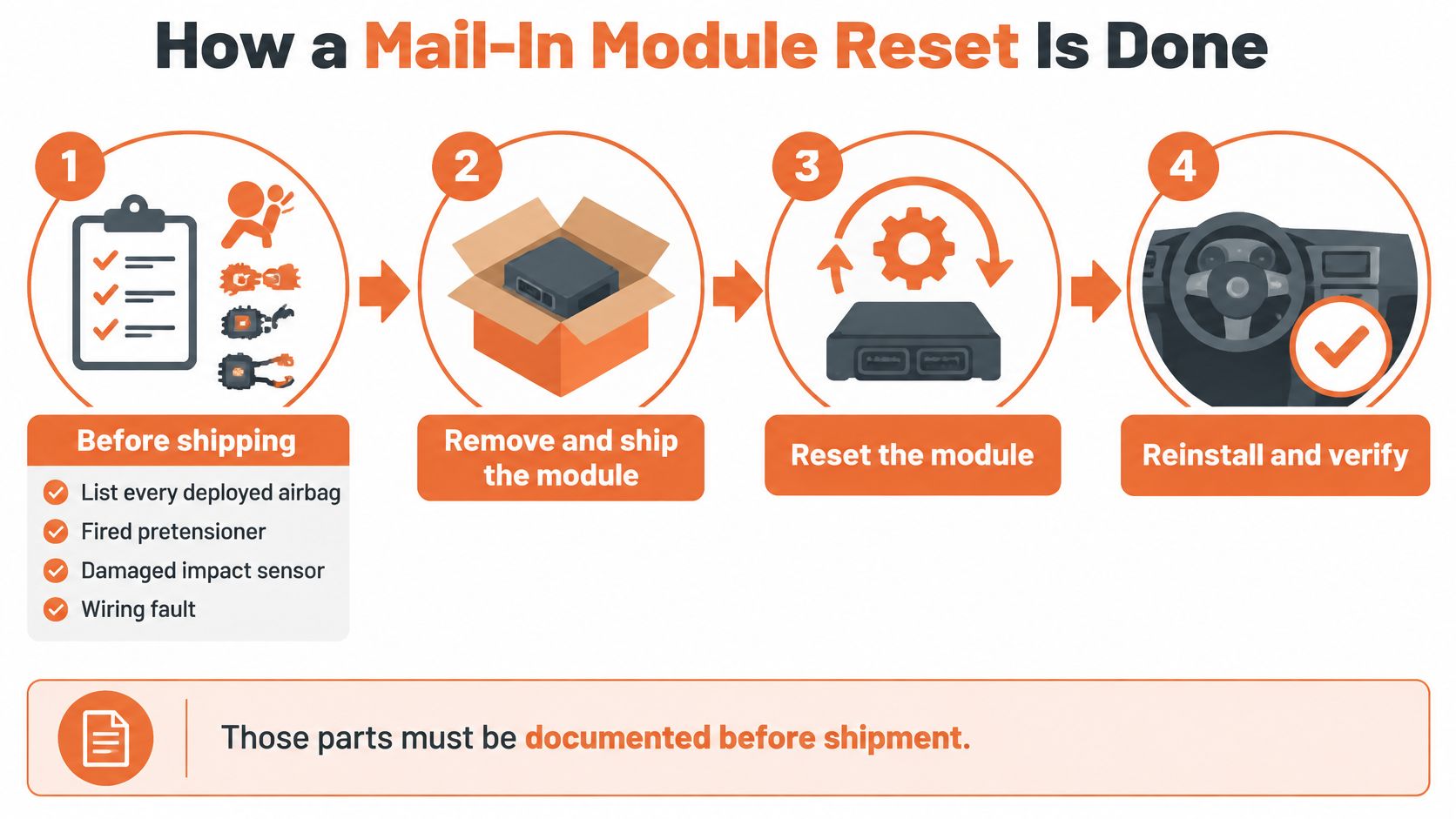
- List the hardware first: Write down every deployed airbag, fired pretensioner, damaged impact sensor, and wiring fault, because those parts must be replaced or repaired or the lamp won't clear.
- Shut the system down properly: Follow the manufacturer procedure, disconnect the battery, and wait at least 90 seconds before working near the restraint system.
- Remove the module: Take off the interior trim, undo the mounting bolts, and unplug the connector. We provide step-by-step removal instructions for seat belts and airbag modules and help if needed.
- Photograph and tag it: Record the connector and mounting position, then pack the unit with your name, return contact, and phone number so the pins can't be crushed.
- Save evidence if a file is open: Get an EDR image before shipping and note the module part number and fault state on the paperwork.
- Ship it to us: This is a mail-in process, so you remove the SRS airbag control module and ship it to Seat Belt Repair at the receiving address on the order page. Confirm current turnaround there before you promise a date.
- Bench reset and test: The original unit is reprogrammed to factory-ready settings, crash data and hard codes are cleared, and it's function-tested before return.
- Reinstall last: Fit it only after the physical restraint parts are corrected, then scan and check the lamp.
Watch the removal and shipping sequence before you start pulling trim.
The order page for the SRS Airbag Module Reset Service After Accident Airbag Light Reset and Crash Data Removal All Makes and Models describes a service that reprograms the original module, removes crash data, clears error codes, and restores it to factory condition. The airbag light turns off only after the module is reinstalled and all deployed components, such as airbags, impact sensors, and seat belt pretensioners, have been replaced.
What Shops Check When the Module Returns
Don't carry the box straight to the car. A two-minute bench-door check prevents installing the wrong unit, a damaged unit, or the right unit at the wrong stage of the repair.
Receiving Checks in Order
- Match identity: Compare the returned part number against the VIN and your original paperwork.
- Inspect the unit: Look for impact damage, moisture, bent pins, and corrosion on the housing and connector.
- Read the paperwork: Confirm it states the reset was completed and which crash data and hard codes were cleared.
- File the bench result: Record the test outcome with the repair order so the next technician isn't guessing.
- Keep it packaged: Leave the module unmounted until every deployed airbag, pretensioner, and sensor has been replaced or repaired.
- Stop on a new fault: If the returned module shows a fault that wasn't present before shipping, don't install it. Send it back and request a diagnostic review.
Owners should follow the same order. Confirm the module matches your car before you accept the box as ready, and don't let an installer treat the returned unit as a finished repair. It's one restored component in a system that still needs verification.
Shops that want a consistent sign-off format can adapt final repair verification checklist templates from RedAppy to their own SRS receiving and install steps. A written checklist beats memory when a rebuild stretches over weeks and several hands touch the car.
A returned module is ready to install. It is not, by itself, a finished restraint repair.
That distinction protects the shop too. If the lamp stays on later, your receiving notes show what arrived, what was cleared, and what hardware was still outstanding at the time. You can then chase the actual remaining fault instead of re-arguing the whole job.
How to Verify the Whole Restraint System
Say a rebuilder replaces the steering-wheel airbag, gets the original module back with crash data removed, installs it, and the lamp stays on. The reset didn't fail. A fired pretensioner and a damaged side-impact sensor were never corrected, and the system is reporting exactly that.
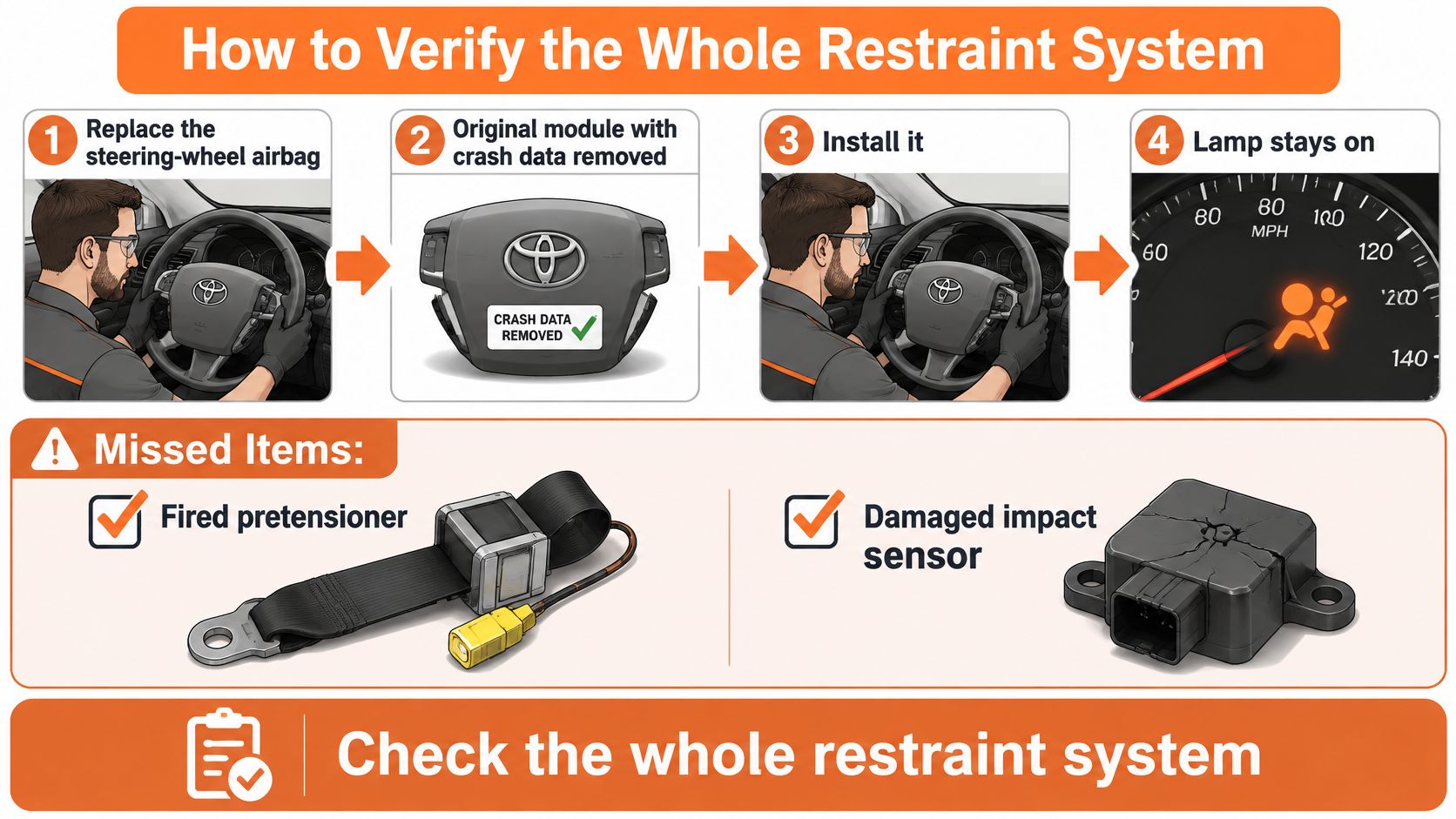
The NHTSA air bags guidance emphasizes that deployed airbags cannot be reused and must be replaced by an authorized service technician, and service documentation shows pretensioner work involves model-specific procedures. Resetting the module alone can provide false reassurance if deployed components remain installed, connectors are damaged, or a replacement module is mismatched.
Verification Checklist After the Module Returns
- Identify the exact module and connector: Confirm the returned unit matches the car.
- Document what deployed: Write down which airbags and which pretensioner stages fired.
- Inspect the hardware path: Check connectors, clock spring, impact sensors, and wiring for damage or poor repairs.
- Repeat the shutdown: Disconnect the battery and wait before plugging anything in.
- Scan, don't just watch the bulb: Look for remaining hard faults with a vehicle-compatible procedure.
- Confirm the self-check: The SRS warning lamp should run its normal key-on check, on and then off.
- Go back to hardware first: If the lamp stays on, return to the parts before blaming the reset.
Any deployed airbags, damaged sensors, blown seat belts, or wiring issues must be replaced or repaired before the SRS light can clear. Our overview of functional testing requirements is a useful companion when you're deciding what counts as verified rather than assumed.
Sign off a rebuild only when belts, pretensioners, airbags, sensors, wiring, and the module all agree. Recorded data, formats, and retrieval methods aren't fully standardized across systems, so follow the vehicle-specific procedure for your car instead of chasing a universal reset method.
Send the Module After the Hardware Is Right
Send the original module for crash data removal once it's present and undamaged, every deployed airbag, pretensioner, and sensor is replaced or on order, and any needed EDR image is saved. If one of those conditions isn't met, you're not ready to ship.
We reset SRS modules for domestic, import, luxury, hybrid, and electric vehicles by nationwide mail-in. The service reprograms the original unit, clears all SRS codes and all crash data and hard codes, and eliminates the need for a costly airbag module replacement when the controller itself is sound.
The SRS airbag module reset service is currently listed at a sale price of $49.97, with a listed regular price of $799.00. Confirm current turnaround and warranty terms on the order page before you plan around them, because shipping time sits outside the bench work. Installation stays with you or your local shop.
If you're still hunting for the unit, our guide to where the airbag module is located will point you to the usual mounting spots before you start removing trim at random. Most modules come out once the trim panels are off and the mounting bolts are undone, but location varies enough that guessing wastes time.
One last reminder, because it's the mistake that generates the most frustrated phone calls. The lamp clears after reinstallation and after the deployed hardware is corrected, not before. Get the parts right, then send the module.
If your original SRS module is sound and your deployed airbags, pretensioners, and sensors are handled, we can reprogram that unit by mail-in, clear its crash data and hard codes, and return it ready for installation and verification. Start your order and check the current receiving address and terms at Seat Belt Repair, then ship the module once your hardware list is complete.

Laisser un commentaire
Ce site est protégé par hCaptcha, et la Politique de confidentialité et les Conditions de service de hCaptcha s’appliquent.