
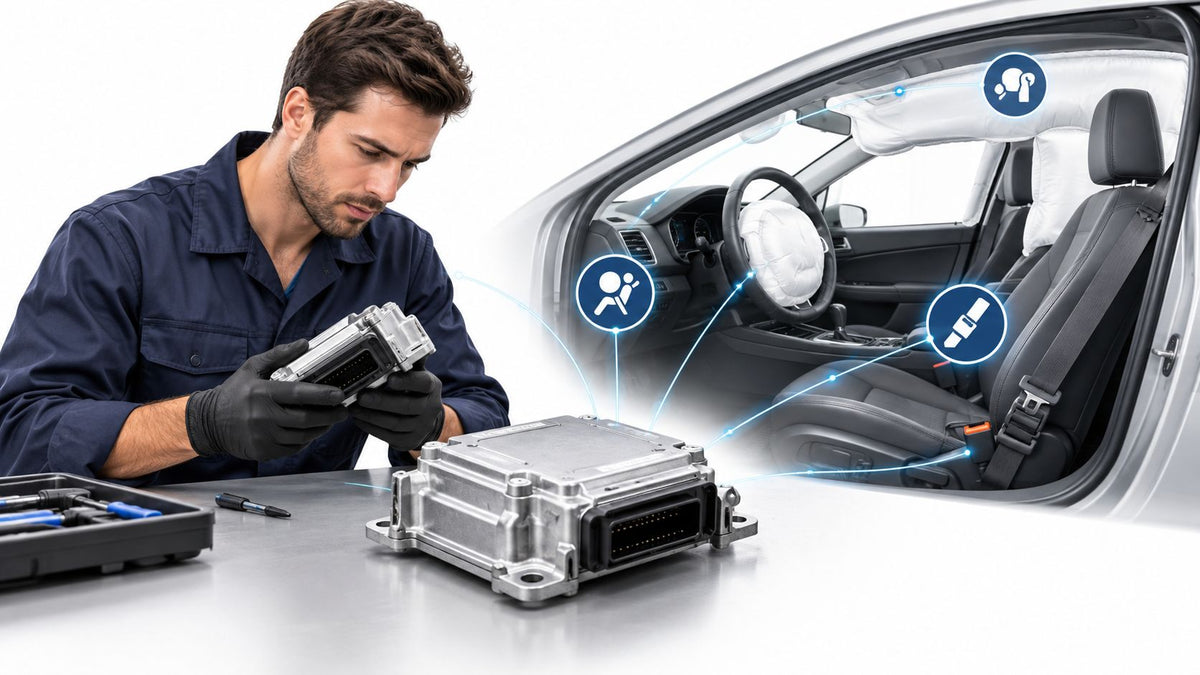
A collision repair can look finished from the outside: damaged panels are straight, replacement parts are installed, and the car is ready for another scan. Then the airbag warning light stays on. That lamp doesn't prove the airbag control module has failed, but it does mean the Supplemental Restraint System (SRS) needs a proper diagnosis before anyone assumes the vehicle is safe.
The key distinction is between electronic memory and physical damage. A module may retain crash data that needs specialist service, while deployed airbags, triggered seat-belt pretensioners, damaged sensors, or faulty wiring need their own repairs. Clearing a code or resetting a module can't substitute for those repairs, and an extinguished warning light alone doesn't prove the SRS is ready.
Table of Contents
- Why an Airbag Warning Light Changes the Repair
- What an Airbag Control Module Does
- How the Module Detects and Records a Crash
- Recognizing Common Failure Symptoms
- Comparing Reset Repair and Replacement Options
- Real-World Post-Collision Examples
- When Professional SRS Service Is Needed
- Key Takeaways for a Complete Repair
Why an Airbag Warning Light Changes the Repair
A vehicle returns from the body shop after a collision. The visible damage has been repaired, and the airbags or belts that deployed have been replaced. But the SRS light remains illuminated. The driver may suspect the airbag control module, while the rebuilder may be tempted to clear the code and move on.
Neither reaction identifies the fault. The lamp is a warning that the SRS has detected a problem or is not confirming that the system is ready. It doesn't say whether the cause is stored crash data, a still-deployed or damaged restraint, a sensor, wiring, power or ground, or the module itself.
The SRS is more than the module. A reset may address an eligible electronic memory issue, but it won't replace an airbag or repair an impact-damaged connector. If a pretensioner fired, that physical restraint also needs to be dealt with. A warning light that turns off after a code clear can't certify that every restraint will operate as intended.
Practical rule: Diagnose first, then decide whether the module needs service. Don't use the dashboard lamp as a pass-or-fail test for the whole system.
A sound repair starts with an SRS-capable scan and a record of the current, history, and communication codes. The technician can then check battery power and grounds, inspect the affected restraints and wiring, and determine whether the module contains a crash record or has an active fault. A step-by-step approach to diagnosing an airbag warning light can help owners understand why the lamp is on, but collision repairs still need to follow vehicle-specific service information.
The decision path is straightforward: identify the fault, inspect the complete SRS, choose an appropriate repair or module service, and validate the finished system. Removing or shipping the module before preserving diagnostic information can make that handoff less useful.
What an Airbag Control Module Does
Think of the airbag control module as an air-traffic control room for the vehicle's restraints. It receives signals from sensors and restraint-related components, evaluates what those signals mean, and coordinates safety-critical actions. It's also called a sensing and diagnostic module (SDM), restraint control module (RCM), or airbag control unit (ACU), depending on the vehicle.
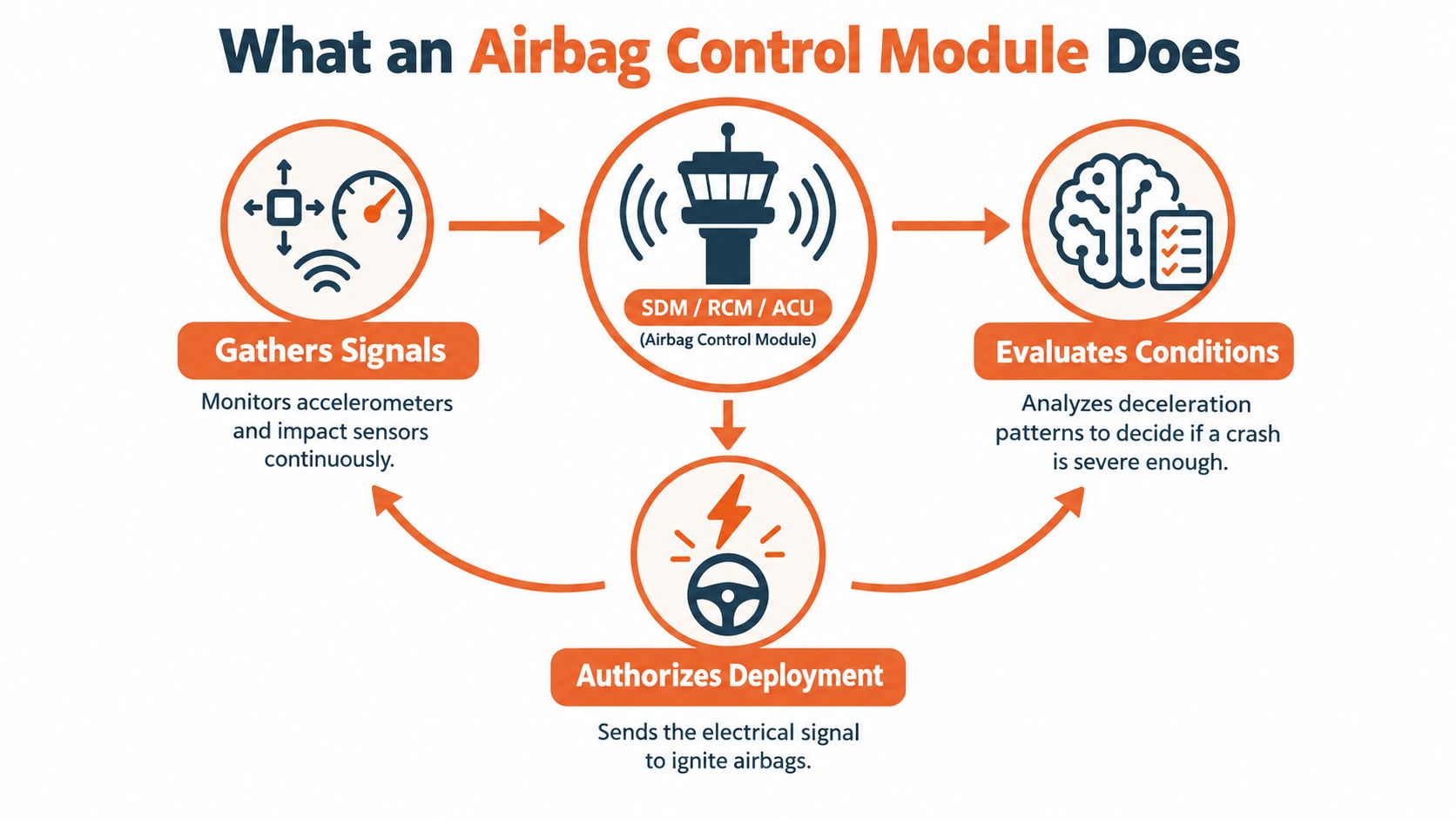
From signals to restraint commands
First, the module receives information such as acceleration and restraint status. It then uses programmed crash logic to assess the signals. If the conditions meet the vehicle's criteria, the module can command the relevant restraints. Depending on the vehicle, these may include front, side, or curtain airbags, seat-belt pretensioners, and other safety devices.
That's more complex than a simple switch that fires an airbag whenever the car is hit. Modern SRS designs may need to coordinate multiple inputs, occupant classification or suppression logic, and staged restraint behavior. The module's job is to make those decisions as the crash unfolds, based on the system's design and available signals.
Monitoring and recording
The control room also checks for faults. It can identify conditions such as an electrical or communication problem and store diagnostic information for later review. In many vehicles, the module also serves as an event-data recorder, retaining crash-related information. The specific data and memory behavior depend on the vehicle.
This combination of real-time control and diagnostic memory explains why a module can be central to collision repair without being the only possible source of an SRS warning. A module can retain a crash record while another component has a separate physical fault. Likewise, a warning caused by wiring or a restraint doesn't automatically mean the module itself needs replacement.
A vehicle's system design matters. Federal requirements evolved from phased automatic occupant protection to requirements for airbags alongside manual belts in passenger cars and light trucks, expanding the role of electronic SRS control across the vehicle population. NHTSA's regulatory history of occupant protection provides context for how the module became part of a federally regulated safety system rather than an optional convenience feature.
How the Module Detects and Records a Crash
A module doesn't judge a collision by looking at the damaged bumper afterward. It evaluates incoming signals using vehicle-specific logic. A useful way to follow the process is to trace what happens from the first change in motion to the diagnostic record left behind.
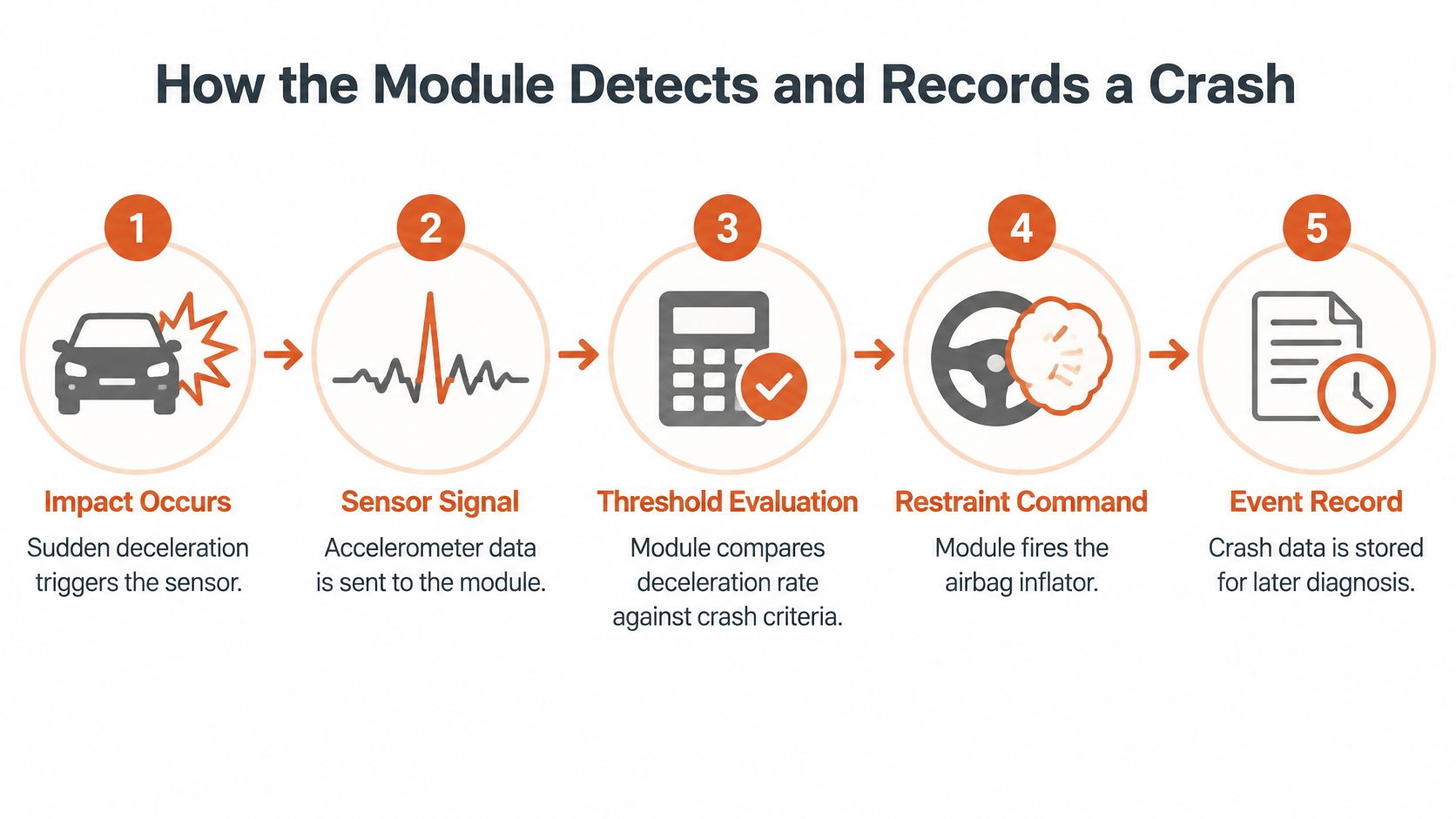
The decision path
- The vehicle experiences a sudden change in motion. Accelerometers and other sensors provide signals about the event.
- The module receives and evaluates those signals. It checks the pattern against programmed criteria and considers relevant restraint status.
- The system makes a deployment decision. Depending on vehicle design and conditions, it may command a restraint, suppress a deployment, or use staged behavior.
- The module records information. It can retain diagnostic trouble codes and, in many vehicles, separate event data.
- A technician checks the result. A complete SRS scan and physical inspection help identify what needs repair before the vehicle returns to service.
Some systems begin collecting event data at a threshold of approximately 2 g of deceleration across several samples, and some deployment records include information from as much as 70 milliseconds before and 220 milliseconds after deployment criteria are met, as described in NHTSA documentation on event data recorders. These are examples of documented system behavior, not universal specifications for every vehicle.
Codes aren't the same as crash records
A diagnostic trouble code points to a condition the system has detected. Nonvolatile crash-event data is a different kind of record. In some systems, deployment records may be locked, so clearing a visible SRS code won't necessarily erase the event or restore the module's state.
For example, a seat-belt pretensioner can activate during a collision even when no airbag deploys. The absence of a deployed airbag therefore doesn't prove that the module has no crash-related record or that every restraint is ready.
Memory behavior varies by vehicle. Some non-deployment events may be overwritten by later events, while deployment events may be retained; certain configurations require module replacement after deployment. NHTSA material on restraint-module event behavior underscores why the technician needs the vehicle-specific procedure rather than a generic assumption about what a reset will do.
Recognizing Common Failure Symptoms
An SRS warning is a clue about the system, not a diagnosis of the module. Look at the pattern of symptoms and the repair history, then use an SRS-capable scan and inspection to narrow down the cause.
What the warning and scan may indicate
If the light stays on after a collision, the module may contain crash data, or the system may still detect a fault in a restraint, sensor, wiring, or power supply. If the light returns immediately after someone clears a code, that suggests the underlying condition may still be present. It doesn't, by itself, identify which part has failed.
Communication faults direct the diagnostic process toward module connections, power and grounds, wiring, or network communication. Problems that appear after low voltage or water intrusion also call for checks of the electrical supply, connectors, and affected components. A scan helps identify what the vehicle reports, but inspection is needed to establish what has been damaged.
Look beyond the lamp
A seat belt that remains locked or won't retract deserves attention as a restraint issue. If a pretensioner has fired, the belt assembly and related SRS components need assessment. Visible damage to a sensor, connector, or harness is another reason not to treat the problem as a simple memory reset.
Before disconnecting components or sending a module out, preserve the current, history, and communication codes. Photograph the module label and record whether airbags or pretensioners deployed. Those details give the repair facility or module service provider a more useful starting point.
A code clear changes what the system remembers or displays. It doesn't mend a wire, restore a damaged sensor, or replace a restraint.
For a salvage vehicle, include any known donor-part information in the diagnostic handoff. An unknown repair history makes it even more important to verify component identity and configuration rather than assume that the warning has one obvious cause.
Comparing Reset Repair and Replacement Options
Choose a service route based on the diagnosed fault, not on the warning light alone. A generic OBD-II scanner may not access all SRS functions, clear locked crash records, or perform vehicle-specific programming. An SRS-capable scan is a better starting point, but it still doesn't replace inspection of the physical restraints and wiring.
| Option | Best suited to | What it resolves | What still requires verification |
|---|---|---|---|
| SRS-capable diagnostic review | A warning light with an unknown cause | Identifies reported codes and helps direct inspection | Physical condition of restraints, sensors, wiring, and power or ground |
| Professional crash-data reset | An eligible, electronically sound original module with an unresolved crash record | Services module memory and, depending on the service, associated hard codes | Deployed restraints, active faults, module installation, and final SRS operation |
| Component repair | A diagnosed fault in a restraint, sensor, connector, or wiring | Addresses the affected physical part or circuit | Whether other faults or stored records remain |
| Module replacement | A module with a fault or deployment history that vehicle-specific procedures say requires replacement | Replaces the affected module | Exact part compatibility, coding or configuration, and the full system test |
Match the service to the fault
A reset can be appropriate when the original module is serviceable and stored crash data is the remaining issue. It won't repair deployed airbags, triggered pretensioners, damaged sensors, or wiring. If the module has a hardware problem, or the manufacturer's procedure requires replacement after a particular event, resetting isn't the right fix.
Replacement isn't automatically simpler. A used or donor module may differ in hardware, software, restraint stages, or vehicle configuration. Before installing one, verify its exact part number and identity, connector arrangement, and any VIN or option-coding requirements. Keeping the original module may avoid introducing a compatibility issue, but only if it's technically serviceable.
Seat Belt Repair offers a mail-in airbag module reset after an accident that clears crash data and hard codes, reprograms the original module to factory specifications, and includes functional testing and a lifetime warranty. The service is completed within 24 hours after the module is received. That is module work, not installation or repair of other SRS components. For a broader discussion of which parts may need replacement or reset, see airbag system repairs after a crash.
Real-World Post-Collision Examples
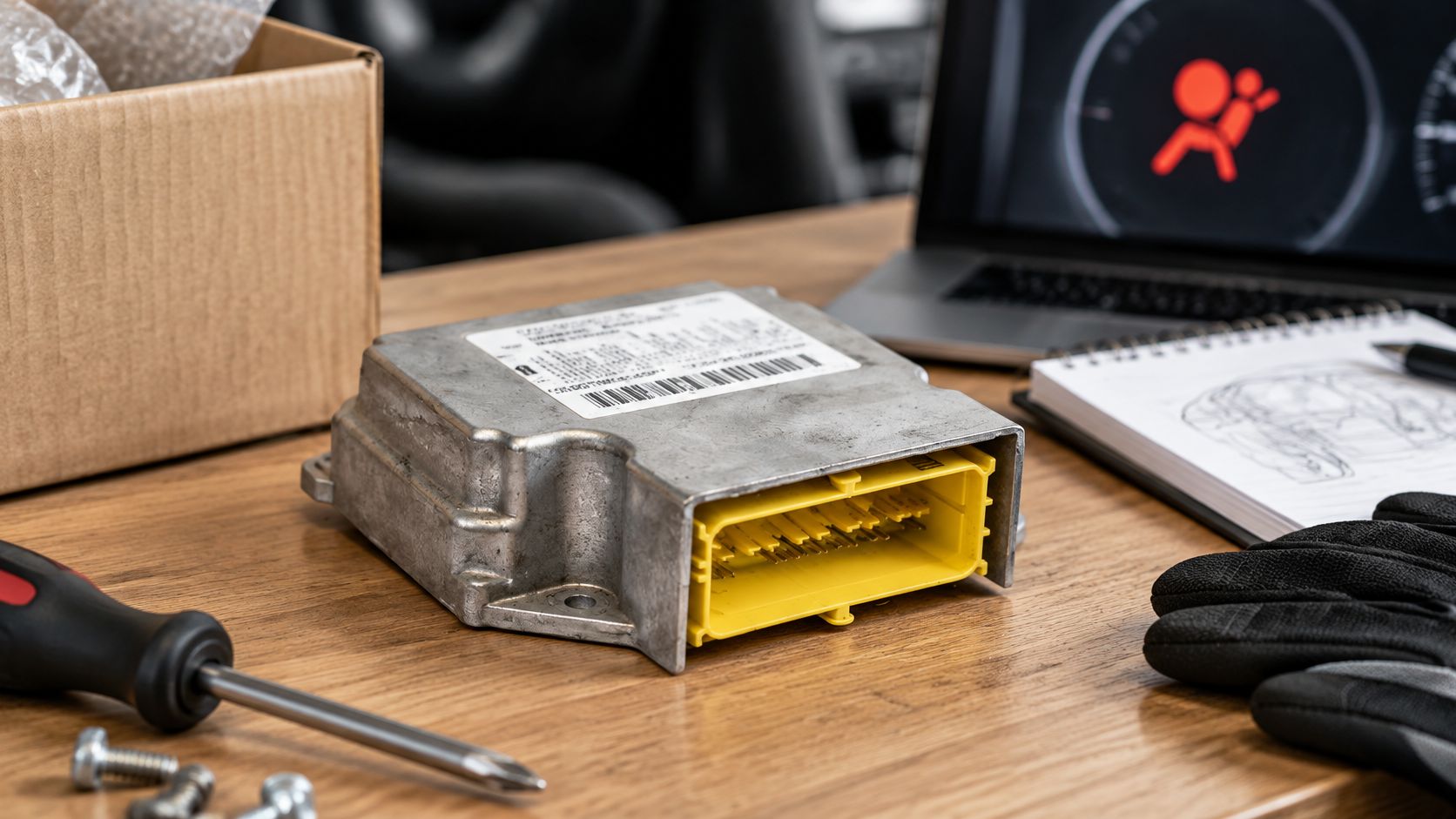
Consider a vehicle in which airbags and pretensioners activated. The visible damage has been repaired, but the SRS light remains on. The technician scans the SRS, records the codes, checks the replaced restraints and related wiring, and identifies whether the original module has a stored event or an active fault. If the module is eligible for service, resetting it may address the memory issue, but the repaired vehicle still needs a final system check.
Now consider a salvage vehicle with mixed replacement parts. The rebuilder finds a donor airbag control module that physically fits, but its part number and configuration haven't been confirmed. A matching connector isn't enough to establish compatibility. The repairer needs to record the original module's identity, compare the replacement's hardware and software, and determine whether VIN-specific coding or other setup is required.
In a third scenario, a code clear turns off the warning lamp, but a damaged sensor or deployed restraint remains unaddressed. That light going out doesn't demonstrate that the component has been repaired or that the system can respond correctly in a future collision. The technician needs to investigate the fault, complete the physical repair, and scan the SRS again.
These examples aren't customer case reports; they illustrate why the repair sequence matters. Module service, physical repair, correct configuration, and final validation are separate tasks. If a collision has also raised questions about the vehicle's paperwork or next steps, this guide for drivers post-collision offers related guidance without replacing the vehicle's repair procedure.
When Professional SRS Service Is Needed
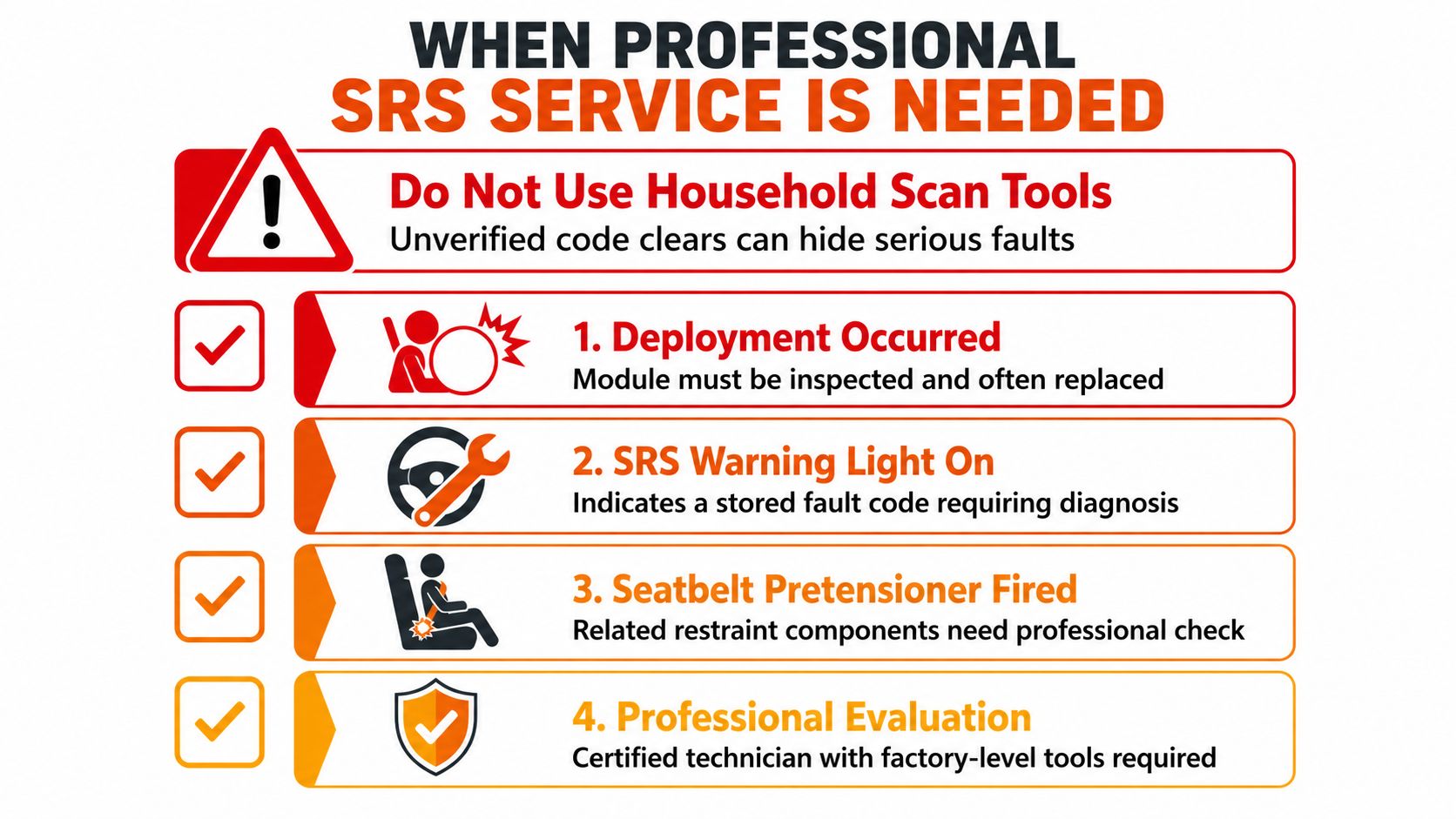
Get a qualified repair professional involved when an airbag or pretensioner has deployed, the warning light remains after repairs, or collision damage may have affected sensors or wiring. Professional assessment is also appropriate when the module contains a locked crash record, its identity is uncertain, or a salvage vehicle combines parts from different vehicles.
Ask for a documented diagnosis
A useful repair record should identify the module's exact part number and software identity, the connector and restraint-stage configuration, and the diagnostic results. It should also document power and ground checks, the condition of deployed or damaged restraints, any component repairs or replacements, and programming requirements.
After installation, the repair facility should run the appropriate final SRS self-test and check for current faults. Functional testing of a serviced module is not the same as testing the complete vehicle system. For a closer look at what final validation involves, consult this overview of functional testing requirements.
A mail-in service can handle work on the module itself, but it doesn't install the unit or repair other parts of the vehicle. The owner or local shop remains responsible for reinstallation, any needed configuration, and confirming that the complete SRS passes its checks. Shops that handle this work may also need suitable business coverage; insurance for auto repair businesses provides context on coverage options for repair operations.
Don't treat an extinguished light as permission to skip diagnosis. If restraints have deployed, warning messages persist, or the vehicle shows signs of unresolved electrical or restraint damage, have it evaluated before relying on the SRS in normal use. Follow the manufacturer's safety procedures for any work around restraint components rather than attempting an unverified code clear with a household scan tool.
Key Takeaways for a Complete Repair
The airbag control module is an important part of the SRS, but it isn't the entire system. It may control restraint deployment and retain crash information, while airbags, pretensioners, sensors, wiring, power, and communication circuits can each require separate attention.
A reliable repair follows the evidence. Preserve the codes, check power and grounds, inspect the restraints and sensors, and confirm the module's identity. Then choose reset, component repair, or replacement based on the actual fault and the vehicle-specific procedure. Complete any required configuration and verify the finished SRS with an appropriate scan and self-test.
For drivers, rebuilders, shops, and fleet teams, written records matter. Document which parts were inspected, repaired, replaced, or sent for service, and keep the diagnostic results with the repair history. That makes it easier to verify the work rather than assume that a quiet dashboard means the safety system is ready.
A reset is not proof of deployment readiness, and an extinguished warning light is not a substitute for a complete system check. No module should return to service until its electronic state and the surrounding restraint hardware have both been addressed and the finished SRS has been validated.
Seat Belt Repair offers a nationwide mail-in service to reset eligible SRS airbag control modules, clear crash data and hard codes, and return the module after functional testing. If the diagnosis points to module memory rather than unresolved physical damage, visit Seat Belt Repair to review the service and coordinate the next repair steps with your local technician.

Laisser un commentaire
Ce site est protégé par hCaptcha, et la Politique de confidentialité et les Conditions de service de hCaptcha s’appliquent.