
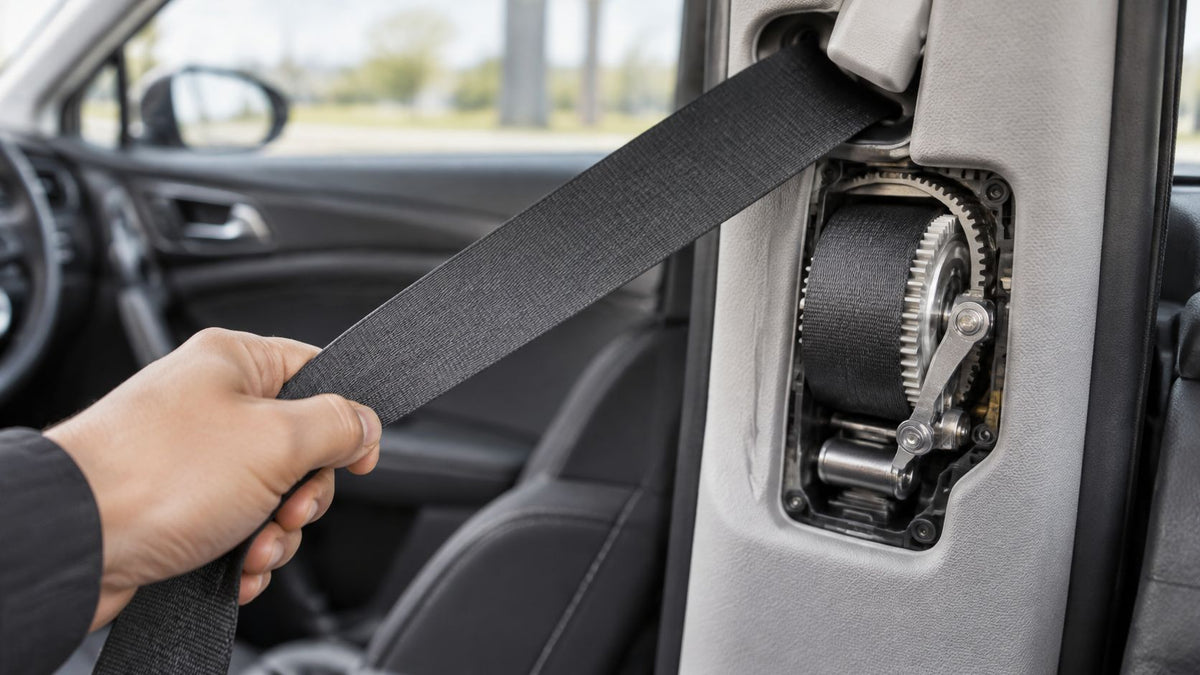
You're back in the driver's seat after a minor collision, the bumper looks fixable, and then you reach for the belt. It gives you an inch, clicks, and stops dead. You tug harder. Nothing moves.
That frozen feeling is why many drivers search for seat belt lock advice, and it's also where much of that advice goes wrong, because one symptom can point to several very different fixes.
Table of Contents
- The Moment the Belt Freezes
- How a Retractor Decides to Lock
- Three Very Different Reasons a Belt Locks
- What a Pretensioner Actually Does in a Crash
- Repair Versus Replacement and the OEM Question
- The Recall You Might Be Missing
- A Practical Triage Checklist Before You Pay for Anything
- Treating the Belt as a System, Not a Strap
The Moment the Belt Freezes
A driver I picture often in the shop leans across to the passenger side after a fender-bender, grabs the belt to move the car off the road, and finds it locked solid. The car still runs. The door still closes. The belt, the one part you need before you move at all, won't pull out and won't retract.
Your first instinct is usually to pull harder, feed it back slowly, or spray something into the pillar. Don't. A belt that won't move is giving you information, and forcing it can turn useful information into damage you can't undo.
Four conditions hiding behind one phrase
When owners say seat belt lock, they're usually describing one of four things. The belt locked for a split second in a hard stop and then released. It locked in a crash and stayed locked because a pretensioner fired. It's ratcheting tight after being pulled all the way out, which can be normal child seat mode. Or it's jammed, contaminated, twisted, or internally damaged, which is failure, not design.
Those four conditions feel similar from the driver's seat. They don't share a remedy. One needs no repair at all, one may be covered by a free recall, one needs a professional rebuild, and one may need replacement parts you've not even inspected yet.
A locked belt isn't a diagnosis. It's a symptom that needs sorting before anyone quotes you a price.
Locked belts are one of the most common post-collision complaints handled by mail-in restoration services, partly because the assembly often looks fine from outside. The housing isn't cracked, the webbing isn't torn, and the buckle still clicks, yet the spool inside has done its one-time job and won't reset itself.
You'll leave here with a way to sort your case in order. What happened right before it locked, whether the airbag light is on, whether a recall covers your VIN, and whether the webbing and anchors still form a safe load path. That sequence matters more than any single trick for freeing a stuck spool, because paying for the wrong fix can leave you with a belt that moves again but can't protect you in the next crash.
How a Retractor Decides to Lock
Think of the retractor as a spring-loaded spool with a toothed gear on its side. During normal driving the spring keeps light tension on the webbing, and the spool pays out belt smoothly as you lean, turn, or reach for the glove box. You're not fighting a lock. You're unwinding fabric from a reel that wants to wind it back.
Locking happens when a small metal piece called a pawl drops into those teeth. Two kinds of sensors can flip it. One reacts to the vehicle itself, sudden deceleration or tilt, often through a pendulum that swings under braking. The other reacts to the webbing spooling out too fast, the way it does when your body lunges forward.
Emergency locking versus automatic locking
An emergency-locking retractor, or ELR, allows free movement until it's triggered by rapid webbing withdrawal or vehicle deceleration, as described in NHTSA recall documentation on emergency and automatic locking retractors. Brake hard for a yellow light, feel the belt catch across your chest, then feel it release when you sit back. That's ELR doing exactly what it was built to do.
An automatic-locking retractor, or ALR, behaves differently on purpose. Pull the webbing all the way out and it switches modes, then ratchets as it retracts so it can cinch a child restraint tight and keep it tight. Feed the belt fully back in and it should return to normal ELR behavior.
- Normal ELR feel: Smooth pull at walking speed, firm catch on a sharp tug, then release.
- Normal ALR feel: Clicking ratchet on the way back after full extension, no payout until fully retracted.
- Not normal either way: Locked solid in one position, uneven retraction, or no catch on a controlled sharp tug.
These aren't loose guidelines. Under Federal Motor Vehicle Safety Standard No. 209 as explained in an NHTSA interpretation, an emergency-locking retractor must lock before webbing extends more than 1 inch at 0.7g acceleration, and it's limited from locking too early at low acceleration. That narrow window is the difference between a belt that protects you and one that either strangles you on every slope or pays out too much fabric when it matters.
Three Very Different Reasons a Belt Locks
Start by placing the belt in front of you into one of three buckets. The visual below gives you the quick version before you test anything.
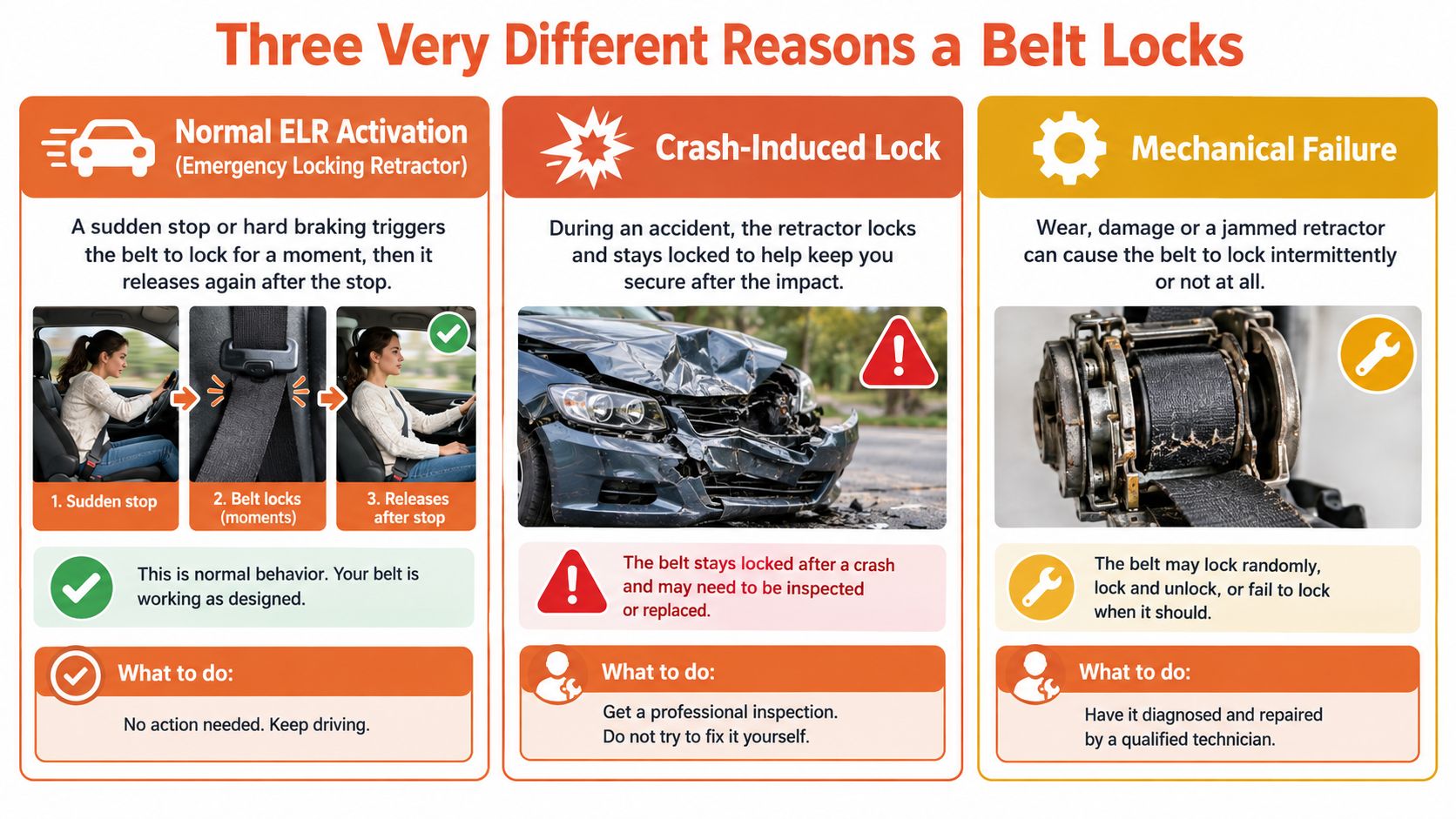
Normal ELR activation is temporary. You braked hard, leaned forward fast, parked on a steep tilt, or yanked the belt while buckling. Once the car settles and you ease tension off the webbing, the pawl disengages and the spool moves again. No crash, no warning light, no lasting change.
Pretensioner deployment is permanent until it's professionally rebuilt or replaced. In a qualifying collision, the pretensioner fires and pulls slack out instantly, and the mechanism stays spent afterward. The belt may be locked retracted, locked extended, tight, jammed, or paired with an illuminated SRS or airbag light. That combination, crash plus persistent lock, is the clearest signal you've got.
Retractor failure imitates deployment without a crash behind it. Twisted webbing folds over itself on the spool, dirt or spilled liquid gums up the mechanism, guides misalign the fabric, or internal parts wear and catch intermittently. It may lock on gentle pulls, retract slowly, or fail to catch when it should.
Comparing the Three Lock Conditions
| Signal | Normal ELR Lock | Pretensioner Deployment | Retractor Failure |
|---|---|---|---|
| Releases on its own | Yes, after tension eases | No, stays locked | Sometimes, unpredictably |
| Crash just before | No | Usually yes | No clear event |
| Airbag or SRS light | Off | Often on | Usually off |
| Retraction | Smooth afterward | None or severely limited | Slow, uneven, or gritty |
Fleet and truck operators build this kind of symptom sorting into routine checks, much like the broader habits covered in safety measures for Washington truckers, because catching a restraint fault before dispatch is cheaper than explaining it after an incident. Private owners can borrow the same discipline with one question.
Watch how a healthy retractor responds to slow and fast pulls before you judge your own belt against it.
The sorting question: Did the locking begin immediately after a collision, or did it creep in gradually with no event at all?
That answer won't finish the diagnosis, but it points you toward deployment, failure, or normal behavior, and it stops you from treating every frozen spool as the same repair.
What a Pretensioner Actually Does in a Crash
A pretensioner exists to remove slack you don't notice while you're driving. Your coat, your posture, and the small gap between your chest and the belt all add loose webbing. In a crash, your body travels through that gap before the belt can start slowing you down, and the pretensioner closes it.
The firing sequence
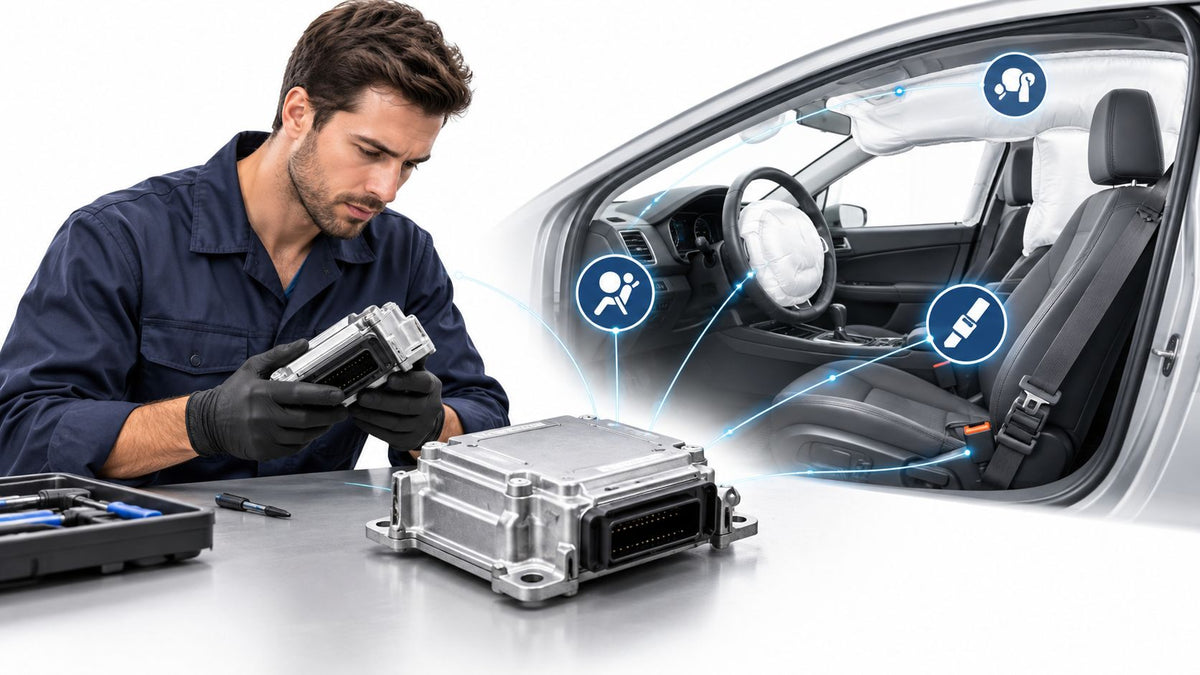
Crash sensors and the airbag control module judge whether an impact qualifies. If it does, the module signals the pretensioner in the retractor or buckle assembly. A small pyrotechnic charge or spring mechanism drives the spool or pulls the anchor, reeling slack in almost instantly so the belt holds you against the seat early in the event, a process laid out step by step in this detailed explanation of how a seat belt pretensioner works and why it needs repair.
After firing, the device is spent. The gas-generating cartridge has done its work, internal parts have moved to their deployed position, and the retractor won't pay out or retract normally again. That's not a setting you can toggle back. It's a one-time mechanical event.
Why the warning light stays on
The module records the deployment and sets an SRS fault, so the airbag light stays illuminated to tell you the restraint system isn't ready for another crash. Connectors and circuits in the belt assembly also tell the module whether the pretensioner is present and intact. A fired unit fails that check every time you start the car.
Owners get misled here. Someone clears codes with a scan tool, the light goes off for a while, and the belt may even move a little, so the car feels fixed. It isn't.
Clearing an SRS code removes a message. It doesn't replace a spent cartridge, reset a deployed mechanism, or prove the belt can fire again.
Treat the light as a symptom pointing at hardware. If the pretensioner fired, the hardware has to be rebuilt or replaced and then functionally tested, and stored crash data in the module has to be dealt with as its own job. One without the other leaves the system half restored, which is a dangerous place for a safety device to sit.
Repair Versus Replacement and the OEM Question
Dealerships usually quote a complete new belt assembly after a crash. That approach works, but it assumes every part of your original assembly is scrap. In many collisions it isn't. The housing survives, the mounting points stay secure, the webbing is undamaged, and only the internal pretensioner mechanism has fired.
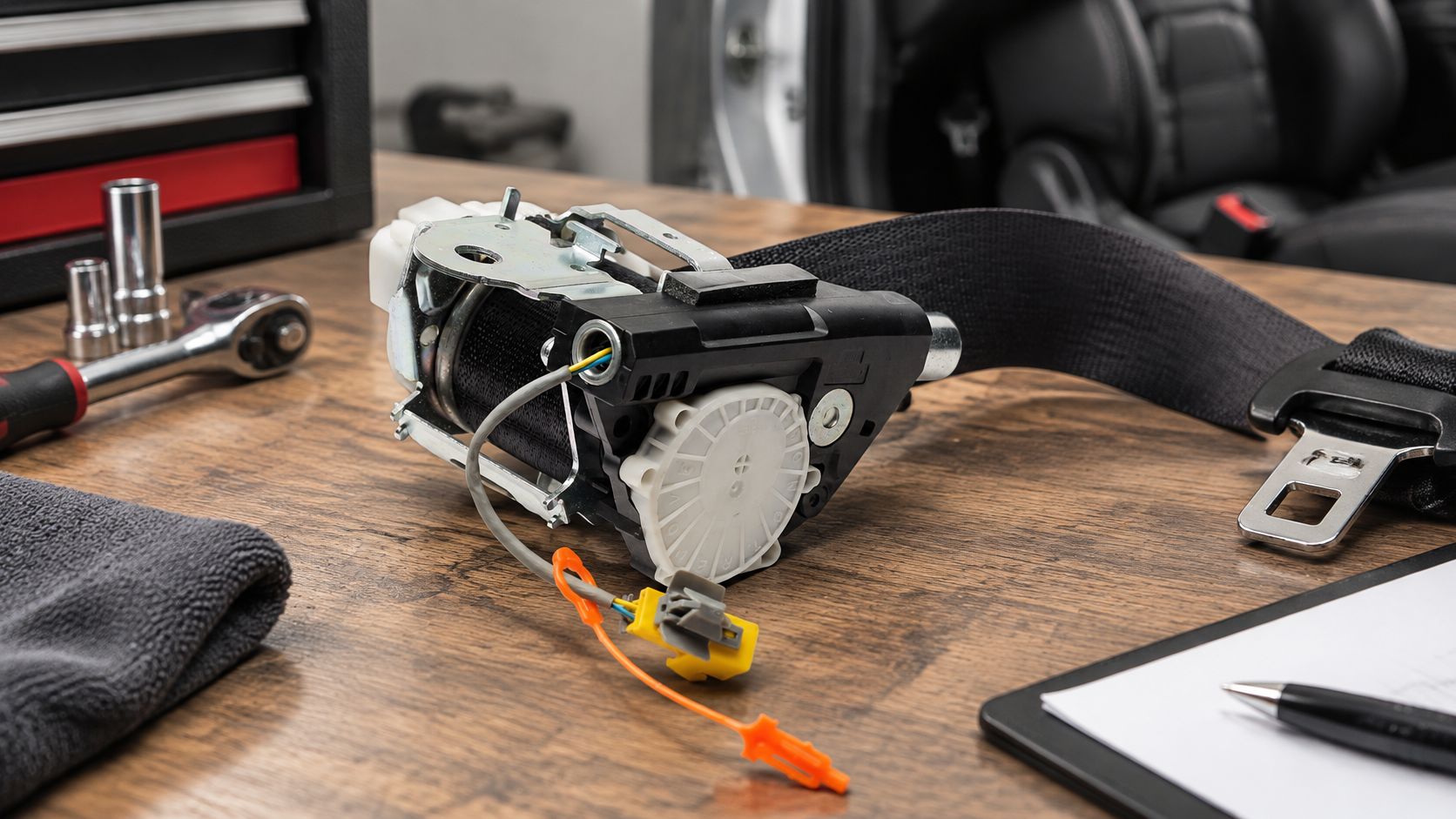
A rebuild targets the part that deployed. A technician opens your original retractor, replaces the spent gas cartridge or pyrotechnic unit with a new OEM component, resets the locking mechanism, and functionally tests extension, retraction, and locking before returning it. You keep your factory housing, trim fit, and labels, which is exactly the approach described for the Locked Seatbelt Repair Service – Fix Stuck Seat Belt After Accident, covering single, dual, and triple stage pretensioners across seating positions.
The image below shows the kind of locked post-accident unit that service is built around.
Where repair stops being enough
Rebuilding a pretensioner doesn't rescue compromised webbing. Under the FMVSS 209 text covering webbing breaking strength, minimum strengths reach 26,689 N for Type 1 assemblies and 17,793 N for the upper torso portion of Type 2 assemblies. Frayed, cut, heat damaged, or chewed fabric can't be trusted to carry those loads, and sewing a patch over damage doesn't restore certified weave, stitching geometry, or edge finishing.
That's also why used salvage belts deserve skepticism, a comparison explored in this breakdown of new, used, and repaired seat belt assemblies. A used unit may look clean while carrying an unknown deployment, recall, or contamination history you can't see.
While you're sorting repair paperwork, it's worth confirming how your coverage treats post-collision safety work, which the Forever Florida Insurance guide explains for Florida drivers in plain policy terms. Keep the decision simple. Repair fits a fired pretensioner with intact housing and webbing. Replace webbing fits damaged fabric on a sound mechanism. Replace the assembly fits structural, anchor, or widespread damage that a rebuild can't address.
The Recall You Might Be Missing
Some locked belts aren't wear, and they aren't crash deployment. They're a manufacturing defect the automaker is required to fix, and paying a shop to rebuild one before you check can mean paying for a remedy you were owed for free.
Ford recalled 419,967 U.S. Expedition and Lincoln Navigator vehicles from model years 2018–2022 because a pretensioner could inadvertently lock the belt and prevent it from retracting or extending, according to the NHTSA report for the Ford pretensioner recall. Read that symptom again. Locked, won't extend, won't retract. From the driver's seat, it looks identical to collision deployment, except there was no collision.
Prior recall work may not close the case
That Ford action superseded earlier recalls 24V099 and 25V197, which means an owner who already visited a dealer for an earlier inspection could still need the new remedy. A stamp in your service history doesn't guarantee the current campaign is satisfied. Only a fresh VIN check against open recalls tells you where your specific vehicle stands.
Audi shows the other side of the problem, a belt that looks and feels normal. The company recalled 7,425 vehicles from the 2025 Q5, Q5 Sportback, SQ5, and SQ5 Sportback lines because incorrectly manufactured front seat belts might fail to restrain occupants properly, as detailed in the NHTSA documentation for the Audi Q5 seat belt recall. No frozen spool warns you there. The defect lives in manufacturing history, not in daily feel.
- Run your VIN first: Check for open seat belt, pretensioner, and anchor campaigns before authorizing paid work.
- Ask what supersedes what: Confirm whether earlier dealer work satisfies the newest recall on your vehicle.
- Match remedy to cause: Recall defects go to the dealer, crash deployments on non-recall vehicles can go to repair, and unexplained faults need diagnosis before either.
An inadvertently deployed pretensioner and a crash deployed one can present the same locked belt. The difference is who pays and which parts get replaced, and you can't learn that by tugging the webbing. You learn it from the VIN.
A Practical Triage Checklist Before You Pay for Anything
Work through these steps in order, parked, with the engine off for the hands-on checks. Write down what you find, because the shop you call will ask exactly these questions.
Use the visual sequence here as your pocket version while you inspect the car.
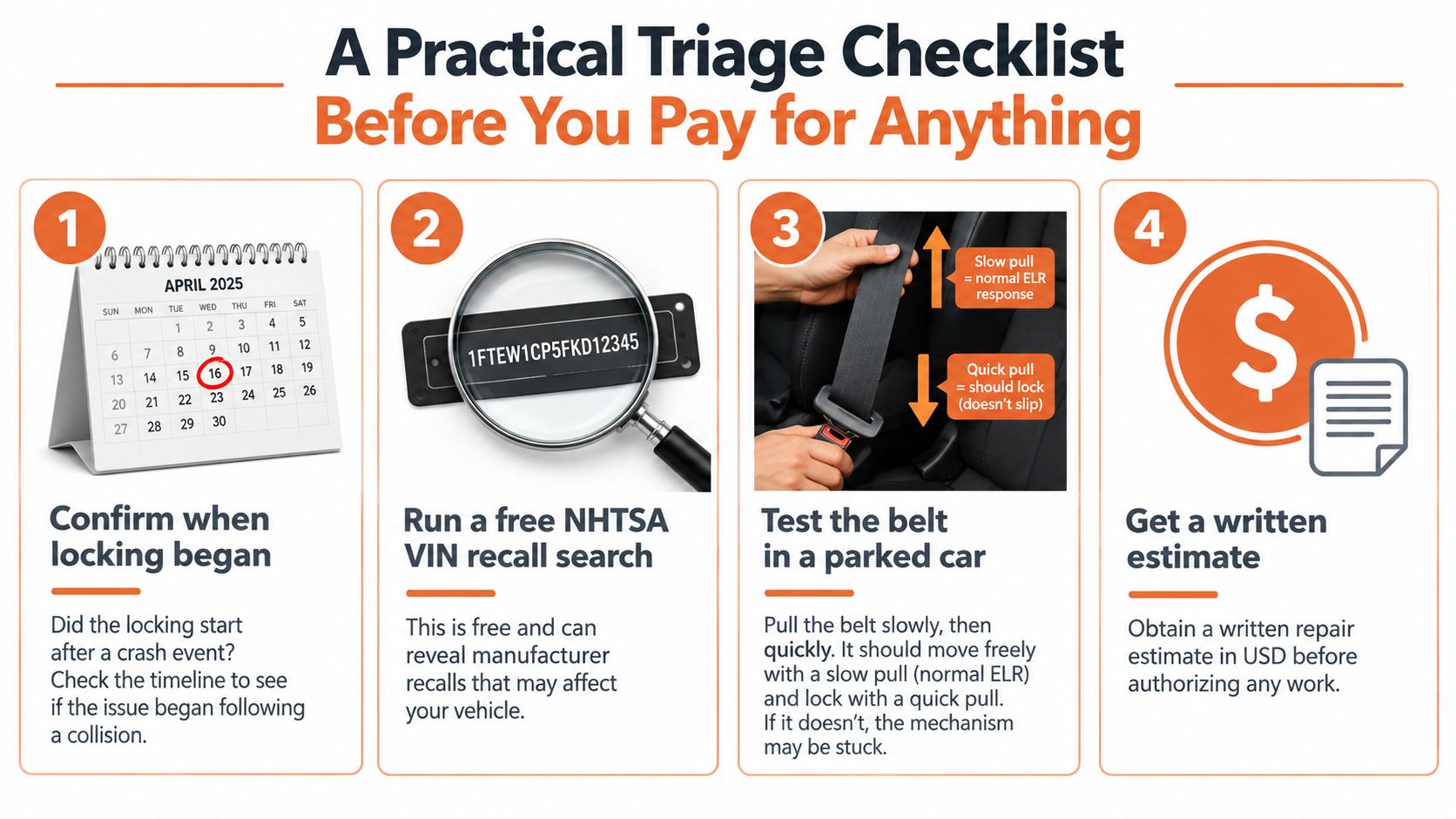
- Pin down the start: Did locking begin right after a crash, after installing a child seat, or gradually over weeks? Sudden post-crash locking points to deployment, full extension followed by ratcheting points to ALR mode, and gradual decline points to failure or contamination.
- Run the VIN recall search: Note every open restraint campaign and whether earlier recall work might've been superseded. This step is free and it comes before shipping anything anywhere.
- Log the symptom signature: Locked fully retracted, locked fully extended, slow to retract, twisting on the spool, or free moving but never catching. Add whether the airbag or SRS light is on, since that changes the job from belt only to belt plus module diagnosis.
- Inspect the webbing and hardware: Pull available webbing into daylight and look for cuts, fraying, heat glazing, pet chewing, and stiff contaminated sections. Check that the belt routes correctly through its guides, the buckle clicks and releases cleanly, and labels are present and legible.
- Choose the route that matches: Recall or unexplained failure on a newer vehicle goes to dealer diagnosis. A fired pretensioner with intact housing and webbing suits a mail-in rebuild. Sound mechanism with damaged fabric suits webbing replacement.
Never lubricate a retractor, pry its housing open, or force a deployed spool to turn. Those moves don't restore a pretensioner, and they can destroy parts a rebuilder could've saved.
If the belt stays immobilized, retracts unevenly, or won't lock on a controlled tug, stop testing and get professional inspection. You've collected enough evidence to have a useful conversation, and further pulling only adds wear.
Treating the Belt as a System, Not a Strap
A seat belt isn't one part. It's a load path that runs from the anchor bolt, through the webbing and its stitching, around the retractor spool, into the pretensioner, across the buckle, and out through wiring to the airbag control module. A fault anywhere in that chain can leave the whole chain unable to do its job, even when the fabric across your chest looks perfect.
That systems view is why proper functional testing requirements for repaired restraint components cover smooth extension and retraction, reliable emergency locking, buckle engagement, correct routing, and SRS fault status together, not as separate checkboxes. Passing one test while skipping the rest proves very little.
The stakes justify the thoroughness. The World Health Organization guidance on safety restraints reports seat belts can reduce deaths among vehicle occupants by up to 50 percent, with 45–50 percent lower fatal injury risk for front-seat occupants and roughly 25 percent for rear-seat occupants. A locked, deployed, or defective belt can't deliver that protection.
Carry three rules out of the shop with you. Stop driving on a locked belt with the SRS light on. Check the VIN before paying anyone. Treat belt and module as one job after a crash. Owners avoid the wrong fix that way, body shops protect their liability, and salvage rebuilders stop mistaking intact looking belts for serviceable ones.
If your triage points to a deployed pretensioner rather than a recall, the team at Seat Belt Repair can rebuild your original locked belt with OEM components, replace damaged webbing, and reset your SRS module through one nationwide mail-in process. Send the assembly in, get it functionally tested and returned ready to reinstall, and fix that seat belt lock the way the whole system requires.

Laisser un commentaire
Ce site est protégé par hCaptcha, et la Politique de confidentialité et les Conditions de service de hCaptcha s’appliquent.