
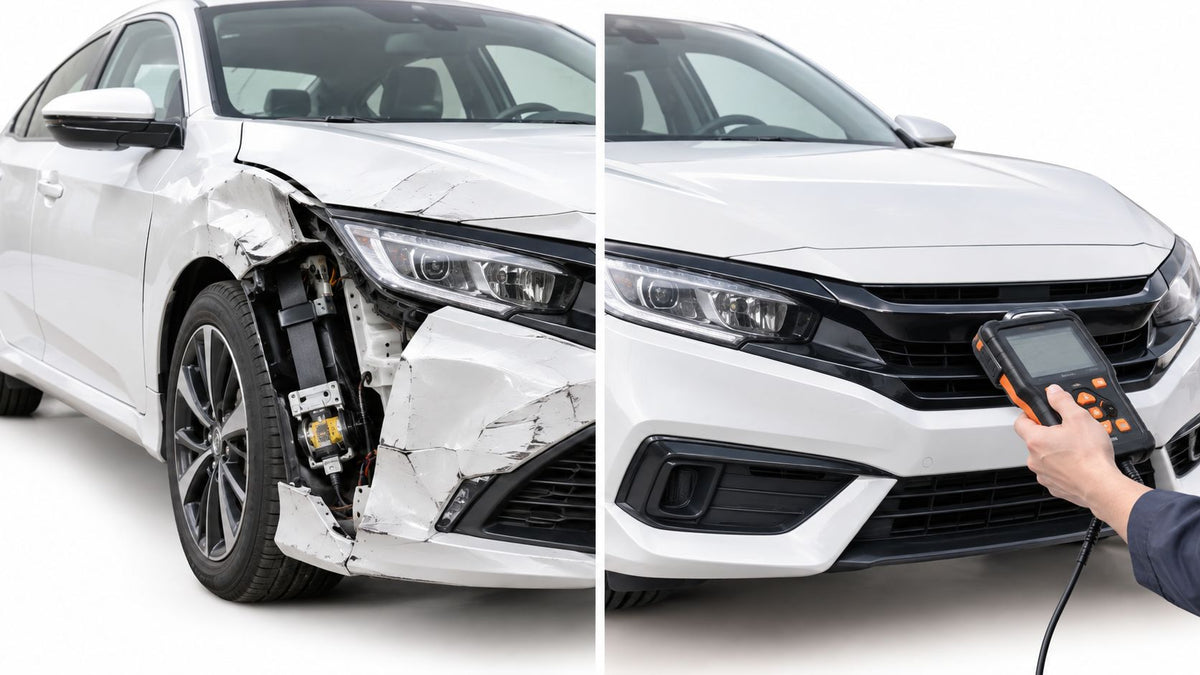
A crumpled bumper can make a crash look simple. Then the airbag light stays on, the driver's belt won't retract, and the insurance adjuster asks whether the vehicle is repairable. The visible damage may fit in one corner of the car, but the safety systems can record the event across the cabin.
The important decision isn't only whether a panel can be straightened or a bumper cover replaced. It's whether the vehicle should be repaired, restored with replacement components, or declared a total loss, and whether the final repair addresses the restraint system as carefully as the paint and bodywork. Modern collision damage repair requires a conversation between the driver, insurer, body shop, diagnostic technician, and sometimes a specialist handling seat belts or the SRS module.
Table of Contents
- The Post-Collision Reality Most Drivers Underestimate
- Understanding the Four Levels of Collision Damage
- What Actually Drives the Cost of Collision Damage Repair
- How the SRS and Seat Belt System Works as One Safety Net
- Why Component Repair Often Beats Full Replacement
- Navigating Insurance, Shop Choice, and the Repair-or-Total Decision
- A Practical Checklist for Drivers, Shops, and Rebuilders
The Post-Collision Reality Most Drivers Underestimate
A driver may leave a parking-lot impact with a damaged front corner, a deployed steering-wheel airbag, and a child seat still buckled into the rear seat. The other driver is calling insurance, the police report is pending, and someone is already saying, “It's probably just cosmetic.”
That conclusion is risky. A collision can trigger a seat belt pretensioner even when the belt webbing looks intact. The SRS control unit can store crash data, and the vehicle may need a diagnostic scan, module service, sensor inspection, or calibration before anyone can call it safe. A bumper cover hides reinforcement, brackets, wiring, radar equipment, and impact sensors. A dashboard hides additional restraints and electrical connections.

The first decision is not always “how much is the bumper”
The question is whether the repair makes technical and economic sense after teardown. A vehicle that appears repairable from the outside may need structural work, suspension measurement, electronic diagnosis, restraint replacement, and ADAS calibration. Conversely, a vehicle with serious-looking cosmetic damage may have a sound structure and a manageable repair path.
Repairable claim volume declined 9.7% in 2025, while the preliminary average total repair cost reached $4,818. Total losses reached 22.8% through October 2025, according to CCC's 2026 Crash Course report. Those figures describe a market where the repair-versus-total decision is becoming more consequential, not a simple relationship between dent size and repair price.
What the shop needs before making a promise
A responsible initial inspection should establish:
- What deployed: Airbags, pretensioners, side curtains, and other restraint components need identification.
- What locked or recorded data: The SRS module and other control units may require a scan before parts are ordered.
- What moved underneath: Rails, cradles, suspension points, and mounting locations need measurement where impact forces traveled.
- What the vehicle needs after assembly: ADAS sensors, cameras, steering-angle systems, and wheel alignment may require calibration.
- What the estimate excludes: Initial visual estimates often change after disassembly reveals hidden damage.
Practical rule: Don't approve a cosmetic repair until the shop has explained the diagnostic, restraint, structural, and calibration work that follows reassembly.
The technician's report should give the driver a path from the first insurance call to a safe delivery decision. If it only lists paint and replacement panels, it probably isn't the complete collision damage repair plan.
Understanding the Four Levels of Collision Damage
A useful shop-floor analogy is to treat the vehicle like a building. Paint and trim are the finish. The frame and mounting points are the structure. Mechanical components keep the building's systems moving, while the restraint system protects the occupants when everything else fails.
Cosmetic damage
This includes scratches, dents, cracked bumper covers, broken lamps, and damaged trim. Paintless dent repair may work when the paint and panel shape allow it. A conventional repair may be needed when the finish is broken, the metal is stretched, or a plastic component has lost its shape.
Cosmetic damage is the easiest level to see, but it isn't proof that the impact stopped there. A front bumper can look like a replaceable shell while hiding sensors, absorbers, brackets, wiring, and reinforcement. The estimate should distinguish between a damaged cover and the systems mounted behind it.
Structural damage
Structural diagnosis addresses rails, pillars, floor sections, aprons, cradles, and other load-bearing areas. A technician must measure the vehicle in three dimensions, identify the direction and points of impact, and account for direct, indirect, and inertia damage before choosing a repair method. The collision structural repair training guidance explains why dimensional diagnosis and documented repair sequencing matter.
A shop shouldn't pull or section a structure based only on a visual impression. Manufacturer procedures determine whether a part can be straightened, replaced, or joined at a specific factory seam. Ford's published guidance, included in that material, emphasizes original equipment parts and manufacturer procedures when restoring the vehicle's original integrity and design.
Mechanical damage
Suspension arms, knuckles, wheels, tires, steering components, cooling systems, and driveline parts can absorb impact energy even when the body panels appear repairable. A wheel that looks straight may sit on a bent hub or shifted suspension point. A vehicle that drives onto a tow truck may still have alignment or steering damage that makes road testing unsafe.
Mechanical checks should include visual inspection, measurement, alignment data, and a controlled road test where appropriate. Do not treat the absence of a warning light as proof that the mechanical system is undamaged.
Restraint-system damage
The SRS level includes airbags, seat belt pretensioners, retractors, buckles, sensors, wiring, and the SRS control module. A belt can look normal while its pretensioner has fired or its retractor has locked. The module can retain crash data after deployment and prevent the system from arming correctly until the underlying faults are corrected.
A driver can ask four direct questions:
- Which restraint components deployed or locked?
- Which parts require replacement, repair, or inspection?
- Has the SRS module been scanned and tested?
- What post-repair scan confirms that the system is ready?
The damage level, not the bumper's appearance, should drive the estimate.
What Actually Drives the Cost of Collision Damage Repair
The cost rises because modern collision work involves more than removing a damaged panel. A shop may need to identify parts, tear down the vehicle, measure structure, inspect wiring, scan modules, replace restraint components, and calibrate safety sensors before it can complete the repair.
CCC reported a preliminary average total repair cost of $4,818 for 2025, up 1.7% from 2024. The same report found that direct repair estimates containing at least one calibration reached 35.6% in the third quarter of 2025, compared with 26.9% a year earlier. These figures explain why an apparently small impact can produce a much larger estimate once the hidden systems are included. See the collision repair parts guide when reviewing the difference between part categories and their effect on the repair plan.
The broader market is also substantial. The global automotive collision repair market was valued at roughly $184.0 billion in 2022 and is forecast to reach about $228.23 billion by 2034. In North America, it was estimated at $49.20 billion in 2025 and projected to rise to $65.64 billion by 2031, according to the automotive collision repair market analysis.
The five lines that deserve attention
| Cost Driver | What It Covers | Why It Inflates the Bill |
|---|---|---|
| Parts | Original equipment, aftermarket, recycled, or alternative components | Sensors, brackets, lamps, reinforcements, and trim can sit behind one damaged exterior panel |
| Labor | Teardown, measurement, repair, assembly, paint, and final inspection | Technicians often need to disassemble surrounding areas before hidden damage becomes clear |
| Calibration | Cameras, radar, parking sensors, steering-angle systems, and related functions | The vehicle may need specific setup conditions and post-repair verification |
| Diagnostics and programming | Pre-repair scans, post-repair scans, module communication, and programming | Warning lights can represent stored faults that visual inspection can't identify |
| Restraint components | Airbags, pretensioners, webbing, buckles, sensors, wiring, and SRS modules | The system must be restored as a connected safety network, not as isolated parts |
Read the estimate as a sequence
A low parts figure doesn't necessarily mean a better repair. An inexpensive bumper may require additional brackets, sensor mounts, or procedures that aren't visible on the first page. An OEM part may cost more but provide a known fit, mounting arrangement, and compatibility with the manufacturer's repair process.
A complete estimate should separate parts, labor, diagnostics, calibration, and restraint work. It should also identify supplements that may appear after teardown. If the crash affects resale value, a driver may also need separate information about diminished value claims, such as this Oregon diminished value recovery resource from Bell Law. That issue is distinct from the physical repair estimate, but it can matter after a collision.
How the SRS and Seat Belt System Works as One Safety Net
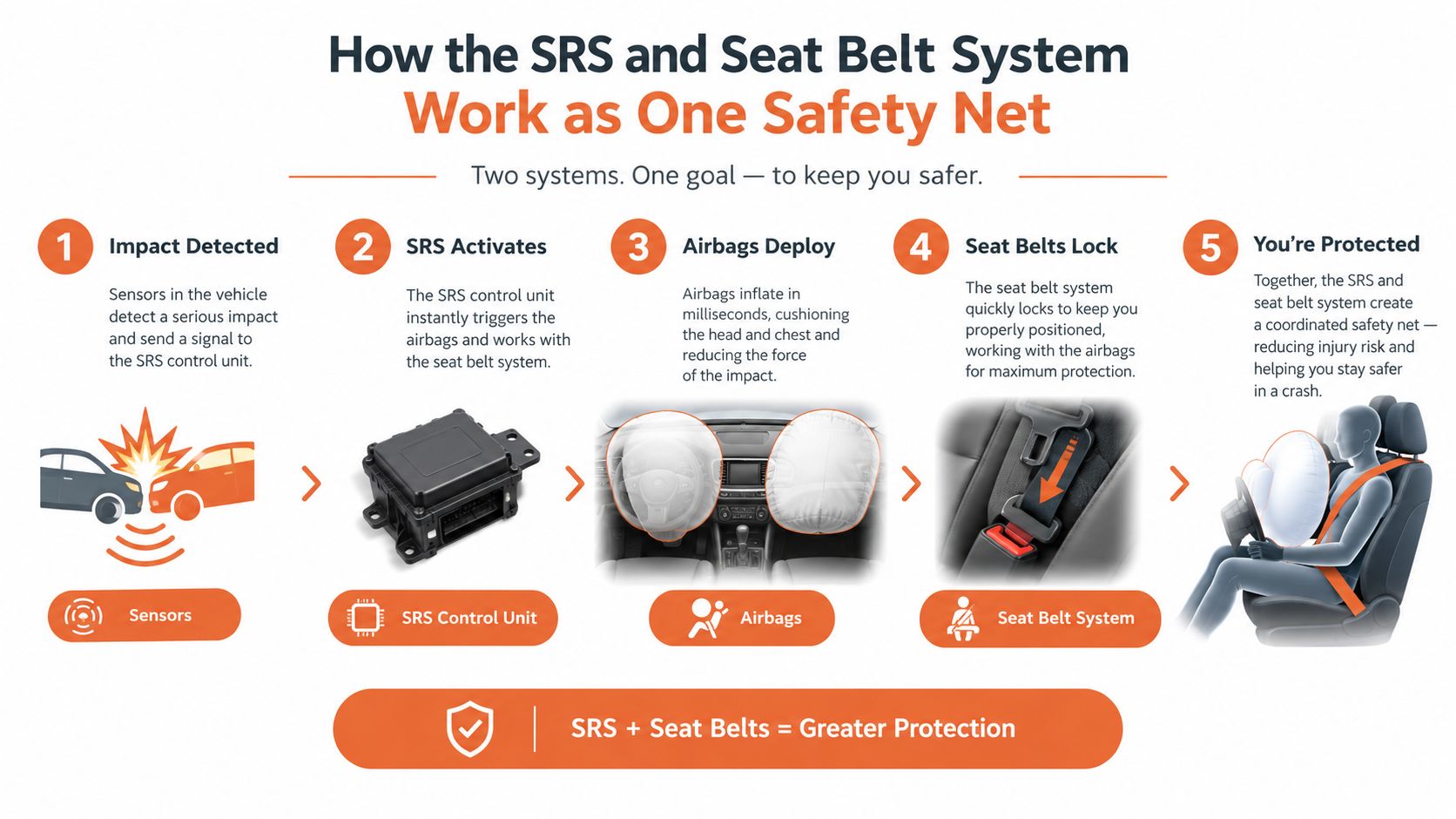
The restraint system isn't a collection of unrelated replacement parts. The SRS control module receives information from crash sensors, evaluates the event, and commands the appropriate restraints. Pretensioners remove slack from the belt so the occupant moves less before the airbag can provide protection. Airbags, belt load limiters, retractors, buckles, wiring, and sensors must work in the sequence the vehicle manufacturer designed.
The deployment sequence
A simplified sequence looks like this:
- Sensors detect the crash event. Impact information reaches the SRS control module.
- The module determines which restraints to command. The response depends on the crash conditions and vehicle design.
- Pretensioners tighten the belts. The mechanism removes slack and can lock the retractor.
- Airbags deploy according to the system strategy. Occupant position and other vehicle inputs can affect deployment behavior.
- The module records the event and reports faults. The system may remain locked or illuminate the airbag warning light until the repair is complete.
The belt webbing still matters after the pretensioner has fired. A technician should look for cuts, fraying, heat damage, contamination, altered stitching, abnormal retraction, and evidence that the occupant load affected the belt. The buckle and connector also need inspection because a belt that clicks into place isn't automatically a belt that will perform correctly in a crash.
Why resetting the module isn't a complete repair
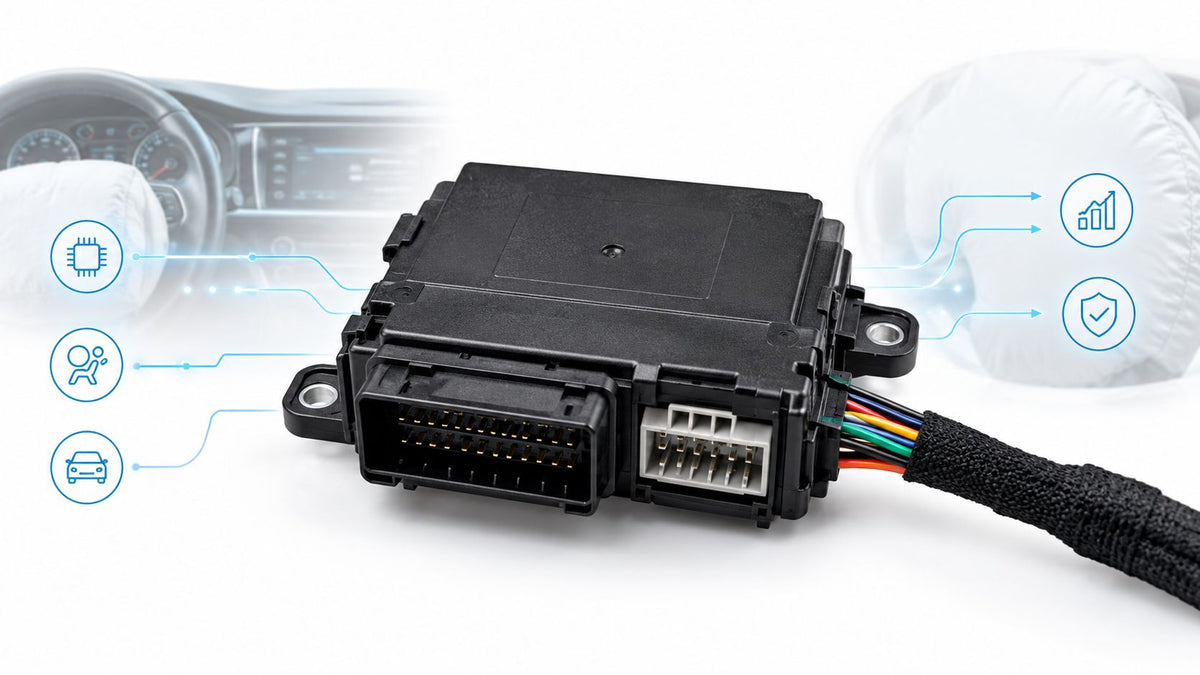
An SRS control unit commonly stores crash-event data in non-volatile memory after deployment. That stored record can keep the module from arming new restraints until it is professionally reset, but clearing the record doesn't repair physical damage. The airbag module and crash-data reset guide distinguishes the reset operation from replacing deployed airbags, fired pretensioners, damaged sensors, wiring, or cracked modules.
A shop that only turns off the warning light has not necessarily restored the system. The hardware faults must be corrected first. Then the module can be reset or replaced as appropriate, followed by a scan and self-test that confirm the system has no unresolved faults.
Industry reporting also shows how frequently diagnostics now appear in collision workflows. CCC found scans on nearly 88% of direct repair program estimates, while calibrations appeared on more than 35% of those estimates in the cited 2025 reporting. The 2025 collision repair complexity analysis describes a front end that is increasingly digital and standardized, even as the repair work behind the estimate becomes more technically involved.
A clear airbag light is an electronic result. It isn't, by itself, proof that every restraint component is safe.
Why Component Repair Often Beats Full Replacement
Full replacement is sometimes the right answer. A cracked SRS module, damaged belt frame, compromised wiring connector, or restraint component outside its approved service path may need replacement. But defaulting to a complete assembly every time can waste a serviceable structure and make a repair uneconomical.
Component-level work can be appropriate when the part is inspected, restored with suitable components, and functionally tested. Examples include replacing damaged seat belt webbing when the retractor and frame remain suitable, restoring a locked pretensioner with the correct mechanism, or processing an SRS module after all deployment-related hardware faults have been resolved.
The decision depends on evidence
A credible repair process should answer practical questions:
- Was the part identified correctly? The make, model, year, connector configuration, and part number must match the vehicle.
- Was the physical component inspected? A belt with damaged structure shouldn't be treated as a webbing-only job.
- Were electrical values verified? Resistance and communication checks can reveal open circuits, shorts, or incorrect components.
- Was the repaired part functionally tested? The technician should document what was tested before shipment or installation.
- Was the installed system scanned afterward? The vehicle needs a final diagnostic check, not just a bench-service receipt.
A repaired component doesn't become acceptable merely because it costs less. The shop must show what it did and why the part remains suitable for service. That documentation also gives an insurer or adjuster a reason to evaluate the repair on technical evidence instead of assuming that every restraint assembly must be discarded.
Comparing the paths without fake averages
There isn't one valid average price for a belt or SRS module across every vehicle. Vehicle design, stage configuration, damage type, part availability, and the approved repair method all change the calculation.
| Component | Full Replacement (Avg) | Component Repair (Avg) | Savings | Safety Standard Met |
|---|---|---|---|---|
| Seat belt pretensioner | Varies by vehicle and assembly | Varies by damage and approved service | Must be calculated from the itemized estimate | Requires suitable parts, correct testing, and installation |
| Seat belt webbing and retractor | Varies by vehicle and damage | Varies by whether the retractor and frame remain serviceable | Must be calculated from the itemized estimate | Requires correct webbing, stitching, inspection, and function testing |
| SRS control module | Varies by module and vehicle | Varies by module condition and service path | Must be calculated from the itemized estimate | Requires compatible processing and a fault-free vehicle scan |
The practical comparison is not “cheap repair versus expensive replacement.” It's documented restoration versus undocumented substitution. A specialist service such as post-crash airbag system repair guidance can help a shop separate components that need replacement from those that may be safely serviced.
A driver or rebuilder should reject any provider that promises a reset without asking what deployed, what failed, and what will be tested after installation.
Navigating Insurance, Shop Choice, and the Repair-or-Total Decision
The claim begins at the scene, but the repair-or-total decision is usually shaped by information gathered afterward. Clear documentation gives the insurer and the shop a better starting point. It also prevents the visible damage from becoming the only evidence used to value the repair.
Build a record before the vehicle moves
Take wide and close photos of the vehicles, roadway, debris, warning lights, deployed airbags, locked belts, and damaged components. Record a timestamped walkaround if conditions permit. Keep the police report, tow information, claim number, estimate revisions, and messages with the insurer in one file.
Don't remove or discard a deployed restraint component before the shop has documented it. If a child seat was occupied during the crash, tell the insurer and technician. The seat itself may need separate evaluation, and the fact that it was installed can help the shop understand the occupant and restraint context.
Let teardown answer the hidden-damage questions
The insurer's first estimate may be based on photographs or a quick inspection. A repair shop can identify supplements after removing the bumper, trim, lamps, and damaged panels. Ask for the estimate to separate:
- Structural measurement and repair
- Mechanical inspection and alignment
- Parts categories and sourcing
- SRS and seat belt work
- Scans, programming, and calibration
- Paint, materials, assembly, and final testing
The insurer may decide that the projected repair cost is too close to the vehicle's actual cash value, or that parts and labor make the repair impractical. The exact threshold and process depend on the jurisdiction, policy, vehicle value, and insurer. A shop can support the repair path with a documented teardown, accurate comparable-part pricing, structural measurements, and a complete restraint-system estimate, but it can't guarantee that the insurer will authorize it.
For a broader explanation of claim documentation and vehicle value considerations, drivers can review this guide on how to maximize your insurance claim in 2026 from Shea Culgin Law.
Choose the shop for capability, not appearance
An OEM-certified facility may have access to manufacturer procedures, parts information, and brand-specific calibration requirements. An independent collision center may offer strong diagnostic capability and flexible component sourcing. A DRP shop may coordinate efficiently with an insurer, but the driver should still ask who performs the SRS work and how the final scan is documented.
Questions that expose capability quickly include:
- Who diagnoses the SRS fault?
- Does the shop inspect or service pretensioners and webbing, or only replace complete assemblies?
- Which scan tool records the pre-repair and post-repair status?
- Who performs ADAS calibration, and what conditions are required?
- Will the shop provide photos, measurements, and final reports?
A total-loss decision can be financially sensible when the repair leaves too little value margin or the vehicle has extensive structural and restraint damage. It can also be premature when the estimate omits hidden damage in one direction or approved component-level options in the other. The driver's strongest advantage is a complete, technically defensible file.
A Practical Checklist for Drivers, Shops, and Rebuilders
A good collision decision becomes easier when every party asks the same basic questions. The checklist below is designed for the estimate, not for a vague conversation at the counter.
For drivers
- Document the event: Save scene photos, the police report, claim details, and a video of the vehicle before teardown.
- Ask about restraints: Confirm whether airbags deployed, pretensioners fired, belts locked, or webbing was damaged.
- Request itemization: Make sure parts, labor, scans, programming, calibration, and restraint work appear separately.
- Ask for both scan reports: A pre-repair scan identifies stored faults, while a post-repair scan shows whether the system is ready.
- Verify training: Ask whether the technician has relevant I-CAR or manufacturer-specific training for the vehicle.
- Clarify the decision path: Find out what additional damage would change the repair estimate or trigger a total-loss review.
A used vehicle with prior collision history also deserves a careful safety inspection. This used-car safety inspection guide can help drivers and rebuilders organize questions before purchase or delivery.
For shop owners
Write the restraint workflow down. Identify the belt stage and connector configuration, photograph removed components, record part numbers, and distinguish parts that need replacement from those eligible for approved service. Keep OEM-compatible webbing and documented pretensioner procedures available where permitted, and use a bench-level process for module work rather than treating a warning-light reset as the whole repair.
Record torque specifications, torque-to-yield fasteners, sensor locations, wiring repairs, calibration results, and pre- and post-repair scan reports. A complete file helps the customer, supports insurer review, and protects the shop when another technician or inspector needs to understand the repair.
For rebuilders
- Verify part numbers: Don't install a module or belt merely because the connector appears similar.
- Inspect the entire assembly: Check webbing, labels, retraction, frame condition, buckle function, wiring, and pretensioner status.
- Retain records: Keep invoices, test results, calibration records, and installation photos with the vehicle file.
- Check replacement history: A salvage part may carry crash data or damage that isn't visible from the casing.
- Stop for unresolved faults: An airbag warning light, incorrect resistance value, or failed communication check needs diagnosis before delivery.
Red flags are consistent. A shop that declines to scan, quotes only complete replacement without explaining alternatives, cannot identify the pretensioner stage, or won't provide a post-repair report hasn't given you enough evidence to approve the work.
Seat Belt Repair handles mail-in service for locked or deployed pretensioners, damaged webbing, and SRS airbag modules, with functional testing before repaired components are returned. If your collision estimate includes restraint work, visit Seat Belt Repair to review the service process and determine which parts your shop can send for evaluation.

Leave a comment
This site is protected by hCaptcha and the hCaptcha Privacy Policy and Terms of Service apply.