
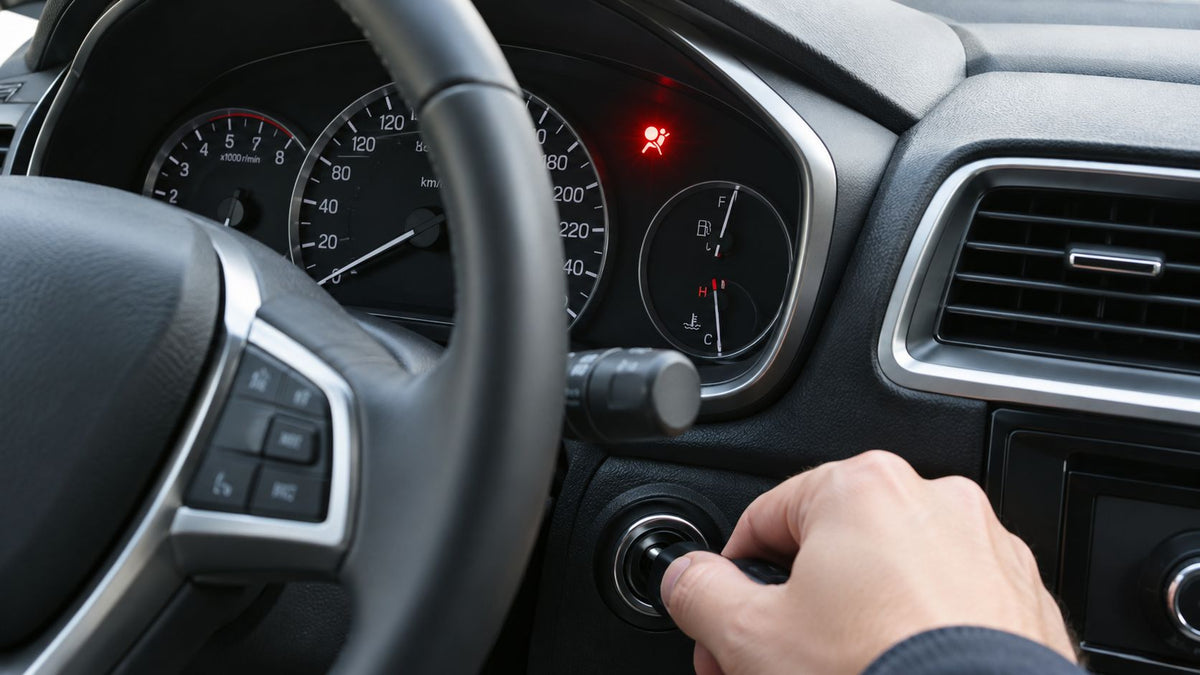
A flashing airbag light usually means the SRS has detected a fault, so the airbags or seat belt pretensioners may not work as designed in a crash, and the car needs an SRS scan before normal use. A normal startup light generally goes out after roughly 6 to 8 seconds, but the exact sequence depends on the vehicle.
You're sitting in the driveway, the engine sounds normal, and the airbag symbol keeps blinking. Before trying a reset sequence, record what the light does. Its timing can help a technician choose the right diagnostic procedure, but it can't identify the failed part by itself.
Table of Contents
- What a Flashing Airbag Light Is Telling You
- Reading the Flash Pattern Before You Act
- Real Safety Risk of Driving With the Light On
- Common Causes After a Collision and Without One
- Diagnose the Fault and Confirm the Repair
- Repair Paths for Clearing, Repairing, Resetting or Replacing
What a Flashing Airbag Light Is Telling You
You turn the key on a cold morning. The dashboard lights come on, then most go out while the airbag icon keeps blinking. The engine may sound normal, but that says nothing about the restraint system's check. The light reports the check result; it does not name a failed part.
The Supplemental Restraint System, usually shortened to SRS, checks its operating condition when the ignition comes on. Its warning lamp should illuminate briefly and then go out. A warning that continues or flashes indicates a condition the system has detected and needs to be investigated.
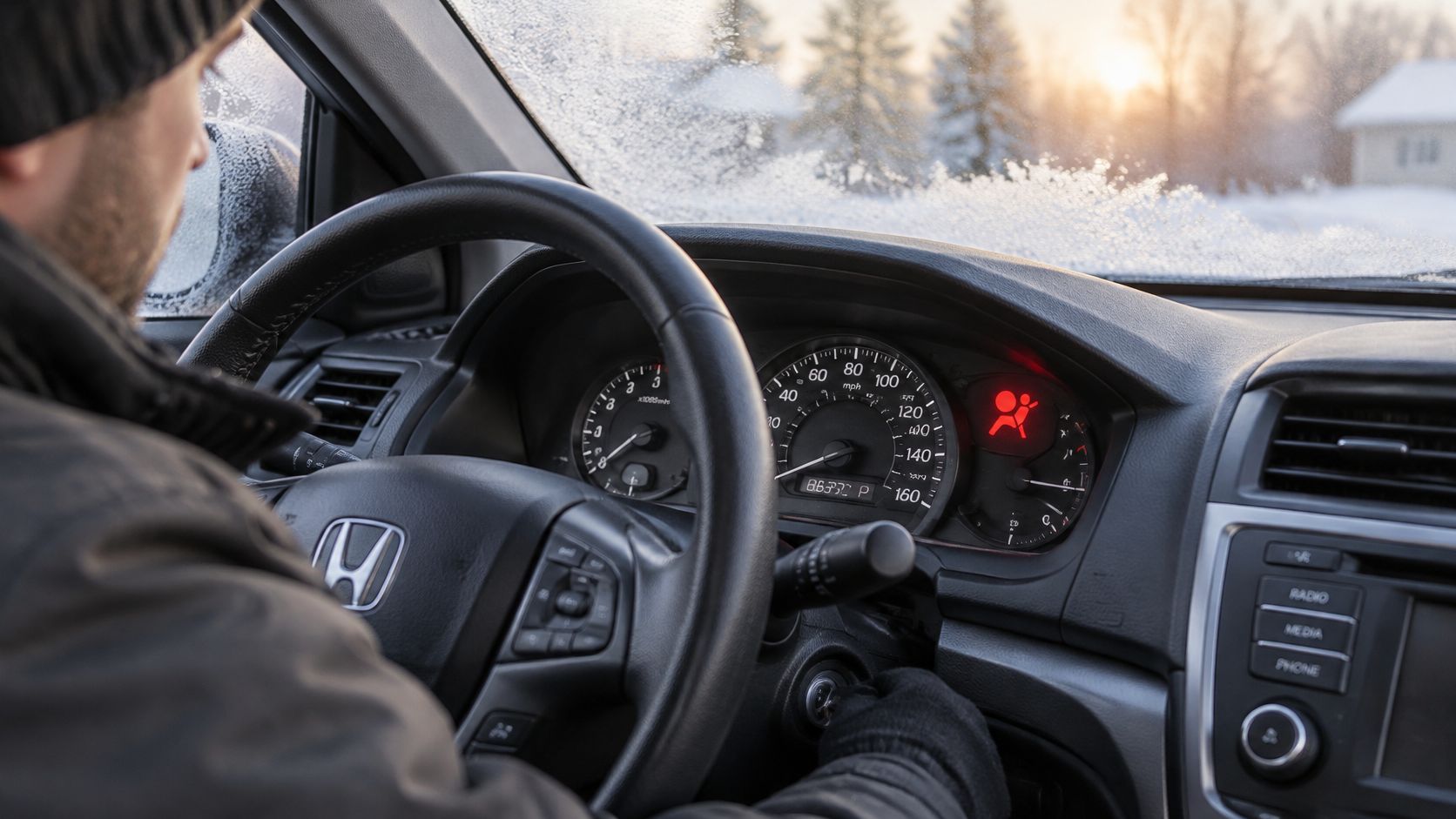
A smoke detector may chirp when its sensor or battery needs attention. That sound does not identify which part needs attention, but it tells you not to assume the detector can protect you normally. An airbag warning works similarly: it signals a system condition, while diagnosis is needed to learn which component or circuit is involved.
The warning isn't a component diagnosis
A flashing icon cannot identify a defective airbag, belt, sensor, or connector. It also cannot show by itself whether the module holds records from an earlier collision. A technician needs diagnostic information and the vehicle's repair history to assess those questions.
NHTSA's airbag control-unit investigation records show that stored codes can remain even when the warning lamp is off. In one crash vehicle, investigators found 28 codes, including 17 associated with the current event and 11 from an earlier event, despite an unlit warning lamp.
Practical rule: Treat the lamp as a reason to investigate, not as the diagnosis itself.
Replacing an airbag based only on a flashing symbol can mean replacing the wrong part. The circuit and module need to be checked, and the repair should be verified. A dark dashboard alone does not confirm that the restraint system has been repaired.
Reading the Flash Pattern Before You Act
| Light behavior | Likely meaning | First action |
|---|---|---|
| Brief lamp at key-on, then goes out | Normal self-check | No action for this behavior alone; drive normally if there are no other concerns |
| Rapid flashing during the ignition check, followed by extinction or a steady lamp | Possible airbag or pretensioner fault, depending on the manufacturer | Have the SRS module scanned before relying on the system |
| Slow flashing, about two seconds on and two seconds off | The airbag diagnostic unit may have been left in diagnostic mode, as described in a Nissan service bulletin | Check the exact vehicle's service information and scan |
| Lamp stays steadily illuminated after startup | Active or stored restraint-system fault | Arrange a full SRS scan promptly |
| Flashing or steady lamp after a collision | Possible crash record, damaged restraint component, or circuit fault | Don't resume normal use until diagnosed and repaired |
| Lamp off but codes remain stored | Historical or unresolved condition | Preserve and assess stored codes, particularly after collision repairs |
This table is a reading guide, not a universal decoder. A pattern described for a particular Nissan doesn't establish what the same blinking means on another manufacturer's vehicle, or even every Nissan.
A brief startup light that extinguishes is the expected behavior. Rapid flashing needs more context: when it begins, whether it stops, and whether the lamp becomes steady afterward. A slow, regular pattern may indicate a diagnostic operating mode rather than identify a failed restraint component.
Match the warning to the vehicle
A steady lamp deserves the same diagnostic attention as persistent flashing. Neither behavior tells an owner how much protection remains available, and a post-collision warning needs the repair history considered alongside the scan.
Also distinguish the main SRS warning from the passenger-airbag status indicator. They aren't interchangeable signals. Record which indicator you see, its wording or symbol, and whether other restraint warnings appear at the same time.
Before anyone clears codes, make a short observation record:
- Vehicle details: Note the make, model, year, and mileage.
- Timing: Record whether flashing starts immediately, after starting, or later.
- Sequence: Note the on-and-off rhythm and whether it eventually becomes steady.
- Context: Tell the technician about collision repairs, seat work, or previous attempts to reset the warning.
The pattern helps narrow the diagnostic path. The scan and vehicle-specific procedure determine what comes next.
Real Safety Risk of Driving With the Light On
A car may start, steer, and brake normally while its airbag light flashes. The warning means the restraint system has detected a fault, and you can't tell from the light alone which functions are affected. Until a technician identifies the cause, treat the system's protection as uncertain.
In frontal crashes, a lap-and-shoulder belt alone reduces death risk by 50%, while a frontal airbag alone reduces it by 34%, according to NHTSA estimates reported in IIHS's airbag safety research. The same research estimates that frontal airbags saved 4,330 lives in 2019. A frontal airbag used with a lap-and-shoulder belt reduces death risk by 61%.
| Restraint setup in a frontal crash | Reduction in death risk, according to IIHS's airbag safety research | What a flashing light means for it |
|---|---|---|
| Lap-and-shoulder belt alone | 50% | A fault may involve the belt pretensioner, not just an airbag |
| Frontal airbag alone | 34% | The airbag may not deploy as designed |
| Frontal airbag plus lap-and-shoulder belt | 61% | A fault may affect part of the coordinated protection system |
These figures describe the benefits of restraint systems. They don't show how much protection remains in your particular car, because the warning doesn't identify the faulty component or function.
Make a conservative transport decision
Postpone nonessential driving and arrange diagnosis now. Ask the repair facility whether towing is appropriate, especially if the warning appeared after a collision, you'll be carrying passengers or children, or you need to make a long trip. The flashing or steady pattern alone can't determine whether driving or towing is appropriate.
Keep wearing your seat belt. An SRS warning doesn't change the need to use the available restraint equipment, and airbags are designed to work with seat belts.
For help deciding how to handle transportation, read whether it's safe to drive with an airbag light on. A diagnosis can identify the fault and help the repair facility advise you on getting the car there.
Common Causes After a Collision and Without One
Consider a hypothetical salvage-auction repair. A rebuilder replaces visibly deployed airbags and damaged sensors, yet the airbag light keeps flashing. The remaining problem could be stored crash data, a pretensioner circuit fault, or both.
That's an example of a diagnostic situation, not a documented customer case. Its lesson is simple: replacing the most visible collision damage doesn't establish that every restraint component has been restored.
NHTSA's restraint-system technical documentation identifies separate faults involving buckle, front, and anchor pretensioner circuits, airbag circuits, and the SRS module itself. It also describes how pretensioner resistance outside the controller's calibrated range can trigger a warning.
Post-collision areas that need attention
The inspection should follow the codes and manufacturer's procedure, rather than an assumed ranking of causes.
- Activated pretensioners: A belt assembly may need attention even when the airbag cover looks intact. Check deployment status through the prescribed procedure.
- Stored crash records: A module may retain collision information after physical repairs. Whether it can be reset or requires replacement depends on the applicable repair instructions.
- Damaged belts and connectors: A cut belt or damaged electrical connection remains a separate problem from the module's memory.
- Airbag and sensor circuits: Installing a component isn't the same as verifying its circuit. Connections and compatibility still require confirmation.
- Internal module faults: A module fault needs its own diagnosis; it shouldn't automatically be treated as removable crash data.
A stored pretensioner code doesn't necessarily mean the controller cannot recognize another crash or command deployment. However, that possibility is not a safety clearance. The code still identifies a condition that requires evaluation.
When there's no known collision
Don't assume crash data is the explanation merely because the light flashes. The diagnostic path may instead involve a connector, wiring, buckle switch, occupant-presence system, impact-sensor circuit, or control-module condition.
Tell the technician what changed before the warning appeared. Recent work and earlier symptoms are useful clues, but timing alone doesn't prove that the last person who worked on the car caused the fault.
Repair principle: The confirmed root cause determines the work. The dashboard symbol doesn't choose the replacement part.
A scan code is also a starting point, not automatic permission to replace the component named in its description. The related wiring and connections need assessment before the repair decision is made.
Diagnose the Fault and Confirm the Repair
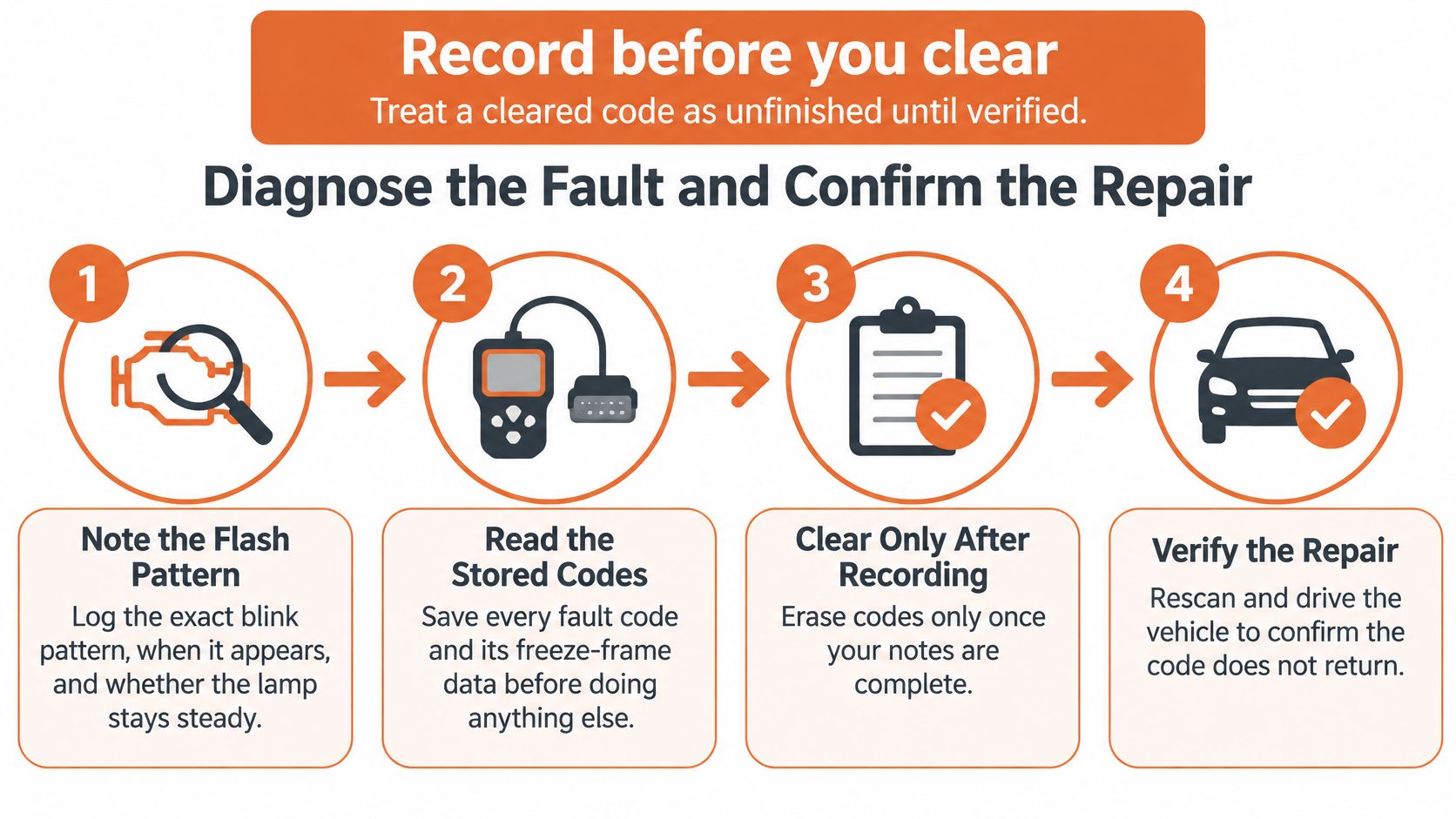
A flashing airbag light can look like a simple countdown, but its rhythm is vehicle-specific. Start by recording what the lamp does, then use the service information for that exact vehicle to guide diagnosis. Clearing a code before recording it can erase useful evidence without fixing the cause.
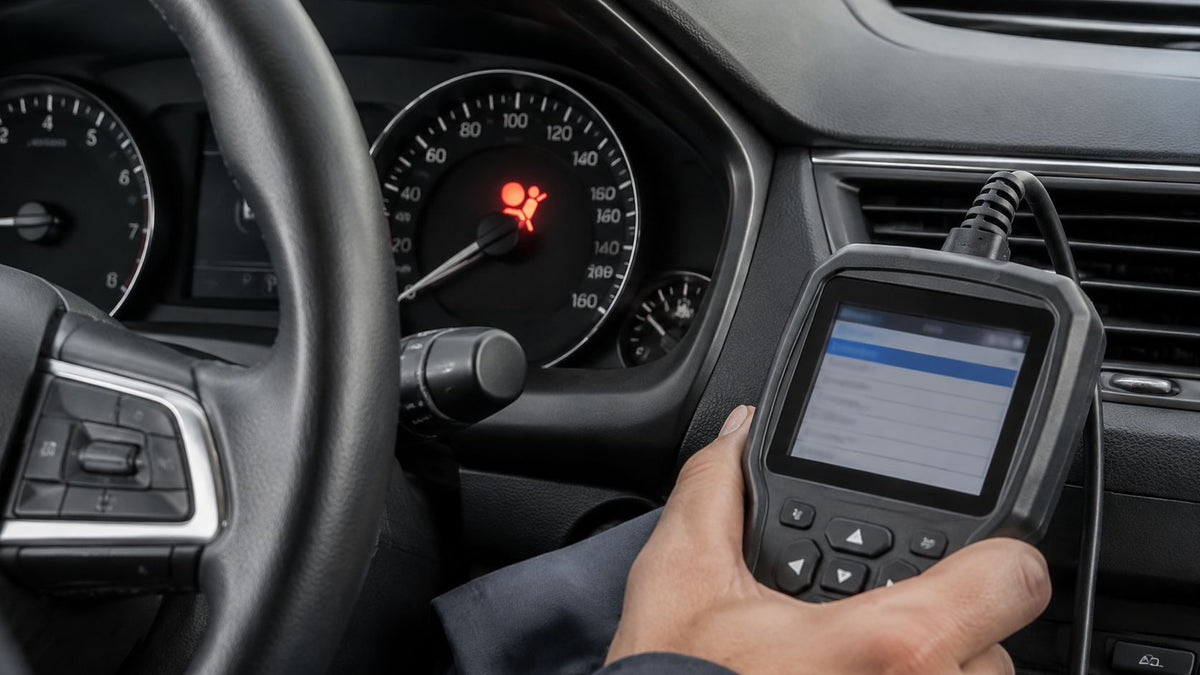
This visual summarizes the record-and-check workflow. Recording information alone is not a reason to clear SRS codes; address the underlying fault first.
Preserve the evidence and identify the fault
- Record the exact lamp behavior. Note the rhythm, when it starts, and whether it changes after the engine starts. A flash pattern is a clue, not a universal code: compare it with service information for the specific vehicle rather than a reset video for a similar dashboard.
- Check the VIN for open recalls. Recall work and ordinary fault repair are separate matters, so ask the repairer to check both. NHTSA's recall information can help determine whether a warning may relate to a safety defect rather than collision damage.
- Request an SRS-capable scan. Ask the technician to save current and historical diagnostic trouble codes, or DTCs, and any available crash-record information. A basic engine-code reader may not communicate with the restraint module, so a report of no engine faults does not show that the SRS was checked.
- Have the indicated circuits inspected safely. The code-specific test sequence may include connectors, wiring, buckle switches, pretensioners, impact sensors, and control-module circuits. A code points to an area for testing; it does not, by itself, identify a part to replace.
Flash timing differs across manufacturers and procedures. NHTSA-published manufacturer diagnostic instructions describe an example with a 7 to 35 second ignition-on diagnostic period, followed by 0.5 second on and 0.5 second off flashing when a malfunction is detected. Other methods use 1.2 second and 0.3 second flashes to represent different code digits, as described in NHTSA-published manufacturer diagnostic instructions. In the same instructions, normal readiness illumination is generally about 6 to 8 seconds, though the vehicle's own procedure takes precedence. These examples show why one rhythm cannot be interpreted the same way on every vehicle.
Repair safely and check the outcome
- Leave electrical testing to someone equipped for SRS work. The applicable disabling procedure may require disconnecting the negative battery cable and waiting for capacitors to discharge before diagnosis. The waiting interval depends on the vehicle. Don't probe airbag or pretensioner circuits with ordinary test equipment or guess at the required wait.
- Correct the confirmed condition. Use components that suit the vehicle and follow the manufacturer's instructions for damaged parts, crash records, or module faults. Keep recall completion separate from code clearing; completing one does not complete the other.
- Clear codes only after the repair, then check the result. Cycle the ignition and compare the lamp sequence with the manufacturer's procedure. Rescan to see whether the original faults remain or return, and keep the original scan, final scan, and repair invoice with the vehicle.
The cited NHTSA instructions support the safety precautions and diagnostic sequence discussed here. They are not a complete do-it-yourself procedure. Disconnecting a battery does not repair a restraint-system fault.
If you're preparing to speak with a shop, this guide to diagnosing an airbag light can help you organize symptoms and questions. Ask whether the report separates current faults, historical faults, and crash-related records.
This accompanying video adds context to the diagnostic discussion.
A momentarily dark lamp is not enough to judge the outcome. Ask what was repaired, how the technician tested it, and whether any further restraint work remains. Resume normal use only after the applicable faults have been addressed, the final scan has been assessed, and the manufacturer-specified self-test passes.
Repair Paths for Clearing, Repairing, Resetting or Replacing
| Repair path | Fits when | Typical cost | Key limit |
|---|---|---|---|
| Clear codes with a basic OBD scanner | The fault is repaired and the tool actually supports the SRS module | Tool-dependent; no reliable price stated | A generic engine reader may not communicate with SRS or remove crash data |
| Repair the failed component | Diagnosis confirms damaged wiring, a failed sensor, or a deployed pretensioner | Varies by component and labor | Components and procedures must suit the vehicle |
| Mail-in module reset | The module is suitable for reprogramming and the vehicle's repair procedure permits it | Obtain a module-specific quote | Addresses the module, not damaged airbags, belts, sensors, or wiring |
| Dealer module replacement | The module is damaged or replacement is required by the repair procedure | Obtain a written parts-and-programming estimate | Installation and applicable coding or programming remain necessary |
Clearing, repairing, resetting, and replacing aren't interchangeable jobs. Each addresses a different condition. An inexpensive code-clearing attempt becomes wasted effort if it leaves the actual fault untouched.
A component-level repair fits a confirmed physical or electrical problem. A module service fits an eligible module condition. Neither should be selected just because the light appeared after a crash.
When a module service fits
One mail-in option is the SRS Airbag Module Reset Service After Accident Airbag Light Reset and Crash Data Removal All Makes and Models. Its stated scope includes reprogramming the original module, removing crash data, and clearing stored hard codes; those services don't repair deployed airbags or damaged wiring.
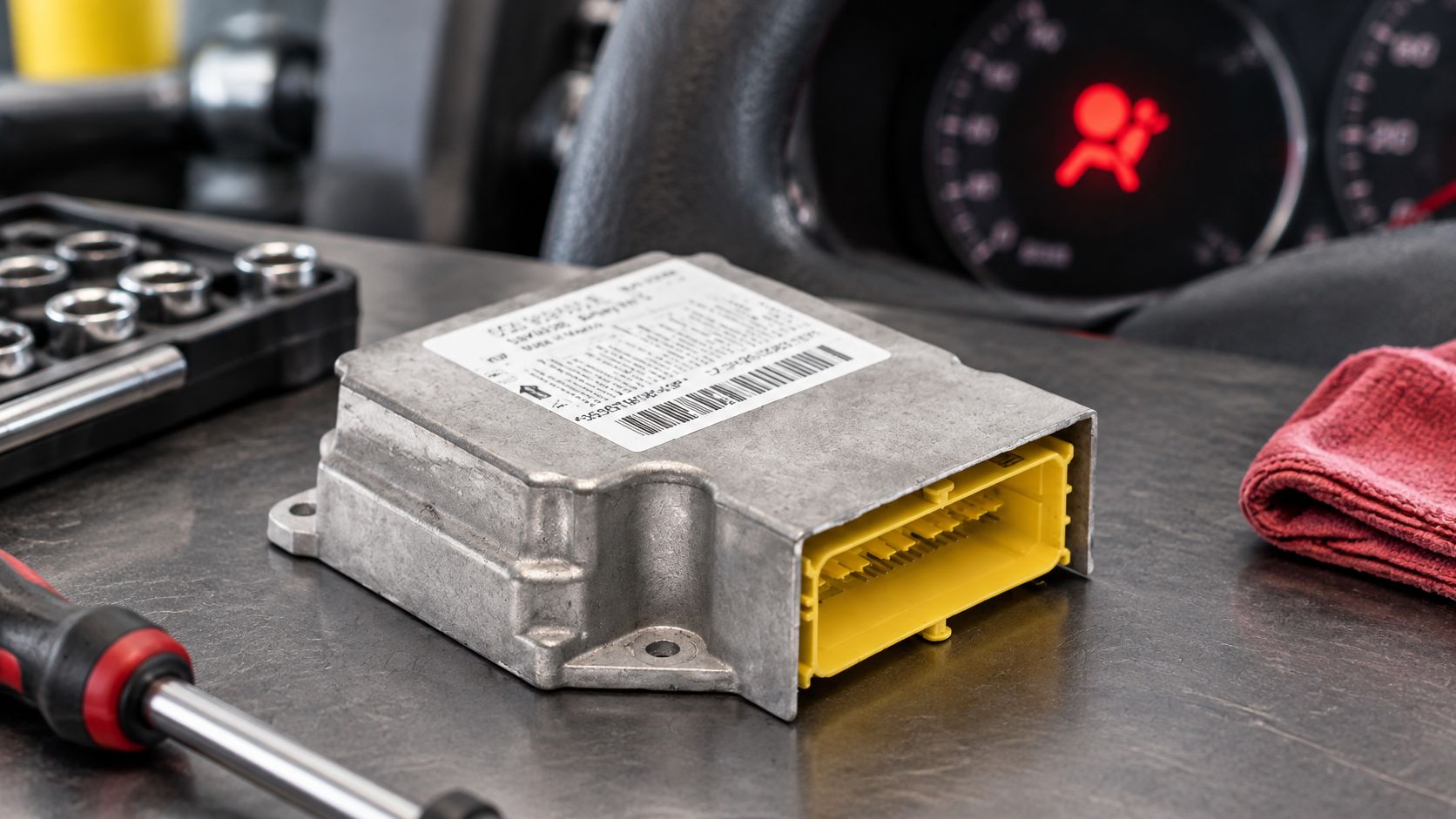
Before shipping a module, ask the installing technician to confirm that servicing it is appropriate under the vehicle manufacturer's repair instructions. Also establish who will remove it, reinstall it, and perform final verification.
Compare the complete repair, not just the service price
A written estimate should identify the exact fault, affected parts, module work, and verification procedure. Ask whether programming, installation, and the final scan are included. There isn't enough confirmed pricing information to give a dependable universal total.
Use the distinction between what needs replacement and what can be reset after a crash when reviewing the estimate. If the proposed work only promises to switch off the warning, ask how the technician will establish that the underlying condition has been corrected.
The right repair path ends with documented system checks, not a promise that the dashboard will look normal.
Seat Belt Repair offers mail-in SRS module resets, seat belt pretensioner repair, and webbing replacement for owners and repair shops addressing post-collision restraint issues. Visit Seat Belt Repair with your vehicle details and SRS scan report to discuss component service, then have your repair facility complete installation and verify the system before normal use.


Оставить комментарий
Этот веб-сайт защищается hCaptcha. Применяются Политика конфиденциальности и Условия использования hCaptcha.