
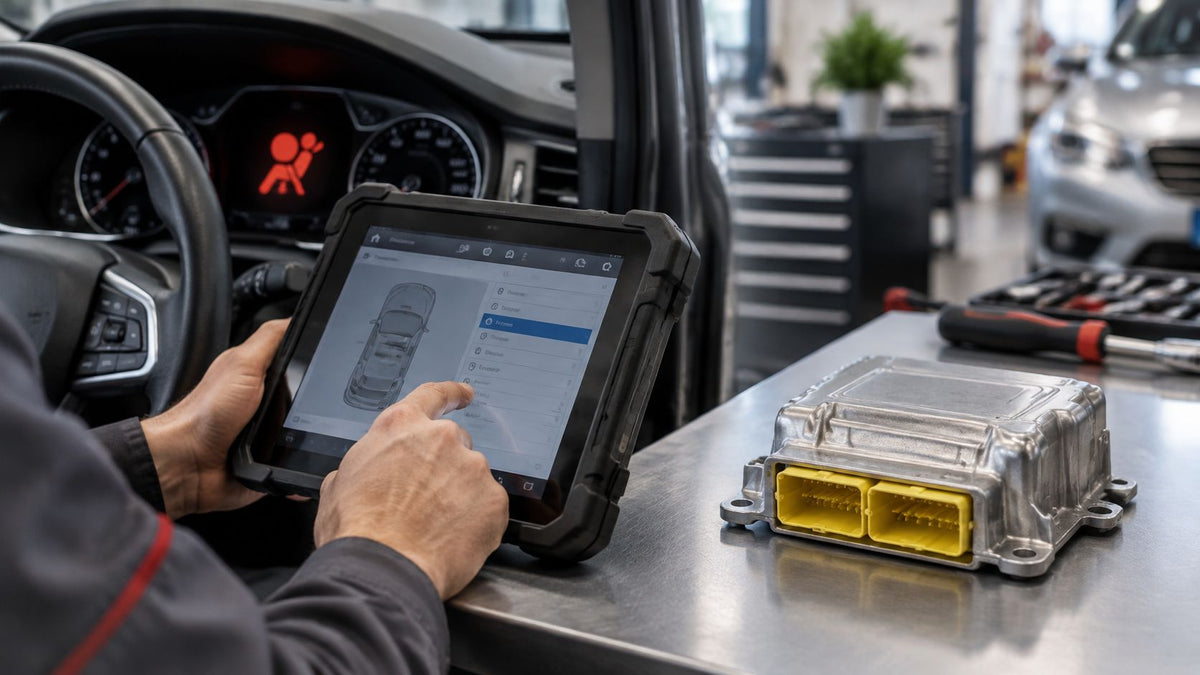
A basic code reader can tell you the engine has no powertrain faults while the airbag light stays on after a collision. That doesn't mean the restraint system is clear. The popular advice to “just scan it and erase the code” skips the important distinction: reading an SRS code, clearing a current fault, and removing stored crash data are three different jobs. A low-cost universal scanner may handle the first, but it usually can't do the rest.
For owners, collision shops, independent garages, and Copart or IAAI rebuilders, the right next step depends on what the restraint module reports and what hardware has been replaced. The scanner is a diagnostic tool, not a substitute for repairs or the vehicle maker's procedure.
Table of Contents
- Why the Airbag Light Needs Its Own Scanner
- SRS Scan Tool Classes Compared by What They Clear
- Reading a Code Is Not Clearing Crash Data
- Which Repair Each SRS Situation Needs
- What a Scan Costs Against a Module Reset
- How to Scan Before You Mail the Module
Why the Airbag Light Needs Its Own Scanner
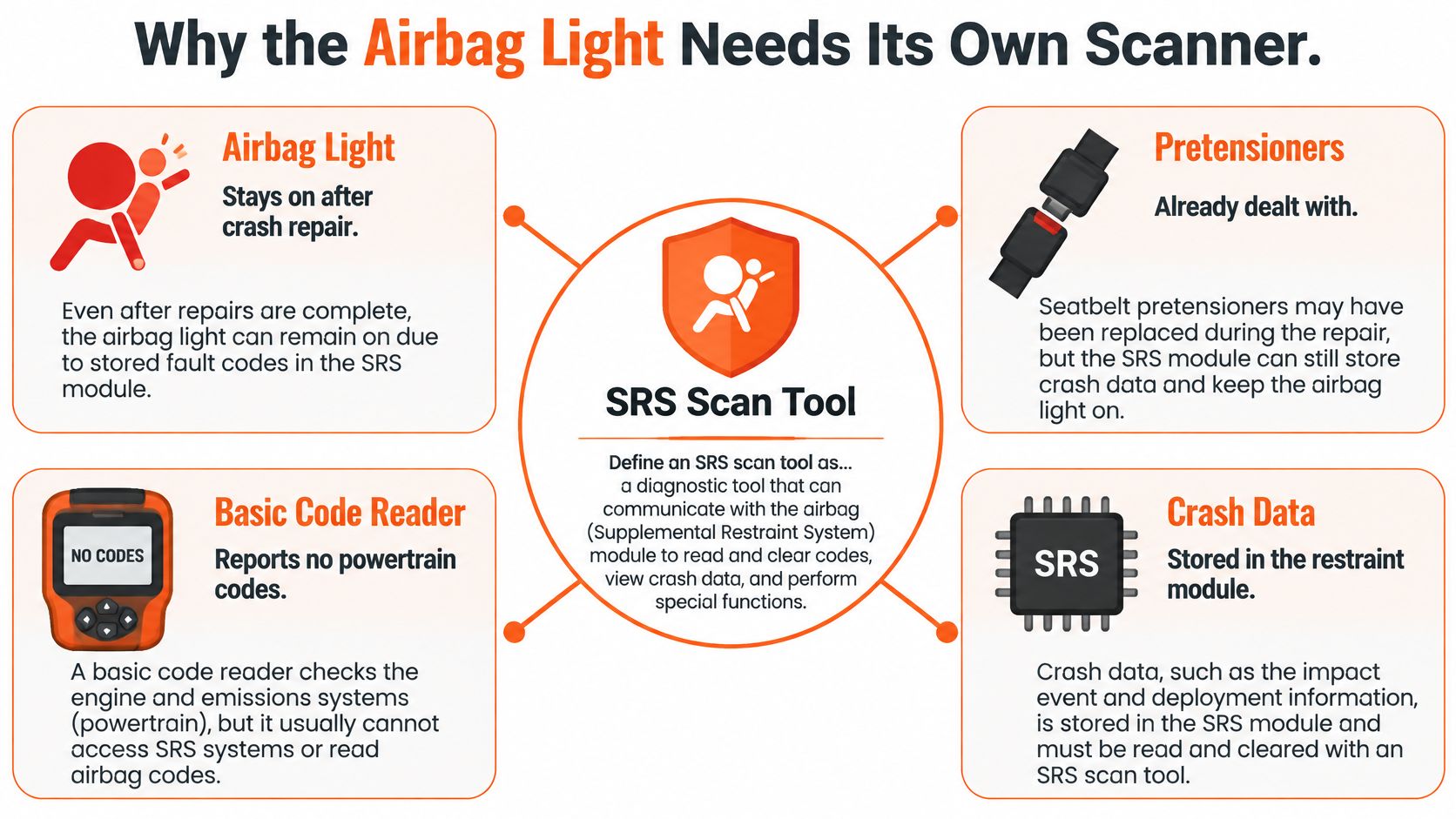
The airbags and pretensioners have been replaced, the trim is back together, and the SRS warning lamp still won't go out. A basic code reader connects, reports no powertrain codes, and leaves the actual problem unanswered. That's a common post-repair dead end because the engine computer and restraint control module are different diagnostic destinations.
Define an SRS scan tool as hardware and software that communicates with the restraint control module, retrieves its diagnostic trouble codes, and helps identify whether a fault involves an airbag, belt pretensioner, impact sensor, wiring circuit, or the module itself. It can provide electronic evidence to guide the inspection, but it can't replace checking the parts or following the manufacturer's repair procedure.
An illuminated SRS lamp isn't an emissions-style inconvenience. It can indicate that a supplemental restraint component may not work as designed in a crash. NHTSA reports that frontal airbags reduce fatalities by 14% for unbelted occupants and 11% when occupants use seat belts, and estimates that seat belts saved 14,955 lives in the United States in 2017. NHTSA also estimates that 2,549 more people might have survived that year if they had been belted, as reported in its traffic safety facts on occupant protection.
The belts matter to diagnosis, too. Pretensioners can be integrated into a belt retractor or buckle and may deploy pyrotechnically. NHTSA documented that approximately 63% of new vehicles had pretensioners by model year 2002. Its analysis estimated a 12.8% lower fatality risk for belted front occupants in passenger cars, CUVs, and minivans when the belt included both a pretensioner and load limiter, compared with a belt without those technologies, as described in its seat-belt effectiveness report.
Shop-floor rule: Before clearing a fault or returning a repaired vehicle to service, establish whether the tool can read the restraint module and whether the damaged components have actually been repaired.
The next step might be to identify a fault, clear a current code after repair, remove stored crash data, or send the original module for reprogramming. Those are separate outcomes, and the right one depends on the scan and the physical condition of the restraint system.
SRS Scan Tool Classes Compared by What They Clear
| Option | Talks to SRS module | Live or event data | Clears current SRS codes | Removes stored crash data |
|---|---|---|---|---|
| Basic OBD-II code reader | Usually no | No | No | No |
| Mid-range bidirectional scanner | When SRS coverage is listed for that vehicle | Often, when supported | Many current faults, not all brands | Rarely, and not a substitute for module reprogramming |
| OEM or dealer diagnostic platform | Yes, for the covered brand | Yes, including brand-specific tests | Yes, per the service procedure | Only if that brand's procedure includes the required reset or programming |
| Mail-in SRS module reset | Bench work on the removed module | Pre-repair scan should already be saved | Yes, as part of reprogramming | Yes, crash data and hard codes cleared on the original module |
A scanner that plugs into the diagnostic connector hasn't necessarily accessed the SRS module. SAE J1978 describes standardized scan-tool functions for services defined by SAE J1979, which primarily governs emissions-related diagnostic data, not universal airbag or seat-belt coverage. A compliant connection to the vehicle therefore doesn't prove the tool has the manufacturer-specific addressing, security access, or software routines needed for restraint diagnosis, as outlined in the SAE on-board diagnostics material.
A basic OBD-II reader is useful for powertrain codes and emissions checks. If the product doesn't explicitly list SRS coverage for the vehicle, don't buy it expecting an airbag diagnosis.
For an independent shop or a serious DIY user, a mid-range bidirectional scanner is often the practical middle ground. Its value depends on whether the manufacturer, model year, and SRS module appear in the coverage list, and whether the listed functions include code retrieval, live data, and any required service routines.
An OEM or dealer platform earns its place when a repair procedure or campaign specifies that software. A generic tool may read a code but still lack the required initialization or authenticated access. A mail-in module reset is different again: the original SRS computer is removed and reprogrammed on the bench. A standard OBD scanner or code reader cannot erase crash data stored in the SRS system.
Before buying, check documented make, model, and year coverage, software update terms, and the specific SRS functions available. The useful test is whether the tool can help distinguish a current wiring or sensor fault from a stored deployment record, not whether the box says “full system.”
Reading a Code Is Not Clearing Crash Data
Challenge the habit of treating code reading and code clearing as the same button. A tool can retrieve a fault without fixing it. It can also clear a code that returns as soon as the module detects the underlying problem again.
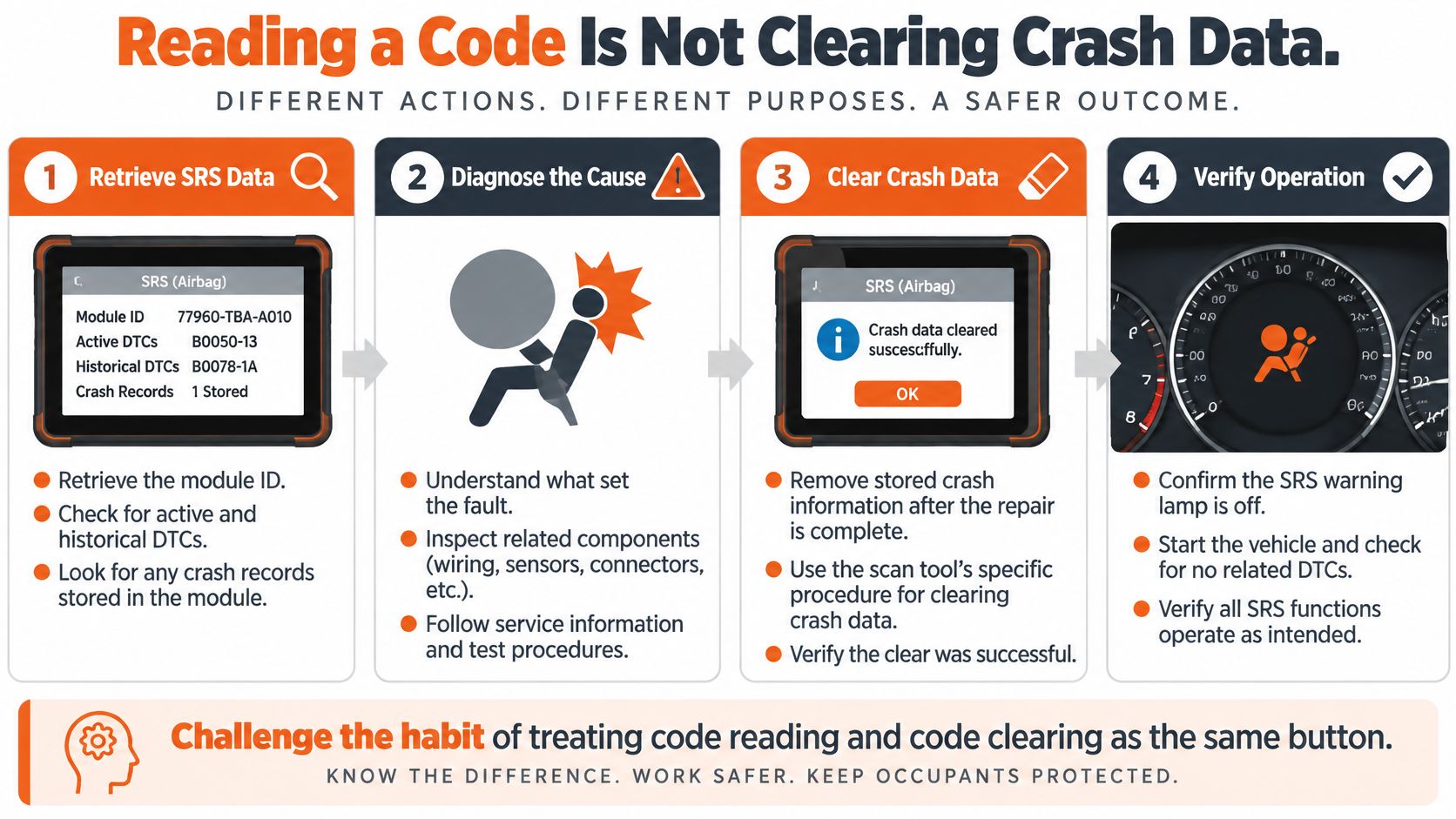
Separate the work into four jobs:
- Retrieve the SRS data. Save the module identification and active and historical diagnostic trouble codes. Record any deployment or belt-status information the tool makes available.
- Clear stored crash-related information. On many vehicles, crash data resides in the restraint module and won't disappear through a generic code erase.
- Repair the active fault. If the scan points to an impact sensor, clock spring, wiring circuit, fired pretensioner, or another component, address that part rather than treating the code as the repair.
- Validate operation. Follow the service procedure and confirm the airbag warning lamp completes its specified self-check. A screen that says “no current codes” isn't, by itself, proof of readiness.
NHTSA recall procedures illustrate why the tool and the repair procedure matter. Technicians may be directed to use current diagnostic software, record active and historical codes, diagnose faults that won't erase, and verify the warning-lamp self-check after repairs. One recall procedure specifies the wiTECH tool with its latest software release, so a universal dongle isn't a defensible substitute when the manufacturer names a platform. The procedure is documented in the NHTSA recall filing.
Software currency matters as well as hardware. Diagnostic updates added new model-year coverage and functions in 2025, so an older scanner can power on normally yet lack access to a vehicle's restraint module. Confirm the current coverage before relying on the tool for a specific repair.
For a plain-language explanation of the separate job of removing stored event information, see crash data removal and SRS module resets. The shop-floor explanation to a customer is simple: no current code is not the same as a finished restraint inspection when airbags, belts, sensors, wiring, or the module are still damaged.
Which Repair Each SRS Situation Needs
| Situation | First action | Why that action |
|---|---|---|
| SRS lamp, no known deployment | SRS-capable scan and circuit repair | Often a sensor, clock spring, or connector fault rather than crash data |
| Parts replaced after a crash, lamp still on | Save the scan, then reset the original module | Crash data and hard codes can remain after bags and belts are changed |
| Belt locked, won't retract, or pretensioner fired | Scan for the code, then repair the retractor | Clearing a code doesn't rebuild a deployed pretensioner |
| Salvage or rebuilt auction vehicle | Document codes, repair hardware, reset the module | Damaged parts or stored crash data can keep the system from clearing |
| Procedure names a brand tool, such as current OEM software | Use that platform and software level | Generic OBD access isn't the specified safety procedure |
A lamp that appears without known deployment history needs diagnosis before anyone assumes the module needs a reset. An SRS-capable tool can identify whether a code points toward a circuit or component, but the technician still needs to inspect the connector, wiring, and named part. If the cause is a current fault, repair it first, then clear it with a suitable tool and confirm the warning-lamp check.
The more commonly misread case is a collision repair where the airbags and belts have been replaced but the lamp remains on. Save the scan, verify that deployed hardware and related faults have been addressed, and determine whether stored crash data is holding the original module in a fault state. A module reset won't repair a fired pretensioner or damaged sensor.
That distinction matters on auction rebuilds. A scan helps identify what remains to be repaired, but it doesn't make damaged parts safe or clear a stored event by itself. For context, CCC Intelligent Solutions reported that 87% of direct-repair-program appraisals in the first quarter of 2025 included a diagnostic scan, in its 2025 Crash Course report.
A locked belt is a parts problem first. Replacing or reprogramming the SRS module doesn't restore a belt mechanism that has fired.
A module can be reached through the vehicle's diagnostic connector or removed for bench work, depending on the vehicle and the job. If the scan indicates crash data and the original module is suitable for reprogramming, a mail-in reset can be an alternative to replacing the computer. Seat Belt Repair's mail-in service is used by body shops, collision repair centers, salvage rebuilders, dealership reconditioning departments, mechanics, and vehicle owners. After reset and reprogramming, the original module is shipped back ready for reinstallation. The restraint control module guide can help clarify what the module does in the system.
A manufacturer procedure that specifies its own platform stays on that platform. Don't substitute a generic scanner just because it can communicate with another module on the same vehicle.
What a Scan Costs Against a Module Reset
The cost decision isn't just the price of a scanner. It's a choice among diagnostic access, module replacement, and reprogramming the original module when it's suitable for reuse.
| Option | Cost | Covers | Does not cover |
|---|---|---|---|
| Basic OBD-II code reader | Low purchase price | Powertrain codes only | SRS access or crash-data clearing |
| SRS-capable scanner | Purchase plus subscription | Codes, live data, and some actuations for listed vehicles | Crash-data reset or hardware repair |
| Dealer module replacement | Several hundred dollars and up, plus programming | New computer installed and coded | Repair of a damaged belt, airbag, or sensor |
| Mail-in module reset | $49.97 sale price, compared with $799.00 listed regular price | Reprogrammed original module with crash data cleared | Installation, deployed airbags, pretensioners, sensors, or wiring |
The scanner market's size doesn't tell you whether a specific tool will read your vehicle's SRS module. Credence Research valued the global automotive diagnostic scan tools market at approximately $41.0 billion in 2024 and reported that handheld scan tools represented 52.3% of that market, in its automotive diagnostic scan tools market report. For a repair decision, exact vehicle coverage and software access matter more than the category's overall market share.
A new dealer module may make sense when the original computer is damaged or the manufacturer requires replacement. But when the original module is reusable and stored crash data is the remaining electronic issue, reprogramming can avoid buying a new computer and paying for its programming. The SRS Airbag Module Reset Service After Accident Airbag Light Reset and Crash Data Removal All Makes and Models is listed at the sale and regular prices shown above. Prices, discounts, and promotions can change.
The reset fee doesn't include installation or repairs to deployed airbags, fired pretensioners, faulty sensors, or damaged wiring. Those parts need separate attention, or an active fault may keep the warning lamp on after the module returns.
Buying rule: Pay for scan capability to diagnose the vehicle. Pay for a module reset when the scan points to stored crash data and the original computer is reusable.
How to Scan Before You Mail the Module
A useful pre-repair scan is a record, not just a code-clearing step. NHTSA technical documentation describes SRS-related retrieval through the vehicle diagnostic connector or by connecting directly to a removed restraint ECU. It identifies data such as deployment time, multistage deployment level, belt-switch status, occupant detection, ignition cycles, airbag-lamp duration, and diagnostic-code numbers, as detailed in the NHTSA technical document on crash-data retrieval.
- Confirm the battery is stable and the ignition procedure matches the service information. Low voltage or an incorrect key-on sequence can complicate diagnosis. Use the vehicle-specific procedure before connecting the scanner.
- Connect an SRS-capable tool and record the module information before any erase. Save the module identification, all active and stored codes, deployment indicators, ignition-cycle counts, and available belt-status data. Don't clear codes first, especially on a salvage vehicle you haven't documented.
- Save the report or photograph the screen. Keep that pre-repair record with the job file so the original fault information doesn't disappear when repairs begin.
- Inspect the parts named by the scan. Plan repairs for deployed airbags, fired pretensioners, damaged sensors, and wiring faults. A module reset can't replace or repair those items.
- If crash data remains and the module is suitable for reprogramming, remove it using the vehicle's disable procedure. The mail-in process requires the customer to remove the SRS control module and ship it to Seat Belt Repair. Use the vehicle-specific airbag module location guide to help identify the module before removal.
- Reinstall the module only after the damaged hardware is corrected, then verify the lamp self-check. Seat Belt Repair tests parts before shipping them back and returns the reset module ready for reinstallation. The stated repair turnaround is 24 hours after receipt.
For a short visual walkthrough, use this video as a companion to the vehicle's service information:
Don't expect a reset to free a belt that won't retract, and don't reinstall a reset module while a deployed airbag or faulty sensor remains unrepaired. The same mail-in approach is used by body shops, collision centers, salvage rebuilders, dealership reconditioning departments, independent mechanics, and individual owners.
If crash data is keeping the SRS light on after the damaged components have been repaired, Seat Belt Repair offers a nationwide mail-in module reset service and seat-belt repairs. Review the process and contact options at Seat Belt Repair before removing or shipping a module.


Laisser un commentaire
Ce site est protégé par hCaptcha, et la Politique de confidentialité et les Conditions de service de hCaptcha s’appliquent.