
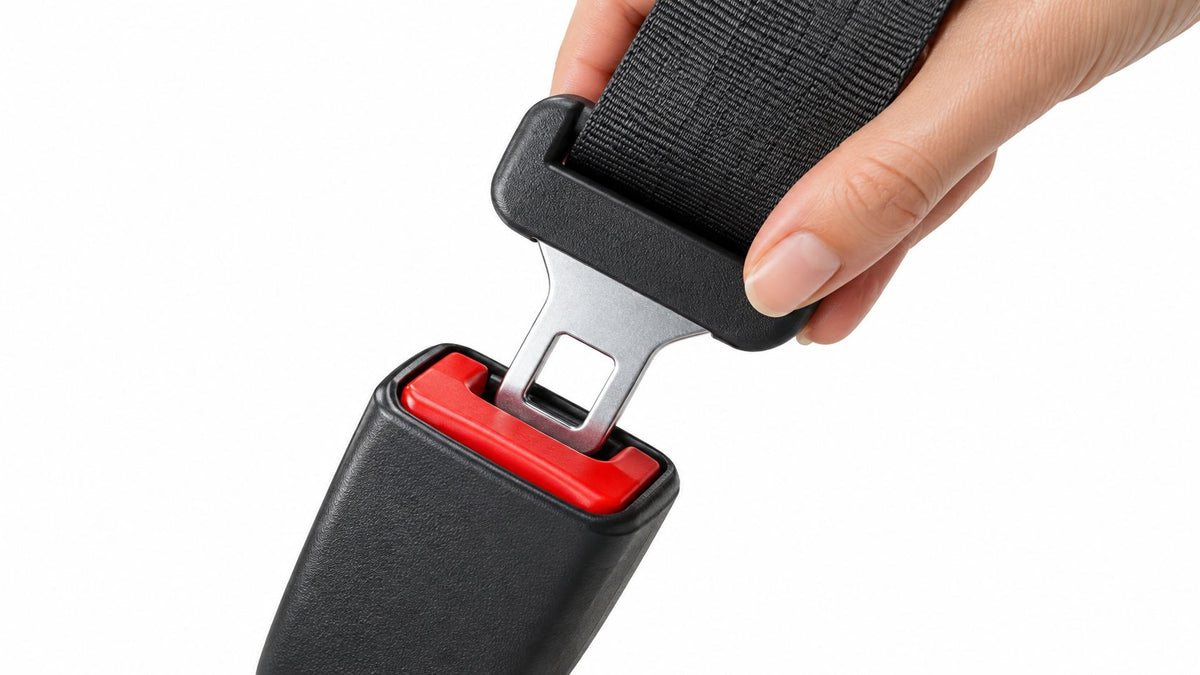
You reach across, grab the belt, and pull. The webbing comes out an inch, then locks solid. Or it clicks into the buckle, but when you press the red button the latch plate hangs up and the belt won't feed back. Sometimes it happens right after a minor crash. Sometimes it shows up after wrestling with a child seat. Sometimes it appears on the first cold morning of the season and turns a routine drive into a very bad question.
Most drivers treat a seat belt like a passive part until it stops acting normal. That's understandable. It lives on the pillar, works thousands of times, and rarely asks for attention. But latch seat belts are mechanical safety devices. They have springs, locking parts, sensors, stitching, webbing, and in many vehicles a pretensioner that may already have done its job once.
That's why a belt that feels “a little off” deserves a closer look. The immediate concern isn't convenience. It's whether the system will lock, hold, and release the way it's supposed to when the load is real. For shop owners and salvage rebuilders, the next concern is just as practical. Are you looking at a repairable assembly, or a replacement-only failure?
Table of Contents
- The Moment You Realize Something Is Wrong
- What a Latch Seat Belt Actually Is
- How Latch Seat Belts Protect You in a Crash
- Common Latch Seat Belt Problems and What They Mean
- Repair vs Replace - Why the Dealer Default Is Often Wrong
- Choosing a Repair Service and Knowing When to Trust It
- Putting It Together for Drivers, Shops, and Rebuilders
The Moment You Realize Something Is Wrong
I've seen the same scene play out in driveways, auction lots, and body shop parking areas. A driver slides in, pulls the shoulder belt across the chest, hears the buckle click, and thinks everything's fine until the webbing won't retract. Another driver presses the buckle release after parking and the latch plate sticks in place for a second too long. That pause is enough to make anyone wonder if the restraint system has failed.
The small symptoms that matter
The first sign usually isn't dramatic. It's a belt that rewinds slowly. A latch plate that needs an extra wiggle. A retractor that locks when the vehicle is sitting level and still. After a fender-bender, some people notice the belt feels tighter, rougher, or oddly stiff even when there's no visible body damage near the seat.
Those details matter because seat belt hardware doesn't fail in only one way. The latch plate, buckle, and retractor each have their own wear patterns and post-crash behavior. Dirt in the buckle, a twisted belt, a tired return spring, or a spent pretensioner can all create similar symptoms from the driver's seat.
A seat belt problem often feels random to the driver. Mechanically, it usually isn't.
Why it often shows up after ordinary use
Minor crashes are an obvious trigger, but they're not the only one. Child-seat installs can leave the belt locked in a child-restraint mode. Cold weather can make a weak retractor spring feel worse. Repeated twisting of the webbing can keep the latch plate from sitting flat and entering the buckle cleanly.
Older vehicles can add another layer. Seat belt anchor points became standard in American automobiles for the 1962 model year, and later safety regulation accelerated after the 1966 Highway Safety Act and National Traffic and Motor Vehicle Safety Act, while Victoria, Australia became the first jurisdiction to require compulsory seat belt use by drivers and front-seat passengers in 1970. Those milestones helped move restraints from optional equipment to a built-in safety system, which is part of why modern drivers expect the belt to work every single time without thinking about it (historical seat belt milestones).
If your belt is stuck, slow, or acting differently after a collision, the question is simple. Is this belt still safe, and what should happen next?
What a Latch Seat Belt Actually Is
A latch seat belt is not one part. It is a small restraint assembly made up of parts that have to line up, lock, release, and retract in the right order every time you use the car. From the driver's seat, it feels simple. In the shop, each part leaves different clues when something starts to fail.
The four parts you actually depend on
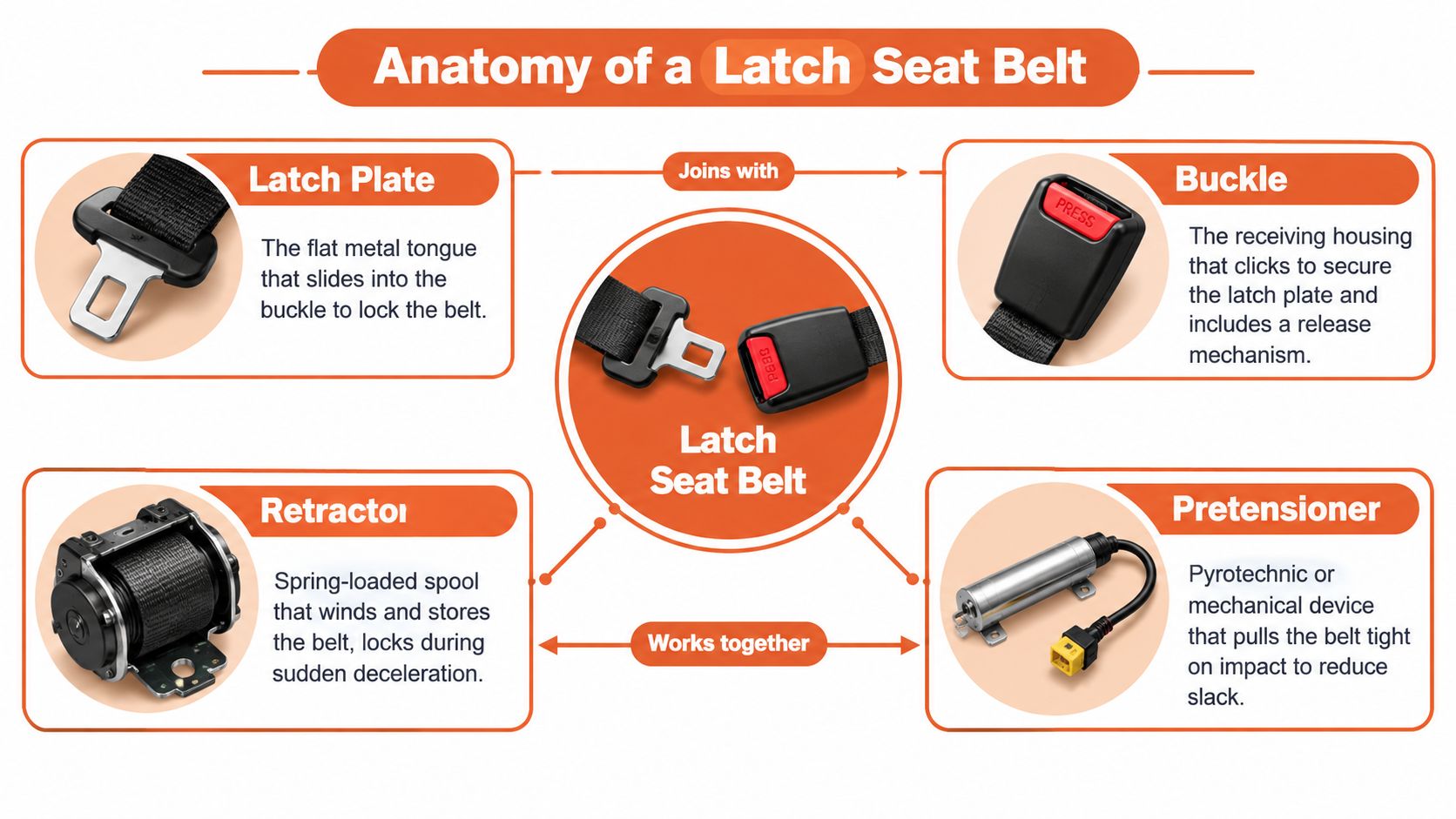
The latch plate is the metal tongue you guide into the buckle. It has to stay flat on the webbing and enter cleanly. If it is twisted, burred, or sitting at the wrong angle, the belt may not click in on the first try.
The buckle is the receiving end with the internal spring and locking pawl. Its job is simple but unforgiving. Hold the latch plate securely until the button is pressed, then release it fully. Dirt, spilled drinks, broken plastic, or a weak internal return can change how that click feels long before the buckle quits completely.
The retractor is the spool assembly, usually mounted at the pillar, seat, or floor. It stores the webbing, pulls slack back in, and contains the locking hardware. In many late-model vehicles, it may also be tied to a pretensioner, which means a belt that only seems “stuck” can be a post-crash unit that has changed internally.
The webbing carries the load across your body. That matters because webbing damage is not just cosmetic. Fraying, cuts, heat glazing, contamination, or stretched fibers can turn a reusable-looking belt into a replacement call.
How the parts work together
The latch plate and buckle handle engagement. The retractor manages slack and locking. The webbing transfers force to the anchor points and the vehicle structure.
That division matters during diagnosis.
If a driver says, “The belt won't click,” the problem is usually at the latch plate or buckle. If the complaint is, “It won't pull out,” the retractor moves to the top of the list. If the belt clicks and retracts but looks distorted or damaged, the webbing itself may have ended the conversation. For a closer look at the latch end specifically, this guide on the seat belt latch and how it works shows the hardware drivers usually notice first.
What modern retractors changed
Modern retractors do more than rewind loose belt. They are designed to lock under specific conditions, either from vehicle deceleration, belt movement, or both, depending on the design. That is why a belt can feel normal in daily use but behave very differently during a hard stop, after a child-seat install, or after a crash event.
By the late 1990s and early 2000s, retractor and child-restraint anchorage requirements became more standardized under federal safety rules, including the child restraint anchorage requirements in FMVSS No. 225. For drivers, that history shows up as a practical difference. Many newer belts are built into a larger safety system, so the right decision is not just “does it latch?” but “did the latch, retractor, and pretensioner all survive the event in a reusable state?”
That is where repair versus replacement starts to become a money question, especially for body shops and salvage rebuilders. A dealer often treats the whole assembly as one replace-only unit. In practice, the failure point is sometimes narrower than that, and identifying the exact component is what keeps a safe repair from turning into an unnecessary parts bill.
How Latch Seat Belts Protect You in a Crash
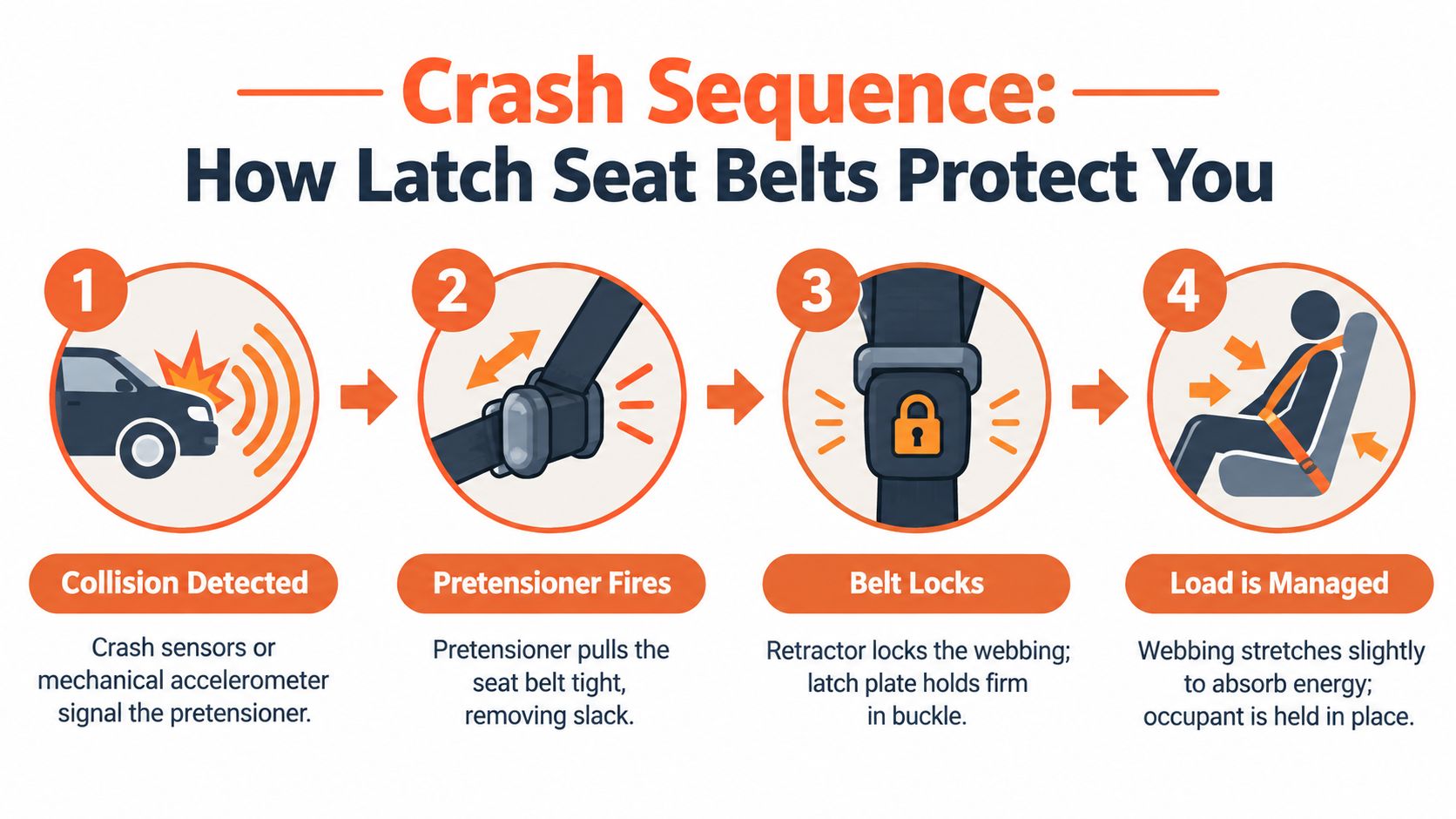
The driver feels a crash as one violent event. The restraint system handles it as a sequence. If you understand that sequence, it becomes easier to diagnose why a post-crash belt can't be judged by appearance alone.
First the belt gets rid of slack
In many vehicles, the first major event is pretensioner activation. The pretensioner tightens the belt rapidly so your chest and pelvis meet the restraint early instead of traveling forward into slack. From the seat, that can feel like the belt grabbed you all at once.
A pretensioner is not a cosmetic device and it is not something to ignore after deployment. Once it has fired, the system has changed state. If you need a plain-English overview of that part, this explanation of the seat belt pretensioner and why it needs repair helps connect the symptom to the internal mechanism.
Then the retractor stops payout
The next job belongs to the retractor. Once the belt tightens, the retractor's locking mechanism engages and stops the spool from feeding out more webbing. At that point, the occupant is coupled to the vehicle structure instead of continuing forward unchecked.
The latch side matters just as much here. NHTSA's interpretation of FMVSS 208 says the latch mechanism on an installed seat belt must be accessible both when stowed and when worn, and must release both the lap and upper-torso portions at a single point by pushbutton action. That's why buckle placement and release access are regulated as human-factors safety features, not just convenience details (FMVSS 208 latch accessibility interpretation).
Practical rule: If the belt no longer moves or releases normally after a crash, treat that as evidence, not annoyance.
Finally the system manages force
After the belt locks and holds, the restraint still has to manage the force going into the occupant. That's where webbing stretch characteristics and load-limiting behavior matter. The belt shouldn't act like a rigid chain. It needs to restrain the body while controlling how sharply the load peaks.
If any part of that chain has been compromised, the whole sequence changes. A contaminated buckle may latch inconsistently. A previously deployed pretensioner may leave the belt locked or semi-functional. Webbing that loaded heavily in a crash may still look acceptable to an untrained eye while no longer being a smart candidate for continued use.
That's the key trade-off I see in real repairs. Drivers focus on the click. Technicians have to think about the whole crash sequence behind it.
Common Latch Seat Belt Problems and What They Mean
Seat belt complaints usually arrive as symptoms, not diagnoses. “It won't retract.” “It's locked up.” “The tongue won't click in.” The useful move is to map the symptom to the part most likely causing it.
Problems that start at the retractor
A belt that won't pull out often points to a locked retractor. Sometimes the mechanism is sitting at a bad angle during removal or installation. Sometimes the locking pawl has engaged and isn't resetting cleanly. After a collision, a deployed pretensioner can leave the assembly in a state that acts like a jammed retractor even though the root issue is crash activation, not spring tension.
A belt that feeds back slowly usually suggests a tired return spring, dirty webbing path, internal drag, or twisted belt. This is one of the few symptoms that can start as a nuisance and become a safety problem later. If the belt doesn't retract fully, it may sit loose against the occupant before a crash ever happens.
Problems at the buckle and latch plate
If the latch plate won't click into the buckle, inspect the simplest things first. Is the tongue bent, dirty, or entering at an angle because the webbing is twisted? Has debris fallen into the buckle housing? Child snacks, coins, and grit create more buckle failures than people expect.
If the belt clicks but won't release smoothly, the buckle catch may be worn or contaminated. That's different from a pretensioner problem. The system may still lock under load, but rough release is a warning that the connector itself isn't operating cleanly.
If the latch plate has to be forced, don't keep testing it by brute pressure. You can turn a contamination issue into a damaged buckle.
Webbing damage is never just cosmetic
Frayed edges, cuts, melted sections, and dog-chewed webbing all belong in the serious category. Webbing is part of the restraint structure. Once fibers are cut or damaged, the question stops being “Can I live with how it looks?” and becomes “Should this still carry crash load?” In practice, visible damage is often enough to move the belt out of the keep-using-it category.
The same goes for webbing that appears stretched or oddly stiff after a collision. Even if it still retracts, prior loading can change what the assembly should be trusted to do.
Child-seat confusion creates real misuse
Many parents still ask whether they should use both LATCH and the vehicle seat belt at the same time. The general medical guidance is that they are alternative installation methods, not something to combine unless both the child seat and vehicle manuals explicitly allow it, and forward-facing seats should still use the top tether. That misunderstanding matters because misuse remains common. NHTSA data found 46% overall misuse in the National Child Restraint Use Special Study, and older studies reported critical misuse rates as high as 72.6%. The same guidance also notes that “LATCH is safer” is often overstated, because seat belts and LATCH are considered equally safe when used correctly (seat belts versus LATCH guidance from UC Davis Health).
Latch Seat Belt Symptom-to-Cause Mapping
| Symptom | Likely Cause | Severity |
|---|---|---|
| Belt won't pull out | Locked retractor, post-crash pretensioner activation, retractor stuck at angle | High |
| Belt retracts slowly | Weak return spring, dirty path, twisted webbing, internal drag | Medium to high |
| Belt won't retract fully | Twist in webbing, worn spring, contamination, crash-related internal issue | High |
| Latch plate won't click | Bent or contaminated latch plate, debris in buckle, webbing twist | Medium to high |
| Buckle clicks but release is rough | Worn or contaminated buckle catch | Medium |
| Webbing is frayed, cut, melted, or chewed | Physical webbing damage | High |
| Belt changed behavior after a crash | Deployed pretensioner, loaded webbing, internal retractor damage | High |
Repair vs Replace - Why the Dealer Default Is Often Wrong
A dealer estimate usually takes the cleanest administrative path. Replace the complete seat belt assembly, document the part number, and move on. From a paperwork standpoint, that makes sense. From a repair-economics standpoint, it's often blunt.
Why dealers lean toward full replacement
Dealers work inside a parts-and-labor system that rewards certainty. A complete OEM assembly is easy to quote, easy to warranty through the parts channel, and easy to explain to insurers. It also reduces the internal liability question because the repair decision is simple. Remove old unit. Install new unit.
That doesn't mean it's the only mechanically sound answer.
For body shops, fleet operators, and salvage rebuilders, the world problem is accumulation. One stuck front belt is manageable. Several deployed pretensioners across the cabin can turn a rebuildable vehicle into an unnecessarily expensive one if every assembly is treated as replacement-only without inspection.
What proper repair actually means
A legitimate repair is not “make it click again.” It means the failed elements are identified and addressed correctly. That may include pretensioner service, webbing replacement, retractor repair, or buckle inspection depending on the fault.
FMVSS 209 gives a good picture of the engineering balance involved. It treats the seat-belt buckle as a quick-release connector and requires Type 1 and Type 2 buckles to release with a force of not more than 133 N (30 lbf), while also requiring the buckle to remain operable and not release under a compressive force of 1,779 N (FMVSS 209 buckle requirements). In plain English, the buckle has to open easily when a person needs to get out, but it cannot open by accident under crash load.
That's why serious repair work follows the function of the original design instead of improvising around it.
When repair makes sense and when it doesn't
Repair is often the right path when the original assembly can be restored with documented, OEM-aligned parts and proper testing. At this point, independent specialty services enter the picture. For example, Seat Belt Repair offers mail-in service for pretensioner repair, webbing replacement, and SRS module reset using OEM components and functional testing, which can fit the needs of out-of-area rebuilders who don't want to source multiple new assemblies.
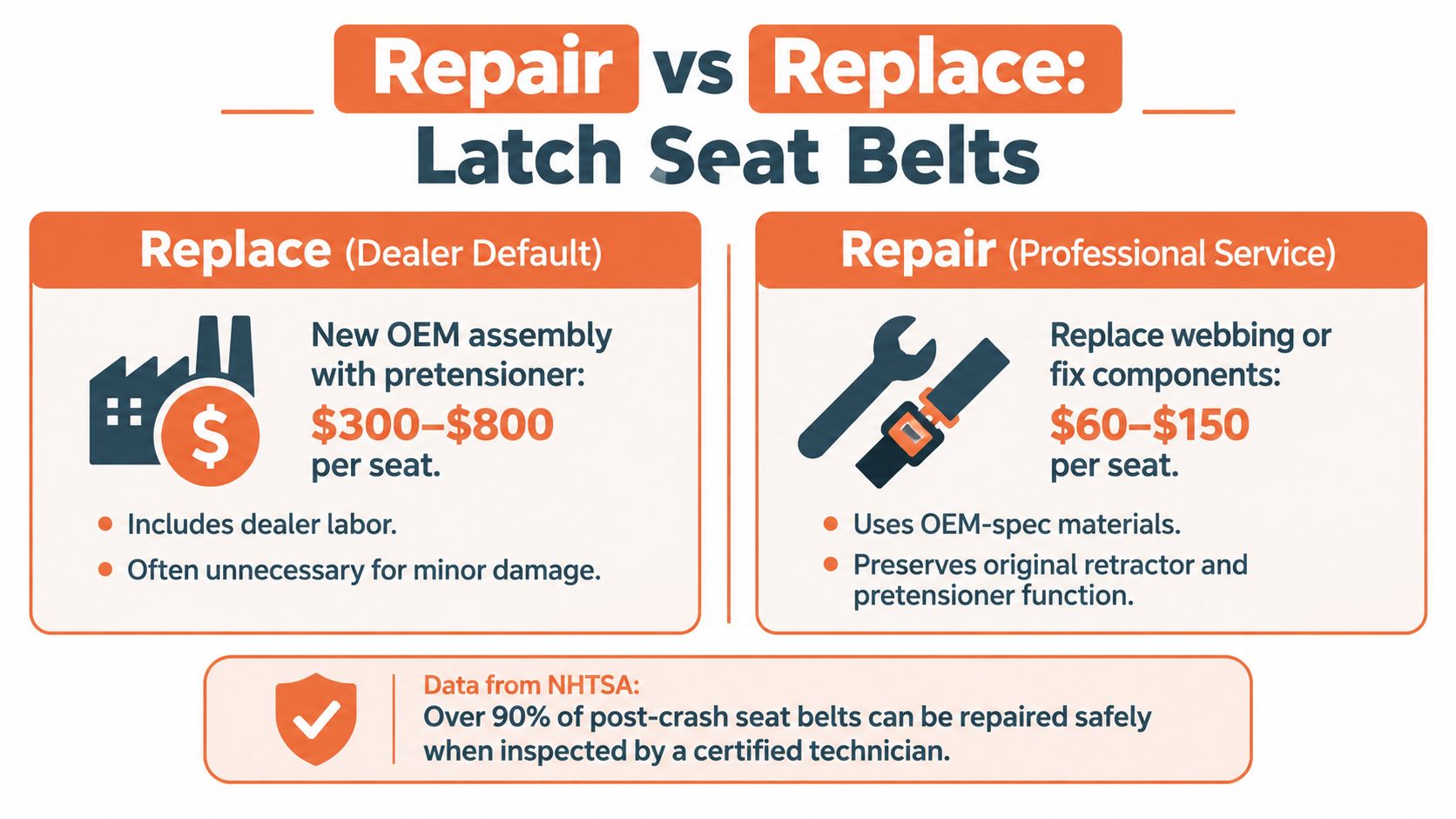
Replacement is still the only safe answer in some cases. Severely damaged mounting points, cracked hardware housings, parts with uncertain origin, or assemblies contaminated beyond reliable service should end the debate. The mistake isn't replacing when replacement is necessary. The mistake is assuming every post-crash or malfunctioning latch seat belt belongs in that category before anyone diagnoses the actual failure.
Choosing a Repair Service and Knowing When to Trust It
The hard part isn't finding someone who says they repair seat belts. The hard part is finding a shop that treats the assembly like a safety device instead of trim hardware.
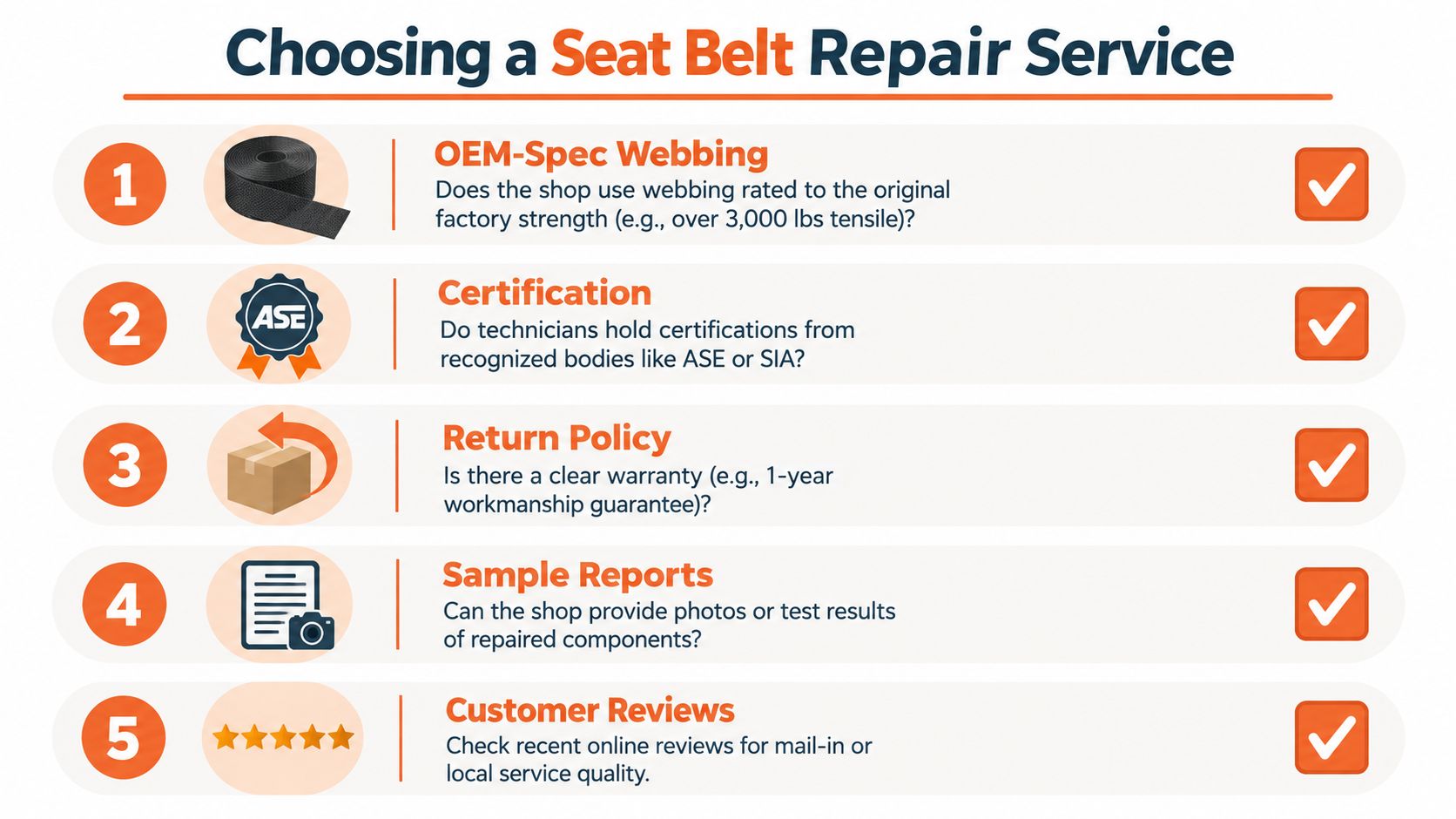
Questions worth asking before you ship anything
Ask what the shop does with a deployed pretensioner. A credible answer should describe actual component replacement or rebuild procedures, not vague language about “resetting” everything. Ask whether they bench-test the retractor lock function after service. Ask what webbing they use, and whether their process aligns with the original design requirements.
If you want a broader screening framework, this guide on how to choose the best seat belt repair service online covers the practical questions customers should put in front of any provider.
Repair types are not all the same
Some services are basically cosmetic or maintenance-oriented. They clean the mechanism, improve spring tension, or fix a sluggish rewind. That can be appropriate for a nuisance fault on an otherwise healthy assembly.
A post-crash rebuild is different. It needs to address deployed hardware, confirm proper locking behavior, and document what was done. If a shop treats those two jobs like they're the same thing, that's a red flag.
The best question is often the simplest one. “What failed inside this belt, and how will you prove it works now?”
Red flags that should slow you down
Watch for repair claims that are all speed and no detail. The issue isn't whether a shop works quickly. The issue is whether they can explain the process and provide documentation that matches the seriousness of the part.
A few warning signs stand out:
- No component-specific explanation: If the answer to every problem is “we reset it,” keep looking.
- No testing language: A repair provider should be able to describe how they verify locking and release behavior.
- No documentation trail: Shops handling safety components should be comfortable discussing records, part identification, and what was replaced.
- No distinction between webbing work and crash repair: Those are related services, not identical ones.
Mail-in service can be a strong fit for salvage rebuilders and shops that need consistent process across many vehicles. Local specialty service can be useful when fast diagnosis and face-to-face inspection matter more. The right choice depends less on geography than on whether the provider can explain the repair in technical terms that make sense.
Putting It Together for Drivers, Shops, and Rebuilders
You notice the problem in a normal moment. The belt clicks, but the pull feels rough. Or it retracts slowly after a grocery run. Or the car came back from auction with an SRS light and a “clean-looking” interior. Those are the cases where a basic latch issue can turn out to be a retractor lock, a fired pretensioner, or crash history hiding inside the assembly.
For drivers, start with simple observations that mean something. Pull the belt fully out. Check the webbing for cuts, heat marks, fraying, or stiffness. Buckle and unbuckle it a few times, and pay attention to whether the latch plate enters cleanly, whether the release button feels normal, and whether the belt rewinds with steady tension. If the vehicle has crash history or an active airbag light, treat the belt as a restraint-system diagnosis, not a convenience problem.
Body shops need to separate what the customer feels from what the hardware did. A slow return can be worn webbing or contamination. A locked belt after impact can point to retractor activation or a pretensioner event even when the buckle side looks fine. Good estimates reflect that difference, because a complete dealer replacement is not the only answer when the original assembly can be properly serviced and tested.
That distinction is where salvage rebuilders save real money.
A rebuilder handling multiple post-crash cars needs a repeatable process. Record the symptoms before parts get moved around. Keep assemblies matched to the vehicle they came from. Avoid unknown used belts with unclear crash history, because a cheap take-out part can create more cost in reinspection, delays, and failed safety checks than a documented repair on the original unit. On the right vehicles, that process can save thousands across a batch of rebuilds.
Child restraints add another layer. Incorrect lower-anchor and tether use remains common, which is why installation quality matters as much as hardware choice (child restraint misuse findings). In the same practical sense, an adult belt that clicks but does not retract, lock, or release the way it should is not doing its full job.
NHTSA reported that adult front-seat belt use in U.S. passenger vehicles remained above 90 percent in 2024 (NHTSA seat belt use findings). The bigger failure point in shop work is usually not whether a belt is present. It is whether the latch, retractor, and pretensioner are all still working as a matched safety assembly.
A latch seat belt feels simple from the driver seat. Inside, it is a mechanical and pyrotechnic system with parts that can wear, lock, or deploy for different reasons. Good diagnosis protects drivers from guesswork and helps shops and rebuilders avoid replacing expensive original hardware when a documented repair is the better call.
If your latch seat belt is locked, slow to retract, deployed after a crash, or has damaged webbing, Seat Belt Repair provides mail-in pretensioner repair, webbing replacement, and SRS module reset for vehicles across the U.S. It's a practical option for drivers, body shops, and salvage rebuilders who need documented service on original assemblies instead of defaulting straight to full replacement.

Laisser un commentaire
Ce site est protégé par hCaptcha, et la Politique de confidentialité et les Conditions de service de hCaptcha s’appliquent.