
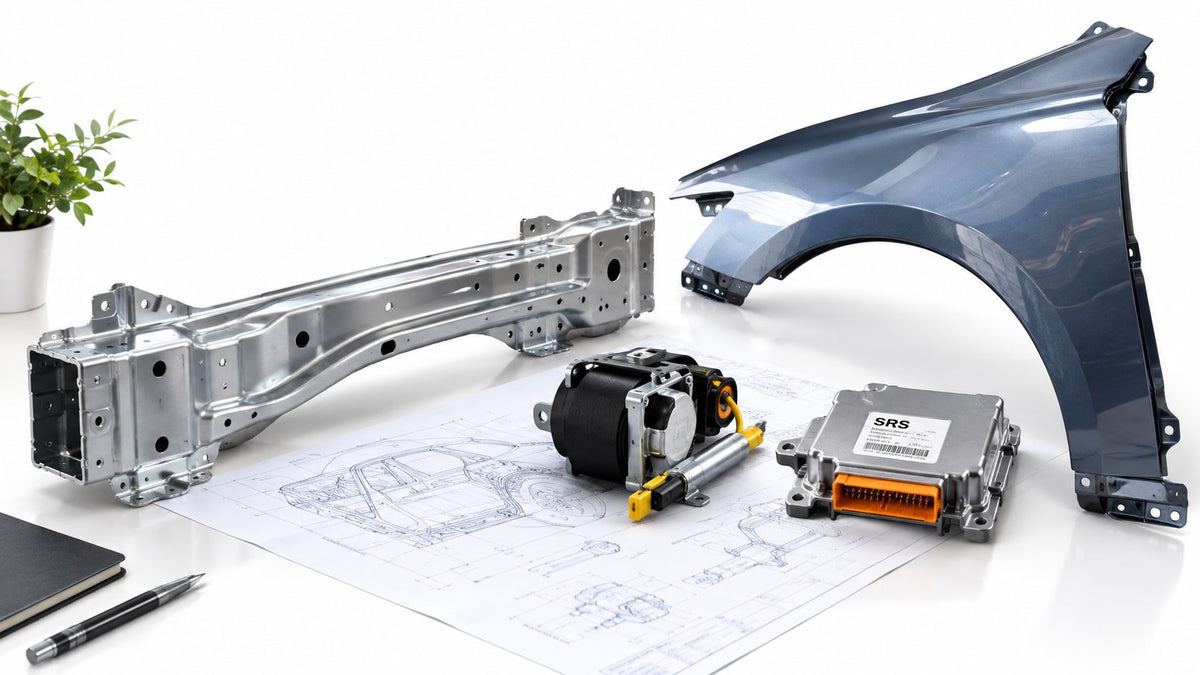
A wrecked vehicle lands in your yard or pulls into your shop. The estimate starts small. Front bumper cover, headlamp, fender liner, maybe a belt tensioner. Then you get deeper. The rail looks tweaked. The retractor is locked. The airbag light is on. A sensor bracket may be bent. Suddenly the parts list isn't just a shopping list. It's a set of decisions that affects safety, profit, cycle time, and whether the customer trusts the repair when they drive away.
That's where a lot of rebuilders and shop owners get jammed up. They treat all collision repair parts like they belong in one bucket. They don't. A bumper cover and a lower rail extension are not the same kind of decision. A used door shell and a deployed seat belt pretensioner are not the same kind of risk. If you price and source them the same way, you can lose money on one job and compromise repair integrity on the next.
I've seen this most often on salvage rebuilds, where the pressure to control costs is constant and the damage story isn't always obvious from the auction photos. If that sounds familiar, this guide pairs well with this breakdown of salvage car repair decisions.
Table of Contents
- Introduction Why Collision Repair Parts Choices Matter Now
- Understanding Collision Repair Parts and Where They Fit
- OEM vs Aftermarket vs Recycled and Remanufactured Options
- How Safety and Structural Integrity Shape Parts Selection
- Common SRS and Seat Belt Parts You Will Encounter After a Collision
- Choosing Between Repair and Replacement for Shops and Rebuilders
- Putting It All Together for Safer Faster Repairs
Introduction Why Collision Repair Parts Choices Matter Now
Collision work is a parts business as much as it's a metal and paint business. The global automotive collision repair market was estimated at USD 199.56 billion in 2023 and is projected to reach USD 227.60 billion by 2030, implying a 1.9% CAGR from 2024 to 2030 according to Grand View Research's automotive collision repair market analysis. The same source also notes a more recent estimate of USD 194.38 billion in 2025, rising to USD 228.23 billion by 2034, with Asia Pacific holding 36.19% of the market in 2025. That tells you something important. Collision repair parts are not a side category. They sit inside a massive repair economy that keeps moving because vehicles keep getting damaged and put back on the road.
The real problem starts after teardown
The hard part isn't finding a part number. The hard part is deciding what kind of part belongs in what location on the car.
One estimate might include all of these at once:
- Cosmetic pieces like bumper covers, grilles, moldings, and fender liners
- Bolt-on panels such as doors, hoods, decklids, and fenders
- Structural pieces like rails, pillars, reinforcements, aprons, and core supports
- Safety system components including seat belt retractors, pretensioners, modules, and related hardware
Each one asks a different question. Does it need perfect appearance? Does it need exact geometry? Does it influence crash performance? Can the original part be restored safely, or is replacement the only sound move?
Practical rule: If a part helps manage crash energy or restraint timing, treat it like a safety decision first and a cost decision second.
Smart sourcing protects more than your margin
Good parts choices do three jobs at once. They protect the occupants, protect the repair from comeback issues, and protect your bottom line from wasted labor on poor-fitting or unnecessary replacement parts.
That's why the smartest operators sort collision repair parts into two big groups early. Safety-critical and cosmetic. Once you make that split, the rest of the estimate gets easier to think through.
Understanding Collision Repair Parts and Where They Fit
Collision repair parts make more sense once you sort them by function instead of by catalog label. On an estimate, one part may be there to restore appearance, another to hold alignment, another to manage heat, and another to help protect the occupant during the next crash.
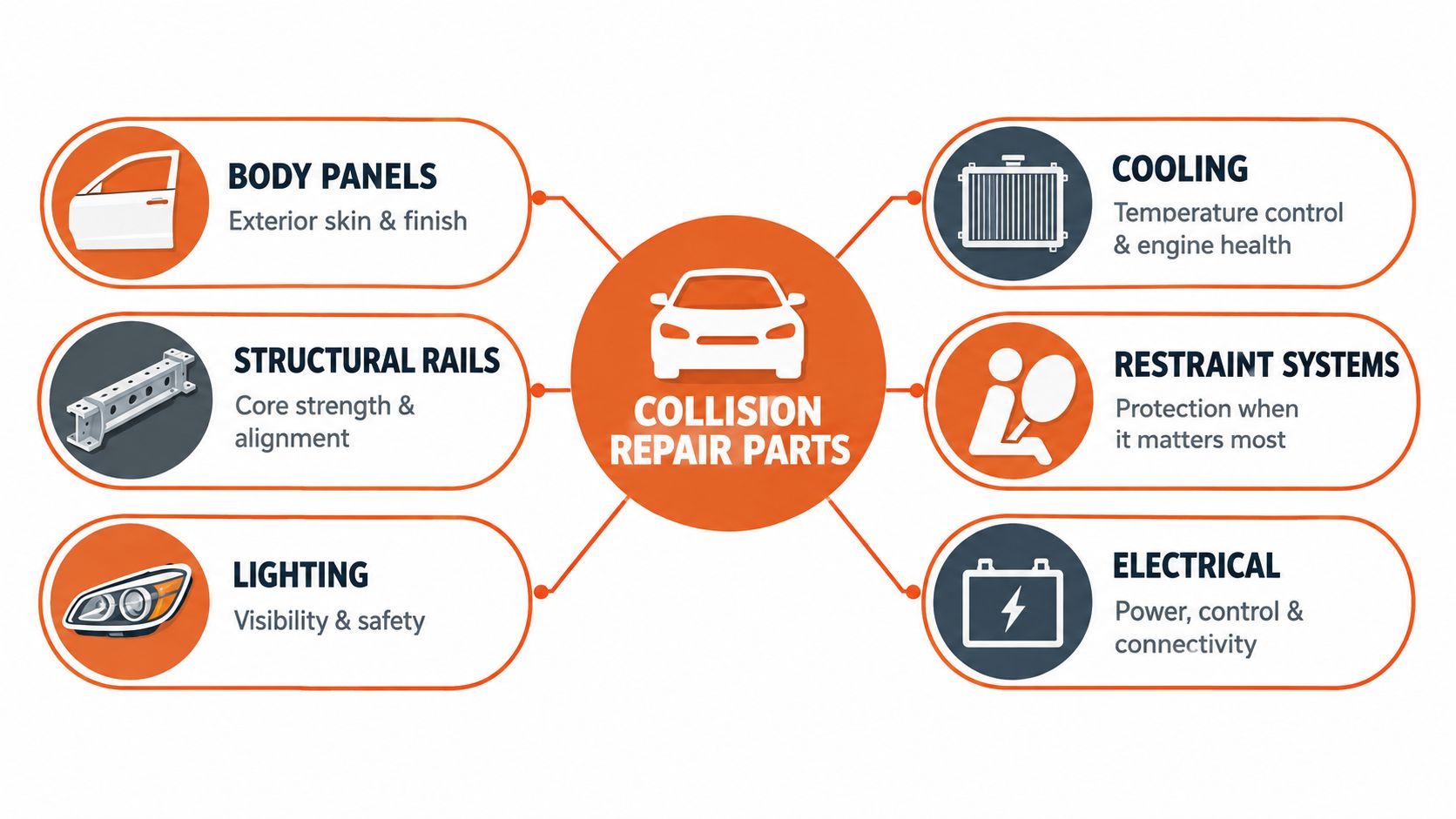
A practical way to read the vehicle is through three functional layers: cosmetic parts, structural parts, and safety system parts.
Cosmetic parts restore what the customer sees first. Bumper covers, grilles, moldings, lamp bezels, door skins, and trim pieces belong here. Their job is fit, finish, corrosion protection, and appearance. If one of these parts is slightly off, the problem usually shows up as bad gaps, paint issues, wind noise, or an unhappy owner.
Structural parts do a different job. Rails, pillars, aprons, rocker reinforcements, core supports, and crossmembers help hold shape and control how force travels through the body. A small error here can create much bigger trouble than a visible cosmetic defect, because geometry affects suspension position, panel fit, and crash behavior.
Safety system parts sit in their own category because they do more than support or cover. Seat belt retractors, pretensioners, airbags, crash sensors, wiring in restraint circuits, modules, and related hardware all affect occupant protection. These parts deserve separate attention even when the damage around them looks minor.
That split matters because shops often waste time arguing over the wrong line items. Cosmetic parts usually raise questions about fit and finish. Safety-critical parts raise questions about function, timing, and whether the original component can be restored to proper operation or should be replaced.
Analysts at Dataintelo's collision repair parts market report found that body panels make up the largest product segment in this market. That tracks with daily shop traffic. A large share of repair volume comes from visible outer parts on passenger vehicles, which is why many parts debates start with bumper covers, fenders, and lamps.
But volume can hide risk.
A bumper cover may be mostly cosmetic, while the reinforcement, absorber, brackets, sensor mounts, and related restraint components behind it may affect crash performance. A seat belt system creates the opposite situation. It may show little or no visible damage, yet still need careful inspection, testing, repair, or replacement because its job is safety, not appearance.
Here is a simple way to sort any estimate line:
-
Does the part mainly restore appearance?
Treat it as cosmetic first. -
Does the part carry load, hold dimensions, or redirect crash force?
Treat it as structural. -
Does the part restrain the occupant, sense impact, or trigger a restraint event?
Treat it as safety-critical. -
Does it sit next to sensors, belts, airbags, or mounting points for those systems?
Slow down and confirm its role before sourcing it.
That last step is where newer rebuilders get tripped up. A part can look ordinary and still affect a safety system because it locates a sensor, supports a module, or controls belt geometry.
If you can state a part's job in one clear sentence, you are much closer to the right decision. If you cannot, stop and verify before you buy, repair, or install it.
OEM vs Aftermarket vs Recycled and Remanufactured Options
The four main sourcing paths each carry different tradeoffs, and the right choice depends on the part's job on the vehicle.
A shop can save money on a bumper cover and lose it right back if the holes are off, the edges fight the adjacent panels, or the sensor bracket sits a few millimeters out of place. The same estimate can work in the opposite direction with a seat belt assembly. In that case, replacing the whole unit with a random used part may cost more and give you less confidence than restoring the original assembly through a tested repair process.
That is why experienced estimators sort parts by role before they sort them by price.
What each sourcing option really gives you
OEM parts follow the original manufacturer's design, materials, and mounting layout. They are usually the safest starting point when fit, sensor position, crash energy management, or restraint operation leaves little room for variation.
Aftermarket parts are built by third-party manufacturers. Some fit well and perform fine in low-risk cosmetic areas. Others add hidden cost through poor hole alignment, edge shape, surface prep, hardware mismatch, or extra labor to make the part sit right.
Recycled parts are original used components removed from another vehicle. Their main advantage is that they began life as OEM. Their main risk is history. A used door shell or lamp support may be a good buy if you can verify condition, prior damage, corrosion, and mounting integrity.
Remanufactured parts are used assemblies restored to serviceable condition. This category deserves more attention than it usually gets. On selected components, especially restraint-related assemblies with a documented rebuild and test process, restoration can preserve original geometry and function while cutting unnecessary replacement cost.
| Collision Repair Parts Sourcing Options Compared | |||
|---|---|---|---|
| Sourcing Option | Fit and Quality | Cost and Availability | Best Use Case |
| OEM | Closest match to original design intent and mounting geometry | Often harder on budget and sometimes slower to source | Structural parts, restraint-related applications, sensor-adjacent components, difficult fit areas |
| Aftermarket | Varies by manufacturer and by part type | Often attractive when budget and speed matter | Non-structural cosmetic panels if inspected carefully for form and function |
| Recycled | Original manufacturer part, but condition must be verified | Often useful when new parts are backordered or expensive | Doors, decklids, bolt-on panels, trim, and other parts where prior damage can be ruled out |
| Remanufactured | Depends on who restores it and how it's tested | Can reduce replacement spend while preserving original assemblies | Seat belt components, modules, and selected serviceable assemblies with proven rebuild process |
The mistake that drives bad parts decisions
Shops get in trouble when they use one rule for every category of part.
A non-structural fender, lower splash shield, or trim panel can justify an aftermarket option if fit and finish check out. A recycled OEM door or decklid can also make solid financial sense if the part is clean and straight. Those are mainly appearance and fit decisions.
Safety-critical and restraint-related parts need a different standard. Here, the question is not just "Will it bolt on?" The better question is "Will it work the same way under load, in a crash event, or during belt retraction and locking?" That is where blind part swapping creates risk.
For restraint hardware in particular, replacement is not always the smartest path. A tested repair on the original assembly can be better than an unknown used unit because you keep the correct factory component for that vehicle and restore its function through a controlled process. This breakdown of new vs used vs repaired seat belt assemblies and what is actually safe explains that choice clearly.
A practical shop rule
Use OEM first for parts tied to crash management, restraint timing, sensor mounting, or structural load path.
Use aftermarket carefully for visible, non-structural parts where inspection and trial fit can catch problems before delivery.
Use recycled OEM where original build quality matters but the part's condition can be verified with confidence.
Use remanufactured service when the original assembly can be restored, tested, and returned with known function, especially on selected SRS and seat belt components.
Good estimates are built on this split. Cosmetic parts can tolerate more sourcing flexibility. Safety-critical parts usually cannot, and some restraint components are best handled by restoring the original assembly instead of replacing it just because it was involved in a collision.
How Safety and Structural Integrity Shape Parts Selection
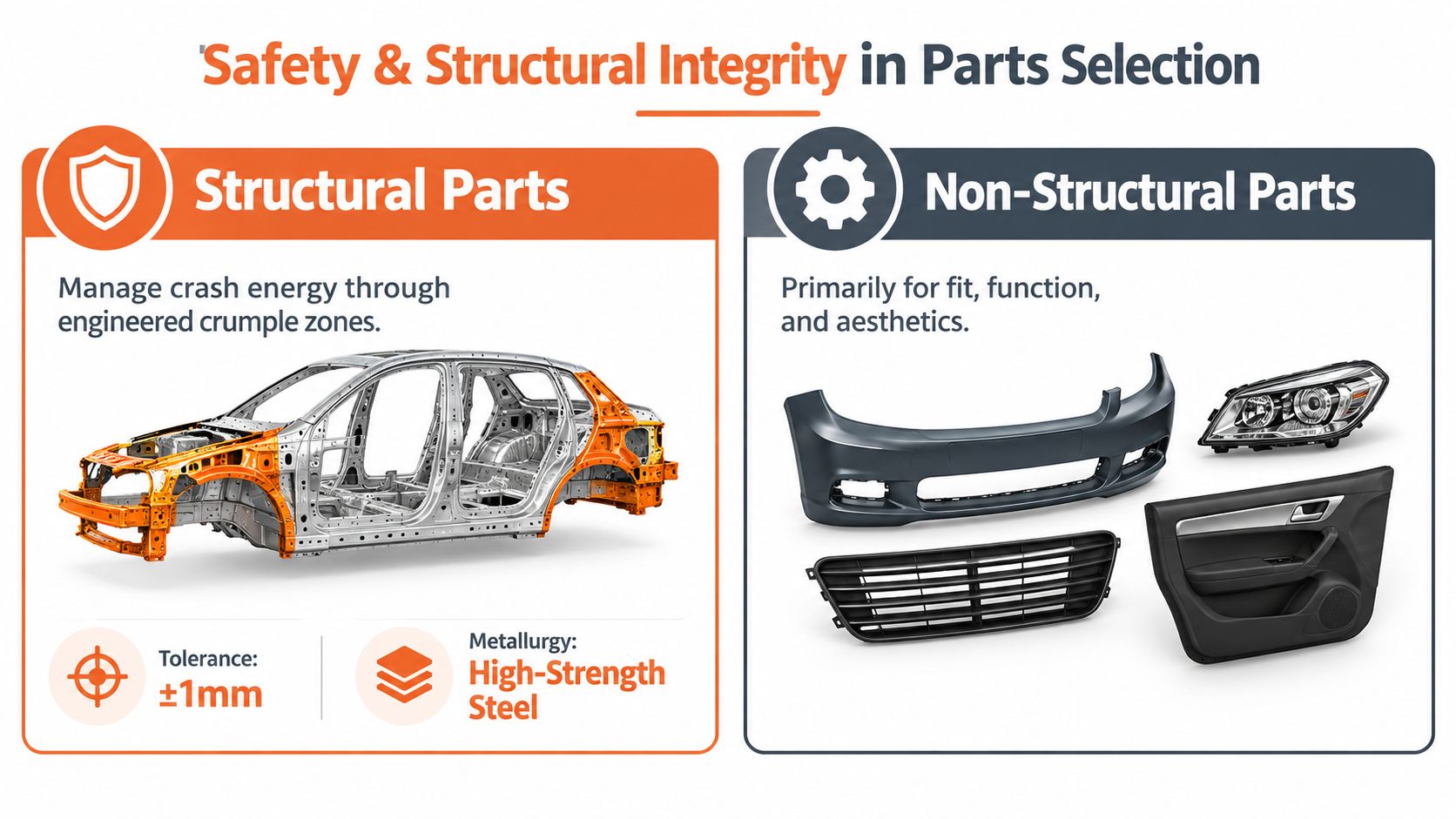
This is the dividing line that keeps a repair honest. Structural parts and cosmetic parts may both bolt to the same vehicle, but they don't answer to the same standard.
Structural parts do more than hold shape
The Insurance Institute for Highway Safety explains that OEM collision replacement parts are engineered to the vehicle maker's original tolerances and validated as part of the vehicle's crashworthy system, and that structural parts such as rails, pillars, and reinforcement bars directly influence how crash energy is managed and transferred through the body, while non-structural cosmetic parts like fenders and bumper covers generally do not affect crash test outcomes in its piece on aftermarket repair parts and crashworthiness.
That's the heart of the issue. A structural rail isn't just a chunk of metal shaped roughly like the old one. It is part of a controlled force path.
Small errors can create bigger consequences
When a structural part is off, problems don't stop at appearance.
You may see:
- Load-path changes that alter how crash force moves through the body
- Panel gap irregularities that hint at geometry drift
- Fastener or mounting stress that shows up later as noise, corrosion, or poor alignment
- Restraint timing concerns because the body may not respond the way the original design expected
A fender that needs a little persuasion is annoying. A rail section that shifts force differently is a safety issue.
Structural parts need more than “close enough.” They need to behave like the original part when the next hit happens.
What that means for sourcing decisions
This doesn't mean every aftermarket part is automatically bad. It means you can't use the same buying logic on every category.
For non-structural cosmetic parts, you're usually focused on surface quality, mounting consistency, corrosion protection, and labor time to make it fit.
For structural parts, you're focused on geometry, metallurgy, fastening points, and how that part participates in occupant protection.
That's why many experienced estimators will accept alternatives in the skin of the car but tighten standards immediately in the skeleton of the car.
The NHTSA point people often miss
The National Highway Traffic Safety Administration has stated that aftermarket crash parts are within its authority to regulate if they contain a safety-related defect, but it has not identified a general safety defect across the category to date in this NHTSA interpretation on aftermarket crash parts. That doesn't mean all aftermarket parts are equal. It means the category is mixed, and the burden is on the repairer to verify whether the specific part is suitable for the specific job.
That's the practical takeaway. Don't ask whether aftermarket is good or bad in the abstract. Ask whether this exact part, in this exact location, preserves repair integrity.
Common SRS and Seat Belt Parts You Will Encounter After a Collision
Restraint parts confuse people because the damage isn't always obvious. A belt can look fine and still be locked. A module can look untouched and still store crash data. A buckle can click normally and still belong to a deployed system that needs service.
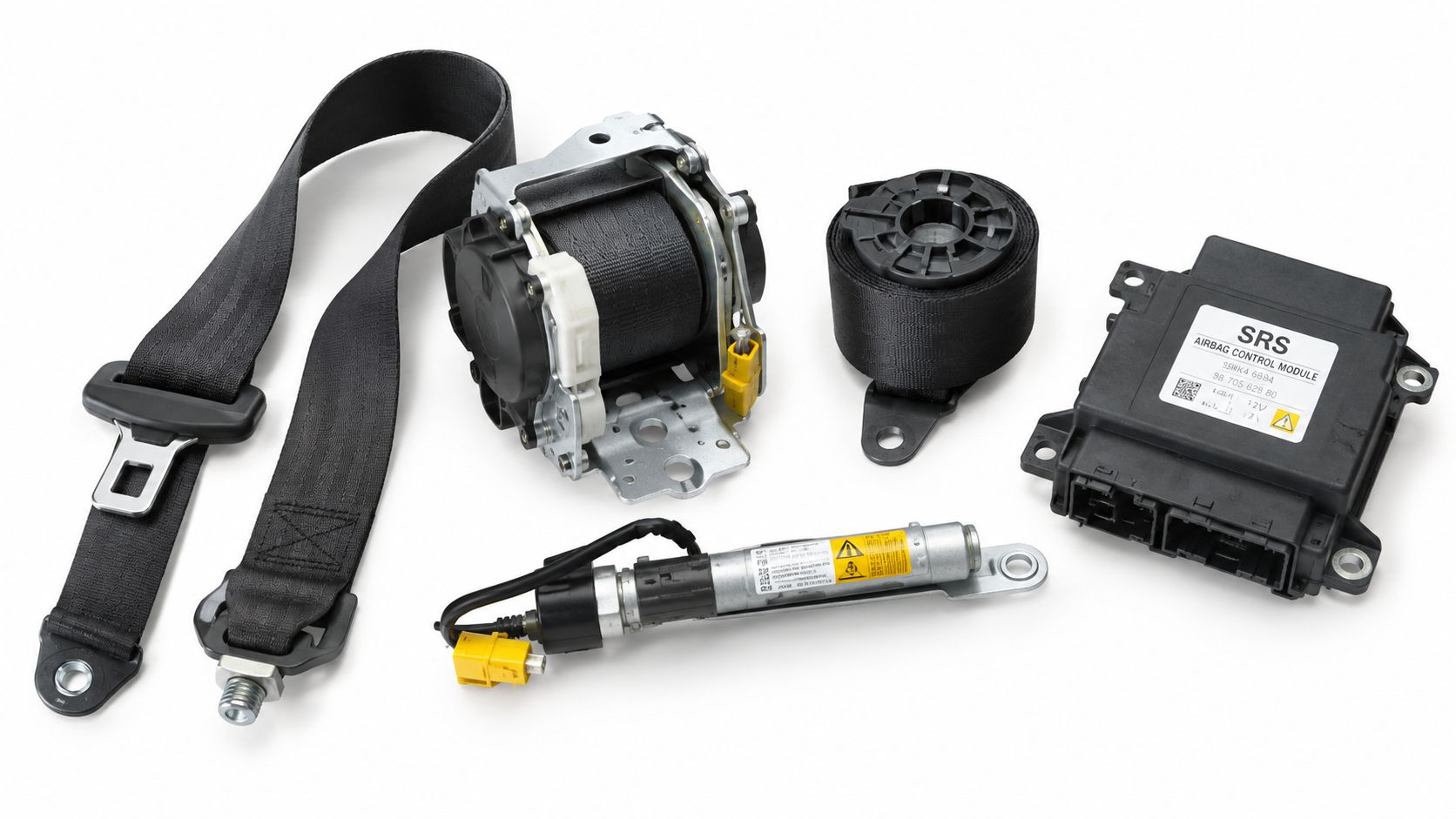
The parts you'll most often inspect
Start with the pieces that usually trigger post-collision questions.
-
Seat belt retractor
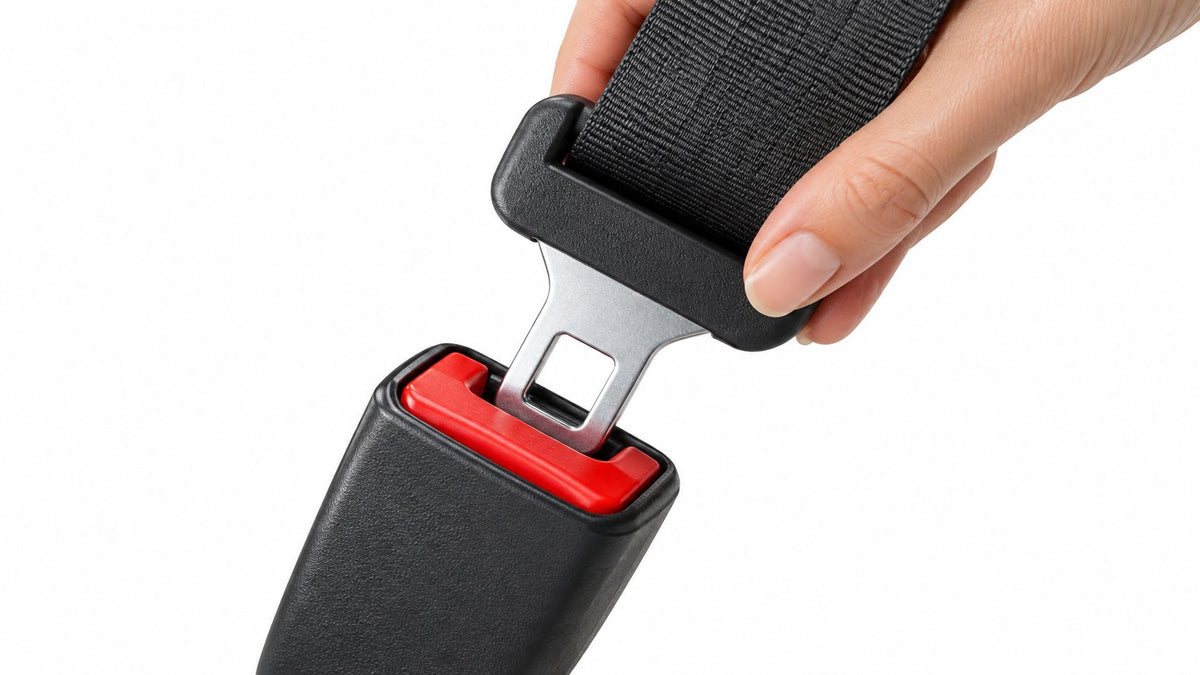
This is the spool mechanism that stores and controls webbing. After a crash, it may lock and stop retracting normally. -
Pretensioner
This is the component that tightens the belt rapidly during a crash event. On many vehicles, deployment leaves the assembly spent or locked and in need of proper service. -
Webbing
If it's cut, frayed, burned, or chewed, it isn't a cosmetic issue. The belt material itself is part of the restraint system. -
Buckle and latch hardware
These parts can be overlooked during teardown, especially when the visible crash damage is elsewhere. -
SRS airbag control module
This module records crash events and can store hard fault data that a basic scan-tool clear won't fix after deployment.
Why the warning light stays on
A lot of rebuilders buy a salvage vehicle, replace visible damage, reconnect the battery, and then hit a wall when the airbag light remains on. That usually means the vehicle still sees a fault in the restraint system, or the original module has stored crash data and needs proper reset after damaged components are addressed.
The same thing happens with belts. The webbing may pull out halfway and stop, or the retractor may not return smoothly. That isn't a nuisance problem. It's a sign the restraint assembly needs close inspection.
For a plain-language breakdown of one of the most misunderstood components, this guide on the seat belt pretensioner and why it needs repair is worth reading.
Single-stage, dual-stage, and triple-stage belts
Not every seat belt assembly is built the same way. Some vehicles use a simpler setup. Others use multi-stage pretensioning strategies tied into the broader SRS logic.
A practical field clue is connector count and assembly design. If you're not certain what stage system you're handling, don't guess. Identify the exact assembly before ordering or sending anything out for service.
Here's a useful visual overview before you dive deeper into diagnosis:
What usually needs professional service
Some issues need more than code clearing or parts swapping.
Common examples include:
- Locked pretensioners that need internal service or replacement of deployed mechanism parts
- Stored crash data in the SRS module that requires proper reset to factory-ready condition
- Damaged webbing that needs correct replacement and stitching
- Non-retracting belts where the retractor function must be restored and tested
A scan tool can tell you there's a restraint problem. It usually can't rebuild the component that caused it.
That distinction saves a lot of wasted diagnostic time.
Choosing Between Repair and Replacement for Shops and Rebuilders
A rebuilder has a late-model vehicle on the frame rack. The front end damage looks manageable, but the estimate gets messy fast once the restraint system enters the picture. A bent bracket and a torn bumper tab are one kind of decision. A fired pretensioner or locked belt is another. If you treat both the same way, you either overspend or take on risk you did not need.
The cleanest way to decide is to split the job into two buckets. First, ask whether the part is safety-critical or cosmetic. Then ask whether the original part is structurally sound enough to repair or restore. That two-step filter keeps you from replacing good OEM safety hardware just because it is easier to write on an estimate.
Start with the part's job
A damaged fender, bumper cover, or trim piece mainly affects appearance, fit, and cycle time. A rail section, reinforcement, seat belt assembly, or SRS control component affects crash performance or occupant protection. Those parts deserve a different standard.
If a structural metal part has yielded, stretched, cracked, or lost its shape, replacement is usually the safer path. Metal remembers the hit. Once its geometry or strength is altered beyond specification, you are no longer judging paint and panel gaps. You are judging crash behavior.
Restraint components call for a different question. Instead of asking, “Can I find another one cheaper,” ask, “Is the original OEM assembly still a sound base that can be restored and verified?” That matters because original restraint parts already match the vehicle's connectors, mounting points, and system logic.
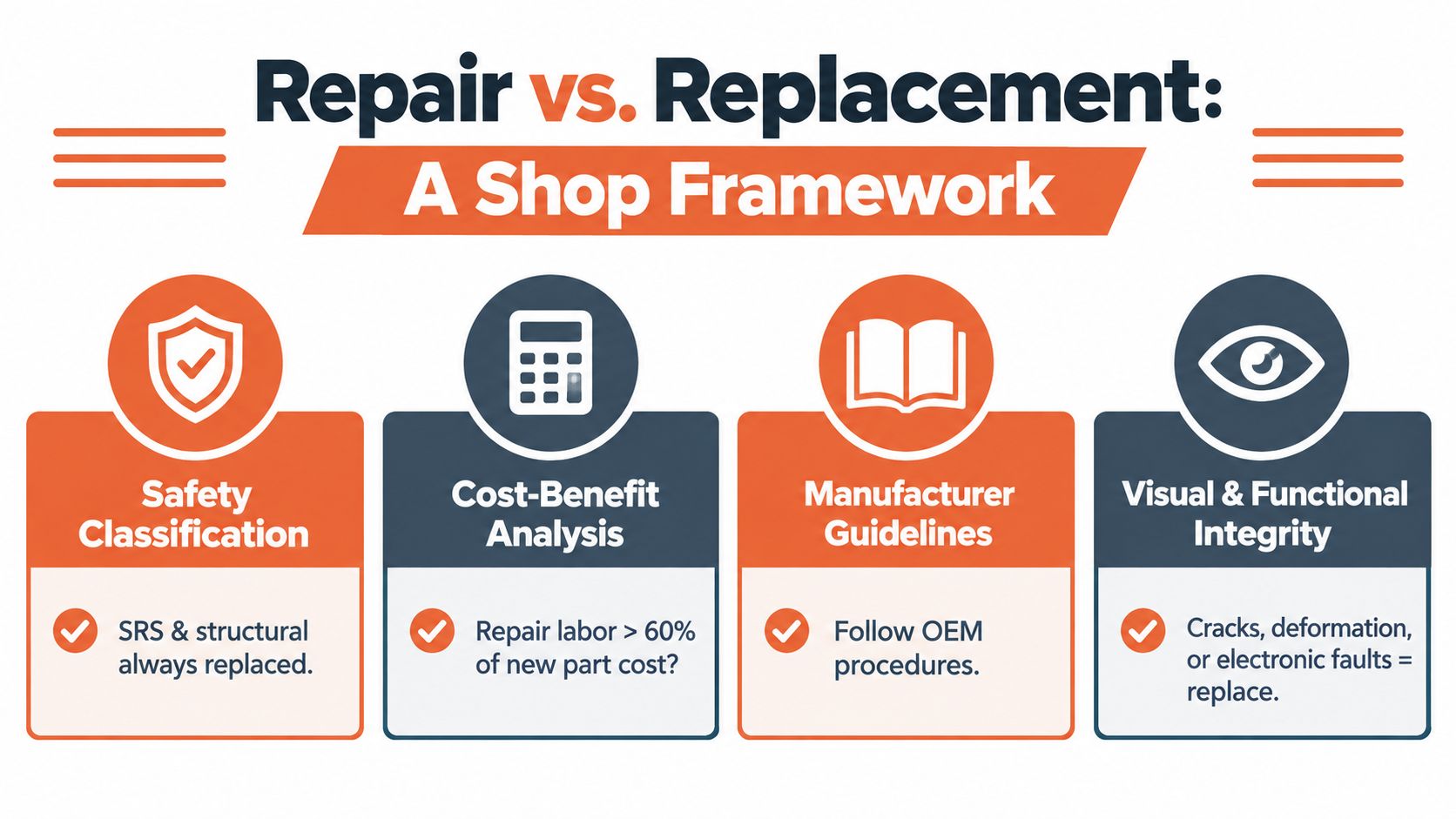
A practical decision checklist
Before you approve repair or replacement, run through these checks:
-
Safety role
If the part manages crash energy or restrains an occupant, follow manufacturer procedures and confirm whether restoration is permitted and testable. -
Base component condition
Check for cracked housings, torn mounts, heat exposure, corrosion, water intrusion, or visible deformation. If the shell or core structure is compromised, replacement usually makes more sense. -
Ability to verify function
A usable path exists only if the part can be tested after service and before final delivery. -
Vehicle-specific fit
Restraint parts are less forgiving than cosmetic panels. A replacement that “looks close” can still create connector, calibration, or compatibility problems. -
Total job cost
Count the full expense. Include programming, calibration, fitment time, and the delays that come from ordering the wrong assembly.
When restoration makes more sense
This is often where shops leave money on the table. They replace an entire seat belt assembly or SRS module even though the original unit is still a good candidate for professional service.
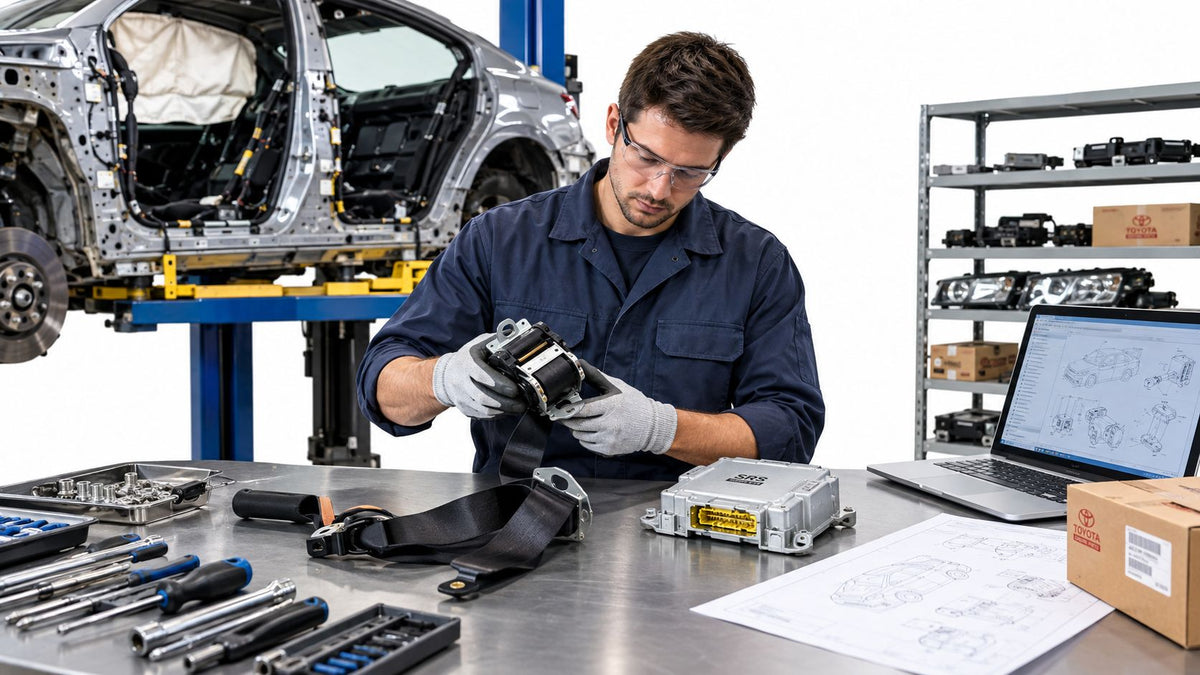
For pretensioners, retractors, webbing, and some airbag control modules, restoration can be the better call when the housing, mounting points, and core assembly remain serviceable. Using the original OEM component can reduce fit issues and avoid the unknown history that comes with used restraint parts. As noted earlier, Seat Belt Repair offers a mail-in service for certain original safety components.
That does not mean every restraint part should be repaired. It means replacement is not the automatic winner. For safety parts, the better choice is the one that returns the system to verified function with the least uncertainty.
Shop-floor advice: Replace parts that are bent, torn, cracked, stretched, or structurally changed. Restore original SRS components only when the base unit is sound and the service includes proper testing.
The mistake that causes bad estimates
Many shops treat replacement as the conservative choice and repair as the risky one. That logic works for many structural and cosmetic parts. It does not always hold for SRS-related components.
A used seat belt assembly with an unknown history can be a bigger gamble than restoring the original OEM unit. A new replacement module may add cost and programming steps that the job did not need. Good estimating starts with function, condition, and proof the finished part will work as intended.
That is the habit to build. Cosmetic parts are buying decisions. Safety-critical parts are engineering decisions. Some original restraint components sit in a middle lane where verified restoration gives you both cost control and system integrity.
Putting It All Together for Safer Faster Repairs
A vehicle comes in after a front-end hit. The bumper cover is torn, a rail section needs careful review, and the seat belts have locked. If those parts are all treated the same way, the estimate usually gets slower, more expensive, and less accurate. The better approach is to sort the job into two buckets right away: cosmetic parts and safety-critical parts.
That first split changes everything.
Cosmetic and non-structural parts often allow wider sourcing, as long as fit, finish, and mounting points check out. Safety-critical parts call for a narrower standard. For anything tied to crash energy, occupant restraint, or vehicle structure, the goal is not to fill a line on the estimate. The goal is to return the system to known function with as little uncertainty as possible.
That is why good parts decisions work like triage in the shop. You decide what affects appearance, what affects crash performance, and what sits in the middle. Some SRS and seat belt components fall into that middle category, where verified restoration of the original OEM part can make more sense than replacement.
The habits that keep repairs on track
A dependable collision repair parts process usually includes these habits:
- Classify the part by job function first. Ask what it does in a crash, not just what it is called in the catalog.
- Inspect the surrounding area before ordering. A good part can still fit poorly if the bracket, mount, or adjacent panel is shifted.
- Check whether the original restraint component is serviceable. If the housing, mounting points, and core assembly remain sound, restoration may be the cleaner choice.
- Review used and aftermarket parts early. Catching poor fit or hidden damage before paint and install saves rework.
- Verify operation after repair. A restored or replaced component still has to return the system to ready status.
The bottom-line position
Fast repairs do not come from buying every part the same way. They come from choosing parts according to risk. A bumper cover can be judged on fit and finish. A reinforcement, pillar, rail section, pretensioner, or control module has to be judged on function, structure, and proof that it will perform as intended.
For shops and rebuilders, that mindset protects both cycle time and outcomes. It also helps control cost without taking chances in the wrong places. As noted earlier, Seat Belt Repair provides mail-in service for certain original safety components. For locked belts, spent pretensioners, damaged webbing, or modules holding crash data, reviewing those service options may make more sense than defaulting to replacement.
The shops that stay consistent here usually make fewer ordering mistakes, avoid more fitment delays, and produce repairs that are easier to stand behind.

Laisser un commentaire
Ce site est protégé par hCaptcha, et la Politique de confidentialité et les Conditions de service de hCaptcha s’appliquent.