
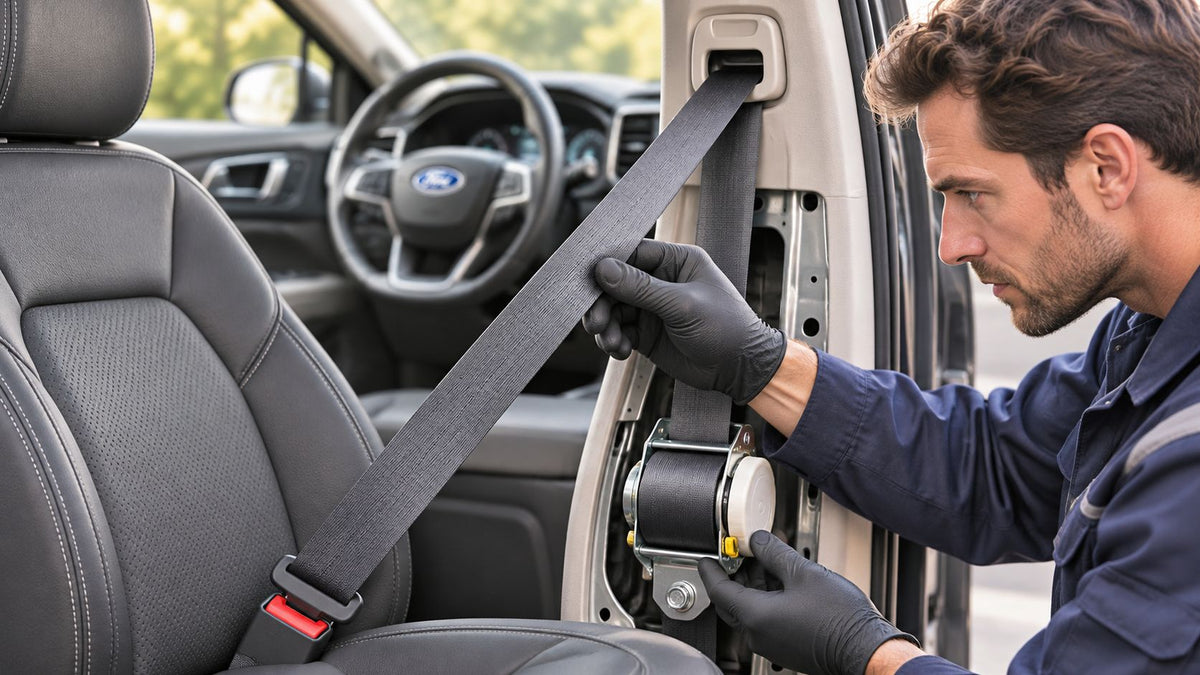
A Ford seat belt that locks after a collision can look perfectly normal: the webbing may be smooth, the plastic cover uncracked, and the belt still stuck inside the pillar. If you've just received a quote for a complete assembly, don't assume every part needs replacing. The right call depends on what failed and whether the housing, webbing, and mounting points are still sound.
A Ford OEM seat belt replacement is the right answer for structural damage, but a locked belt with intact external parts may have a repairable fault inside the retractor or pretensioner. Start by matching the symptom to the likely fault, then check the parts that determine whether repair is appropriate.
Table of Contents
- Match Your Ford Seat Belt Symptom to the Likely Fault
- When Repair Beats Replacement on a Ford
- Real Ford Cases and the Path Each One Takes
- What Drives the Cost of Dealer Replacement
- How the Ford Mail-In Seat Belt Repair Works
- Safety Checks Before Reinstalling a Ford Belt
- Confirm Your Ford Seat Belt Fix Before You Order
Match Your Ford Seat Belt Symptom to the Likely Fault
A belt that locks after a crash is one of the most common reasons an owner looks into replacement. The lock can indicate that the pretensioner or retractor deployed, even when there's no visible damage. Use the table to narrow down the next step.
| Symptom | Likely cause | Usual path |
|---|---|---|
| Belt locked after a crash, no visible damage | Pretensioner or retractor deployed | Repair the retractor and pretensioner |
| Belt will not extend or retract, no crash history | Retractor spring or internal lock fault | Inspect; repair if the housing is intact |
| Webbing cut, frayed, or chewed | Damaged webbing | Replace the webbing, or the full assembly if mounts are also affected |
| SRS or airbag light on after a collision | Module stored crash data or belt fault | Reset the module and check the belt |
| Buckle will not latch or release | Buckle or latch failure | Replace the buckle, usually as a unit |
| Cracked housing or bent mounting points | Structural damage from impact | Replace the full assembly |
A deployed pretensioner can leave the belt locked without cracking the housing or marking the webbing. That doesn't mean the belt is safe to use: the visible fabric and the internal restraint mechanism are separate parts, and either can fail independently. If a belt won't extend or retract without a crash history, inspect it before deciding; a jammed retractor isn't automatically evidence of a deployed pretensioner. The seat belt retractor troubleshooting guide can help you recognize common retractor symptoms.
The SRS light needs its own diagnosis. A belt repair won't necessarily clear crash data stored in the airbag control module, so the warning can stay on after the mechanical fault is fixed.
Run this quick check before calling a shop:
- Does the belt lock, fail to extend, or fail to retract?
- Is the webbing intact, with no cuts, fraying, or chewing?
- Has the vehicle been in a collision?
If the belt has structural damage, don't drive with it in service while you weigh options. Have the restraint system inspected and repaired before relying on it.
When Repair Beats Replacement on a Ford
A locked belt tells you something failed inside. What it doesn't tell you is whether the rest of the assembly survived. Repair makes sense when the structure is sound and the fault sits in the mechanism, and three checks separate a rebuildable belt from one that needs to come out entirely: the housing, the webbing, and the mounts.
Housing: Look for cracks, distortion, or damage around the retractor. A damaged housing can compromise how the mechanism sits and operates, so it isn't a sound candidate for an internal repair.
Webbing: Check the full length of the fabric for cuts, pulled threads, fraying, or heat damage. The webbing must remain intact and have the correct color and stitching; stitching up damaged load-bearing webbing isn't an acceptable shortcut.
Mounts: Inspect the attachment points and the surrounding seat or body structure. Bent mounts, loose hardware, or damage to the seat structure call for further assessment, not a retractor-only fix.
If those three areas pass inspection, the fault is likely limited to the retractor mechanism or pretensioner. Single-stage, dual-stage, and triple-stage belts can all be serviced, but the correct stage has to be identified before the belt goes in. Connector count is the quick way to tell: one plug indicates single-stage, two indicate dual-stage, and three indicate triple-stage. That identification matters because the gas cartridge and internal components differ between stages, so a shop working on your belt needs to know which version it's rebuilding.
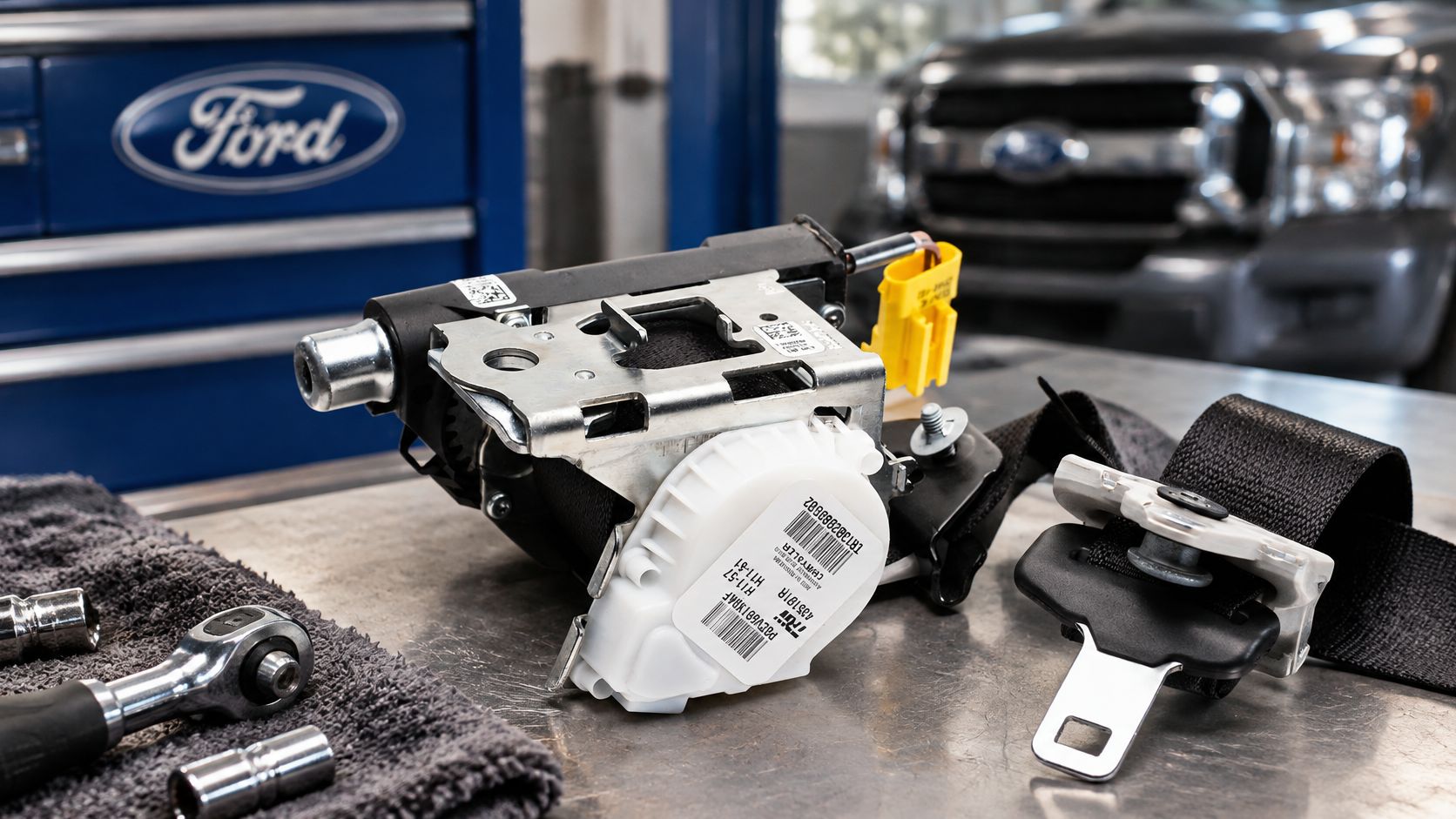
For a locked belt with sound structure, Fix a Stuck Seat Belt After Accident – OEM Seat Belt Repair Service is a mail-in option that rebuilds the original unit with OEM parts rather than swapping in an aftermarket substitute. You keep your factory belt and skip the higher cost of a full assembly.
Some faults land outside what a rebuild covers. Replace torn webbing, a cracked housing, bent mounts, a buckle that won't latch, or a belt attached to a damaged seat or mounting structure. Rule of thumb: repair when the belt is locked or stuck and the housing, webbing, and mounts pass inspection; replace when the damage is structural.
Real Ford Cases and the Path Each One Takes
A driver has a low-speed collision in a Ford SUV. The belt locks, but the cover and mounting points look intact and the webbing has no visible damage. Before pricing a complete assembly, the owner has the belt checked for a deployed pretensioner and asks whether the original unit can be rebuilt, then checks whether the airbag module also stored crash data.
A buyer rebuilding a salvage Ford from an auction faces several locked belts at once. The parts bill stays in check only if each belt is assessed on its own: count the connectors on each retractor to confirm the stage, check the anchor points for bending, and separate belts that need webbing work from those that need only the mechanism serviced. The airbag module needs a reset as well, and the buyer confirms positions, connectors, and mounts before reinstallation rather than assuming the assemblies are interchangeable.
In a different case, a dog has chewed the shoulder belt in a daily driver. The retractor still works, but the webbing is damaged, so a mechanism repair alone won't solve it. The fix is new webbing matched to the original color and strength, and the owner should confirm it tracks cleanly through the guides with no twists before use.
On salvage rebuilds, the buckle is the check most often missed. Buyers count plugs on the retractor and overlook the pretensioner built into the buckle end, so a belt they planned to service at one stage arrives with a second fired charge. Catching it before ordering parts keeps a return shipment out of the job.
What Drives the Cost of Dealer Replacement
A dealer quote bundles several lines into one number, and the belt itself is often the smallest part of the decision. Ask for an itemized breakdown before you approve anything: it shows whether the estimate replaces a complete assembly when the actual fault sits inside the retractor or pretensioner. The seat belt pretensioner replacement cost comparison lays out how a full replacement quote stacks up against a mail-in repair.
A dealer quote typically includes:
- New OEM assembly or pretensioner: the parts line often covers the complete unit even when the housing and webbing survived. Ask whether the quote prices a whole assembly or only the failed component.
- Removal and reinstallation labor: trim panels come off to reach the belt and go back on afterward. Ask how many labor hours the estimate assumes.
- Diagnostic work: the shop scans the restraint system for belt faults or stored crash data. Ask whether the scan fee applies even if you decline the repair.
- Reset or programming: if the airbag module stored crash data, the quote may add a reset line. Ask whether that work is included or billed separately.
- Parts delay: a model-specific assembly can hold the car while it ships. Ask for the expected wait before you commit.
Crash damage can affect several belt positions at once, and the airbag module may need attention on top of that. The scope of a quote shifts with the Ford model, the number of belts involved, and whether the module also needs a reset.
| Option | Scope | Listed price | Turnaround | Installation |
|---|---|---|---|---|
| Mail-in stuck-belt repair | Retractor and pretensioner repair | $64.97 (mail-in) | 24 hours after receipt | Not provided |
| Dealer OEM replacement | New assembly, labor, diagnostic reset, programming if airbag involved | Not stated; request an itemized quote | Set by the shop and parts availability | Included |
The mail-in price covers the retractor and pretensioner, not damaged webbing, a faulty buckle, or an airbag module. Seat Belt Repair uses only OEM parts, and keeping your original factory belt avoids the higher cost of a full replacement when the fault is internal. Before accepting a full assembly quote, ask whether the shop will rebuild the unit or only swap it, and what the quoted work will and won't address.
How the Ford Mail-In Seat Belt Repair Works
Seat Belt Repair runs a mail-in service for OEM seat belt repair after an accident. It suits cases where the belt can be removed safely and the suspected fault sits in the retractor or pretensioner, rather than the webbing, buckle, or mounting structure.
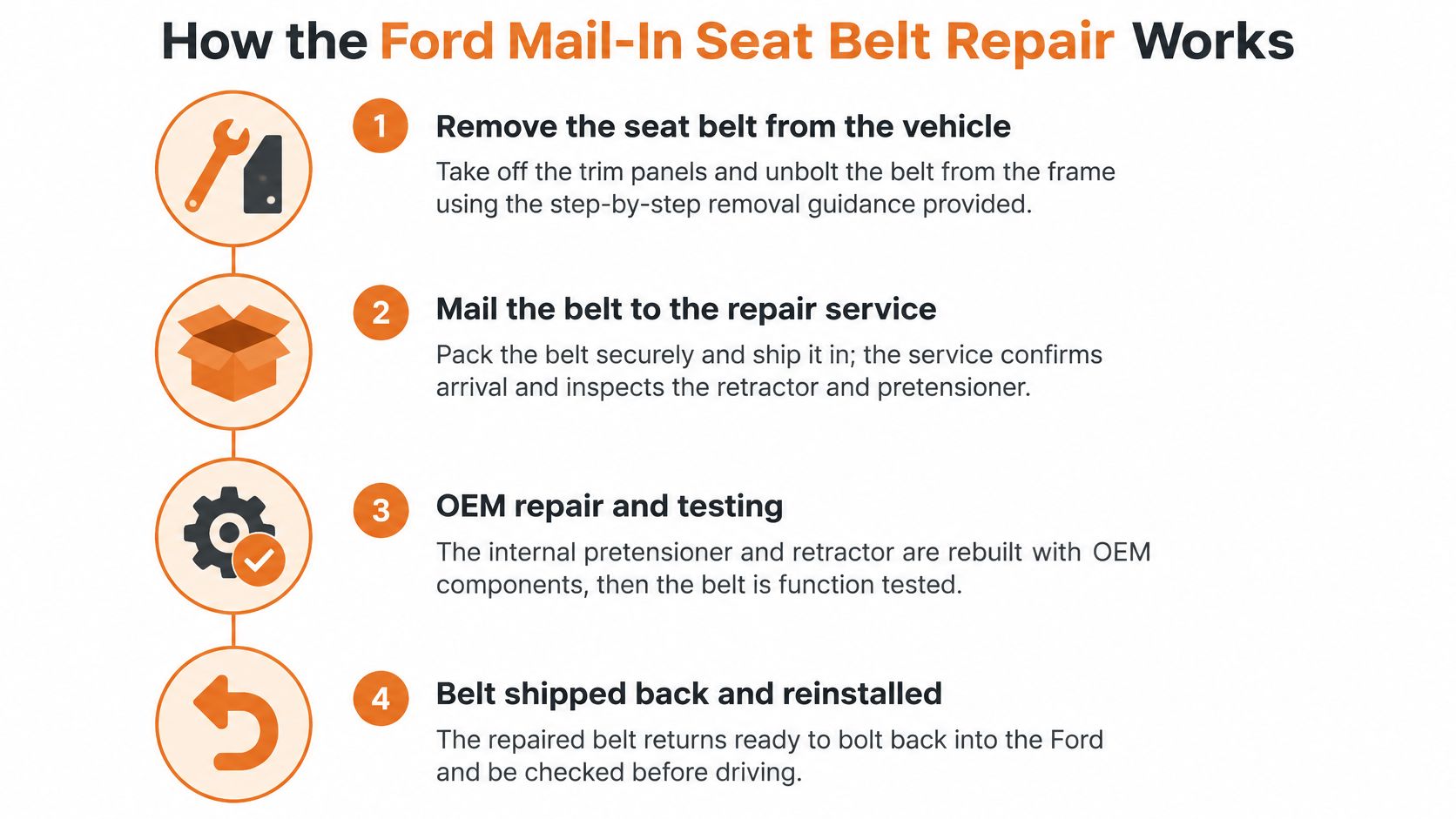
- Remove the belt from the vehicle. Access usually means taking off trim panels and unbolting the belt from the vehicle frame. Step-by-step removal instructions are provided, and help is available if you get stuck; skipping guidance or forcing a panel can break trim clips.
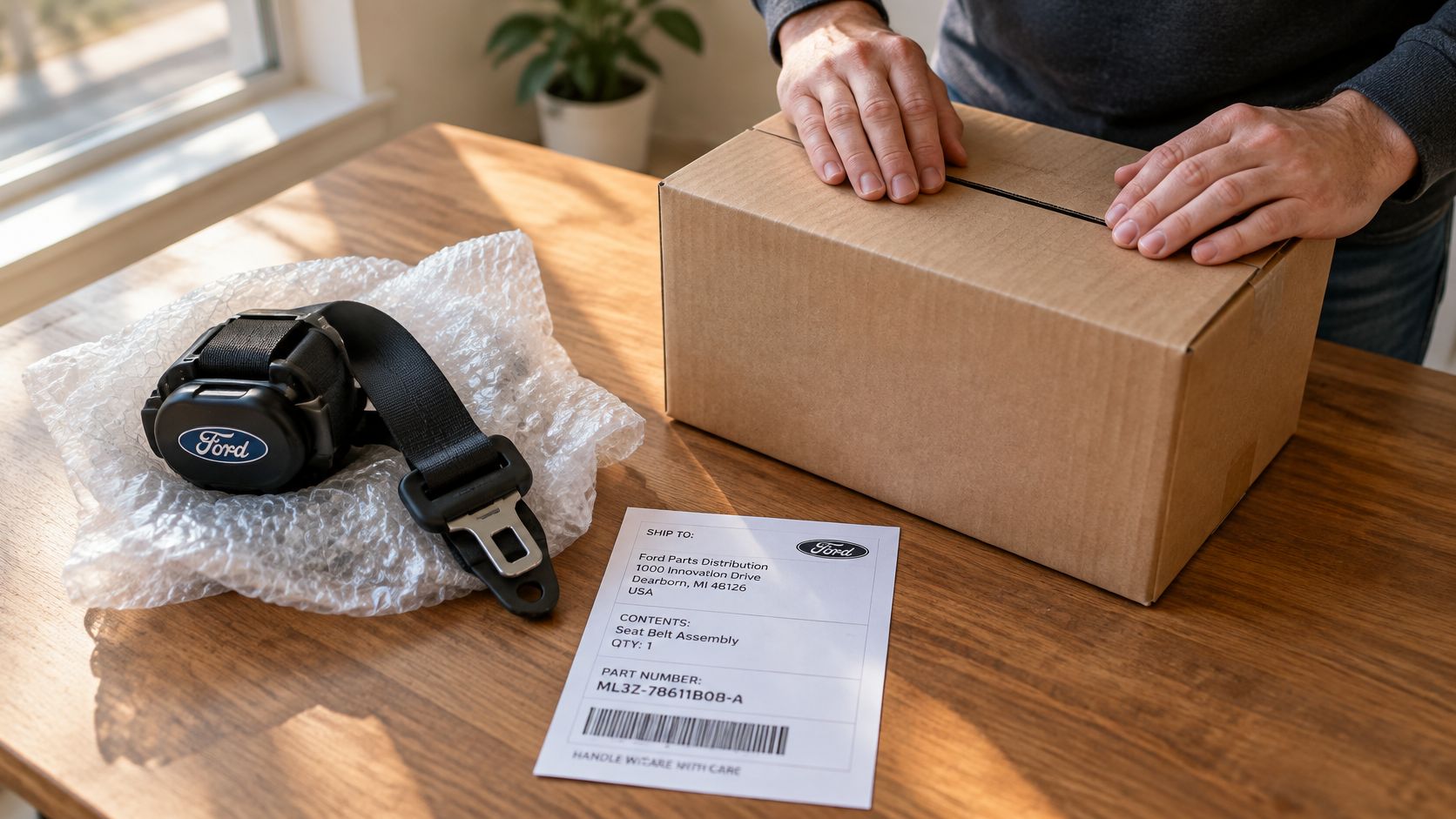
- Package and ship the assembly. Protect the belt so it can't be crushed or snagged in transit, then send it to 40 Main St., Westfield, MA 01085. A loose belt rattling around a box can arrive with avoidable damage.
- Allow time for repair and testing. Repairs turn around in 24 hours after the belt is received. The work centers on the internal retractor and pretensioner using OEM components, so don't assume it covers other damaged parts.
- Receive the repaired belt and arrange installation. The typical total return shipping window runs 24 to 48 hours, and the unit comes back ready for installation. Installation isn't part of the service; reinstall it yourself only if you can follow the correct procedure, or have a local body shop or mechanic do the work.
For background on how the internal mechanism relates to a locked belt, see this guide to seat belt pretensioner repair. The repair covers the retractor and pretensioner; torn webbing or a faulty buckle may need separate work, so get those issues addressed before the car goes back into service.
Safety Checks Before Reinstalling a Ford Belt
Use this checklist before the belt goes back into the vehicle. If you can't confirm a match or spot damage, stop and have the part or installation checked before relying on it.
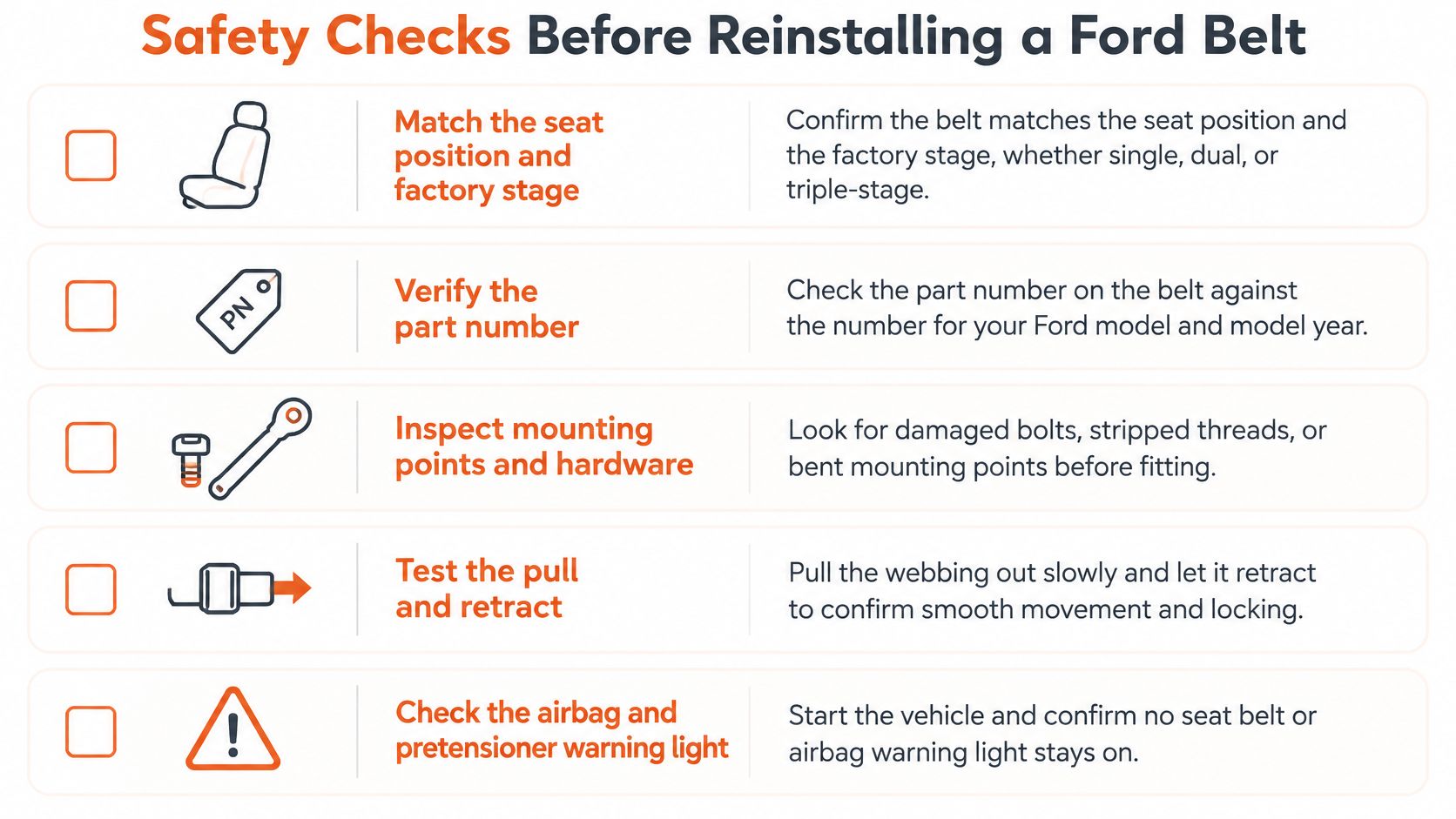
- Match the belt to the seat and factory stage. Confirm that the assembly belongs in that position and has the correct single-, dual-, or triple-stage configuration; connector count helps identify the stage.
- Verify the part number. Compare the number on the belt with the correct listing for your Ford model and model year so you don't fit a similar-looking but incompatible assembly.
- Inspect mounting points and hardware. Look for bent mounts, damaged bolts, or stripped threads, and torque the fasteners to the specification in the Ford service manual.
- Check the pull, retract, and lock. Extend the webbing slowly and let it retract, then check that it locks with a sharp pull; smooth motion alone doesn't prove the locking function works.
- Check the buckle and warning light. Confirm that the buckle latches and releases firmly, and that the SRS or airbag warning light goes out after the battery is reconnected.
If the warning light stays on, have the restraint system diagnosed before driving. The belt and airbag module work as parts of the same safety system, and a belt repair may not clear crash data stored in the module.
Keep the repair paperwork and original part number with the vehicle records. They'll help identify the correct assembly if the belt needs service again.
Confirm Your Ford Seat Belt Fix Before You Order
Before shipping anything, get a few answers from the repair facility in writing. Ask whether the quoted work covers the gas cartridge and mechanism rather than a cosmetic fix, whether the repair uses OEM parts or aftermarket substitutions, and what happens if the belt fails its function check after the work. Ask how the facility identifies your belt's stage, since a single-, dual-, or triple-stage Ford assembly needs the correct procedure for its connector count.
For a locked or deployed belt, mail-in repair keeps your original factory assembly and avoids the higher cost of full replacement. Confirm the unit will be function-tested before return shipment, keep the original belt until the incoming part is installed and checked, and flag any SRS light still on once the car is back together.
A facility that cannot answer the parts and testing questions directly is a reason to price the dealer replacement instead.
Seat Belt Repair offers mail-in service for locked or deployed belts, webbing replacement, and airbag module resets using OEM components. If your Ford belt is stuck or damaged, visit Seat Belt Repair to review the relevant service and decide what to do next.


Laisser un commentaire
Ce site est protégé par hCaptcha, et la Politique de confidentialité et les Conditions de service de hCaptcha s’appliquent.