

A delivery van starts normally but isn't ready for its route. After a low-speed bump, the driver's seat belt has locked and the airbag warning lamp is still on. The engine runs, the tires are sound, and the van may look fine from the outside. But until someone checks the restraint system and clears the vehicle for service, it's a sidelined asset.
That's the practical challenge of fleet vehicle maintenance: a unit can be mechanically drivable and still be unsafe or unavailable for work. A useful program makes routine checks, repairs, parts decisions, and return-to-service steps part of one shop process.
Table of Contents
- What a Working Fleet Program Actually Covers
- Preventive Intervals for a Mixed Light-Duty Fleet
- Which Parts Belong on the Shelf
- How Seat Belts and SRS Modules Age in Service
- In-House Dealer or Mail-In Repair
- Score Downtime Before the Next Vendor
What a Working Fleet Program Actually Covers
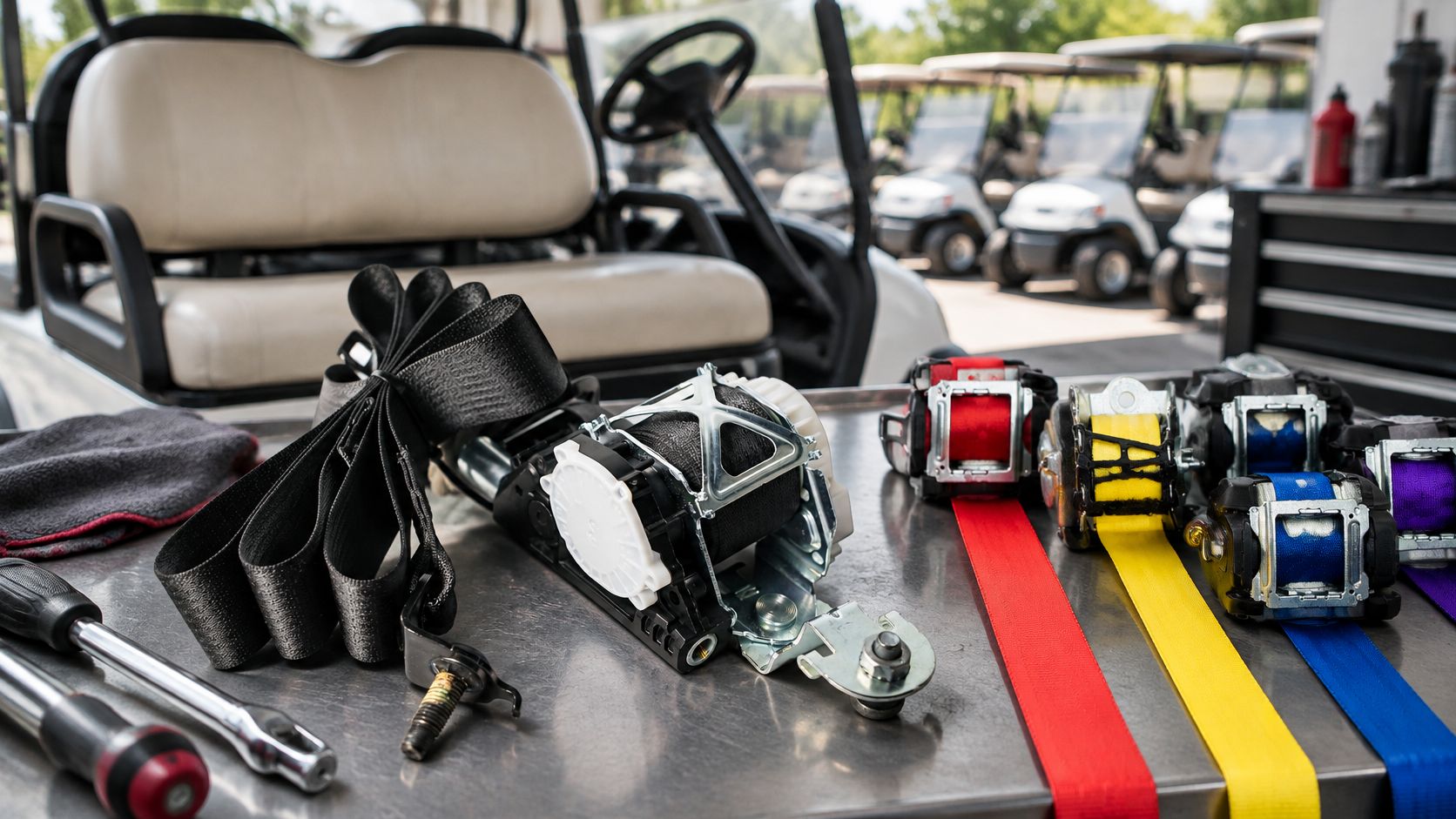
A personal car can miss a check and inconvenience one household. In a fleet, the same missed inspection can idle several routes, force a spare or rental into service, leave a driver waiting, and expose the company to a failed roadside inspection. The goal is to catch problems before a vehicle is scheduled to earn.
That means preparing before the route wave, not during it. A shop that waits until a van fails at dispatch to find a belt retractor or a module reset path has already lost the day.
A working fleet vehicle maintenance program answers five practical questions, in order:
- When should each vehicle be checked? Build the schedule on mileage and time, then adjust it to the manufacturer's instructions and how hard the unit works.
- Which parts belong on the shelf? Stock the items the fleet burns through, such as filters, wipers, and bulbs. Avoid tying up inventory in parts that fit only one vehicle or are needed only after a crash. A locked pretensioner or a module holding crash data can go out to a specialist mail-in repair service instead of sitting on your shelf or arriving as a costly new dealer assembly.
- How do seat belts and SRS modules fit the schedule? Treat them as scheduled safety assets you inspect, document, and repair on a cycle, so a warning lamp is not the first time anyone looks at them.
- Who should do each job? Assign routine service to the shop that can complete it safely and promptly. Send specialized restraint work to a qualified repair path; with a mail-in service, your shop or a local facility still handles removal and reinstallation.
- How will you prove the program is working? Track dispatch availability, missed routes, parts decisions, and return-to-service dates.
Run the five questions against a van that starts but shows a locked belt and a lit SRS lamp. The walk-around and the annual review make the fault visible, the parts decision keeps a repair path ready, and the work order records who handled it and when the unit returned to service. That is the difference between a fleet that reacts to failures and one that schedules around them.
Preventive Intervals for a Mixed Light-Duty Fleet
| Interval | Main tasks | Owner |
|---|---|---|
| Walk-around, every shift | Lights, tires, leaks, SRS lamp, visible belt condition | Driver |
| Lube service, every 5,000 to 7,500 miles or monthly | Oil and filter, tire pressure, wipers | In-house or quick lane |
| Mid inspection, every 15,000 to 30,000 miles | Brakes, battery, cabin filter, fluids | Shop |
| Major service, every 30,000 to 60,000 miles | Transmission or coolant per OEM, steering, alignment | Shop or dealer |
| Annual safety review, yearly or at 12,000 miles, whichever comes first | Inspection items, belt pull and retract test, buckle latch, safety kit | Fleet lead |
Treat the intervals as planning triggers, and follow the manufacturer's schedule whenever it is shorter. When time and mileage both appear in a row, use the one that arrives first. A van that idles all month can hit a time limit long before it hits the mileage number.
Start with the walk-around
At the start of each shift, have the driver look at the tires, lights, and ground around the vehicle for damage or leaks. The driver should also check the dashboard for warning lamps, including the SRS light, and confirm that each belt is present, accessible, and free of obvious visible damage. Keep this check brief. It is a screen for defects, and the closer belt inspection belongs in the safety review and shop inspection.
A fleet schedule works like a route plan: the walk-around catches what changed overnight, and the mileage services catch what wears out slowly.
Move through service by mileage
At lube service, change the oil and filter, set tire pressures to the vehicle specification, and replace worn wipers. At the mid inspection, have the shop inspect the brakes, test the battery, replace the cabin filter, and check and top up fluids as needed. Pairing small routine jobs with inspections gives the shop a regular chance to spot wear before it becomes a roadside call.
At major service, use the OEM schedule for transmission service and coolant. Have the shop check steering and suspension condition and assess alignment. If the manufacturer's instructions specify a different interval or procedure for a fluid, follow the manual instead of a generic chart.
Pull work forward for severe duty
Towing, dusty roads, long idle periods, and repeated short trips can justify earlier service. For those units, move each mileage-based row forward by about 30 percent, then check the change against the OEM manual. Make the adjustment for the vehicles doing that work, not automatically for every unit in the fleet.
During the annual safety review, test that each belt pulls out smoothly, latches, and retracts without slack or delay. Confirm the SRS lamp behaves normally at key-on and review the safety kit. Seat belts and SRS modules belong on this calendar because they can age in service even when the vehicle starts and drives. Log the date, odometer reading, technician, and next due date for each completed service. That record turns the schedule into the next work order, and it gives the fleet lead a due date instead of a reminder someone can forget.
Which Parts Belong on the Shelf
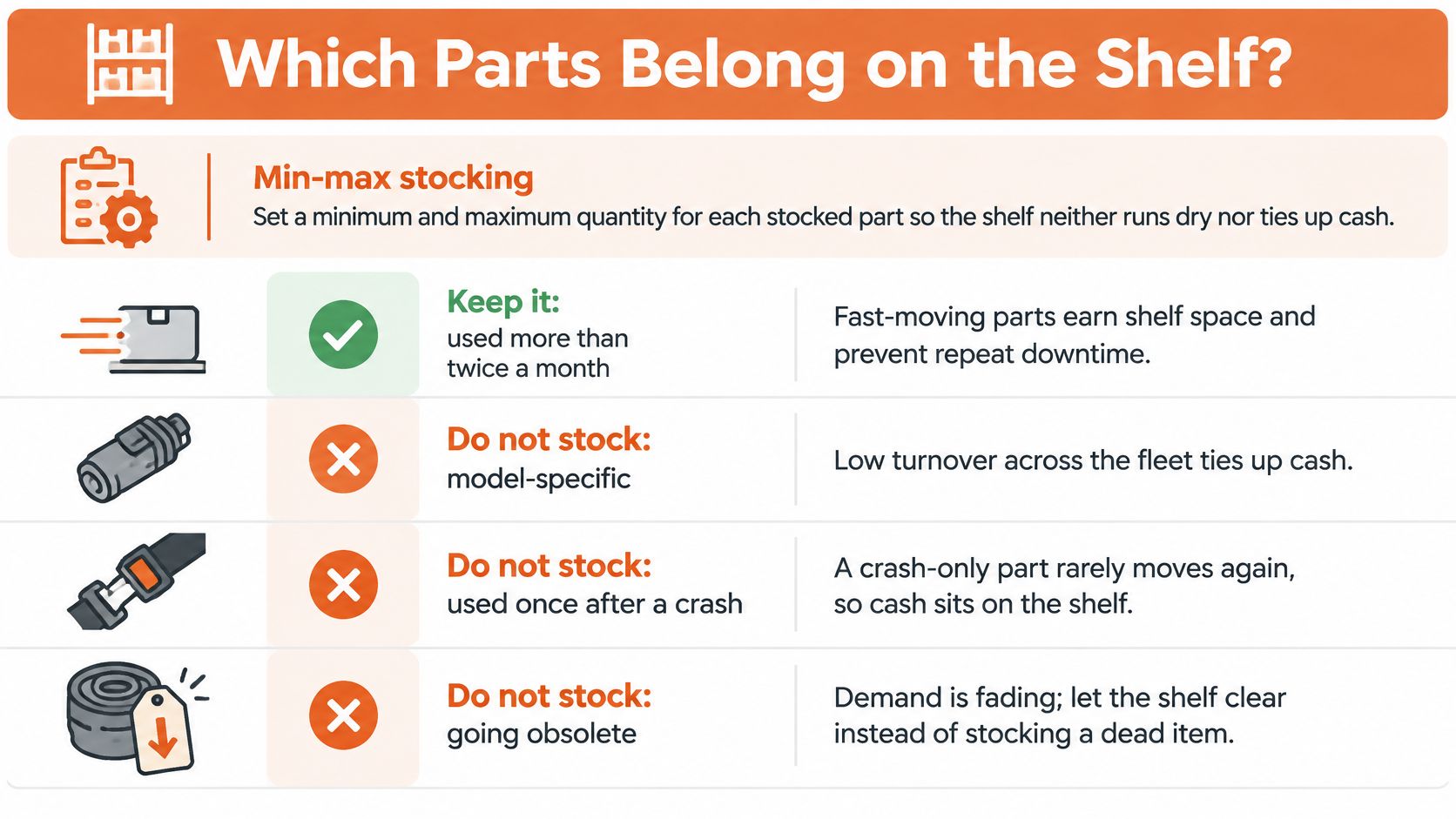
If your fleet uses a part more than twice a month, it's a strong candidate for the shelf. Fast-moving items such as oil filters, brake pads, wiper blades, bulbs, and common sensors can prevent a routine job from turning into another trip to the supplier.
A min-max system gives each stocked part a minimum quantity that triggers a reorder and a maximum quantity that keeps the shelf from growing without purpose. Set the reorder point to cover the amount the fleet is likely to use while the supplier's order is in transit. Place the order before the next route wave needs the parts, not after the last one is gone.
| Part | Use pattern | Decision |
|---|---|---|
| Oil filters, brake pads, wiper blades, bulbs, common sensors | More than twice a month on vans and light trucks | Stock |
| One oil filter shared by a 40-van fleet | Same part fits many units | Stock |
| Model-specific SRS module or deployed pretensioner | Once after a crash and different by model year | Send out, do not stock |
The stocking rule breaks down when the part is expensive, vehicle-specific, or needed only after an uncommon event. A fleet may use one oil filter across many vans and still need a different SRS module for each model year. Buying one of every possible module ties up shelf space and cash in parts that may sit unused or become obsolete.
A deployed pretensioner is an especially poor routine stock item. It's a one-time crash repair, and the belt assembly may need specialist work rather than a simple swap. For a general overview of collision-related parts choices, see this guide to collision repair parts.
If a locked belt or deployed pretensioner comes in, a mail-in service may let the shop repair the original assembly rather than keep replacement assemblies for every model year. For example, the Seat Belt Repair Near Me After Accident – Any Make Any Model service handles locked or non-retracting belts and deployed pretensioners through a mail-in process; the local shop removes and reinstalls the assembly.
Keep every repaired or rebuilt part traceable. Attach a core tag and warranty note that identify the unit and repair date, and record where the part went. That way, a later fault can be tied to the right vehicle and work order.
At the next inventory review, mark each part number stock, buy as needed, or send out. Don't treat a low-use safety component as a fast mover because it could be urgent when needed.
How Seat Belts and SRS Modules Age in Service
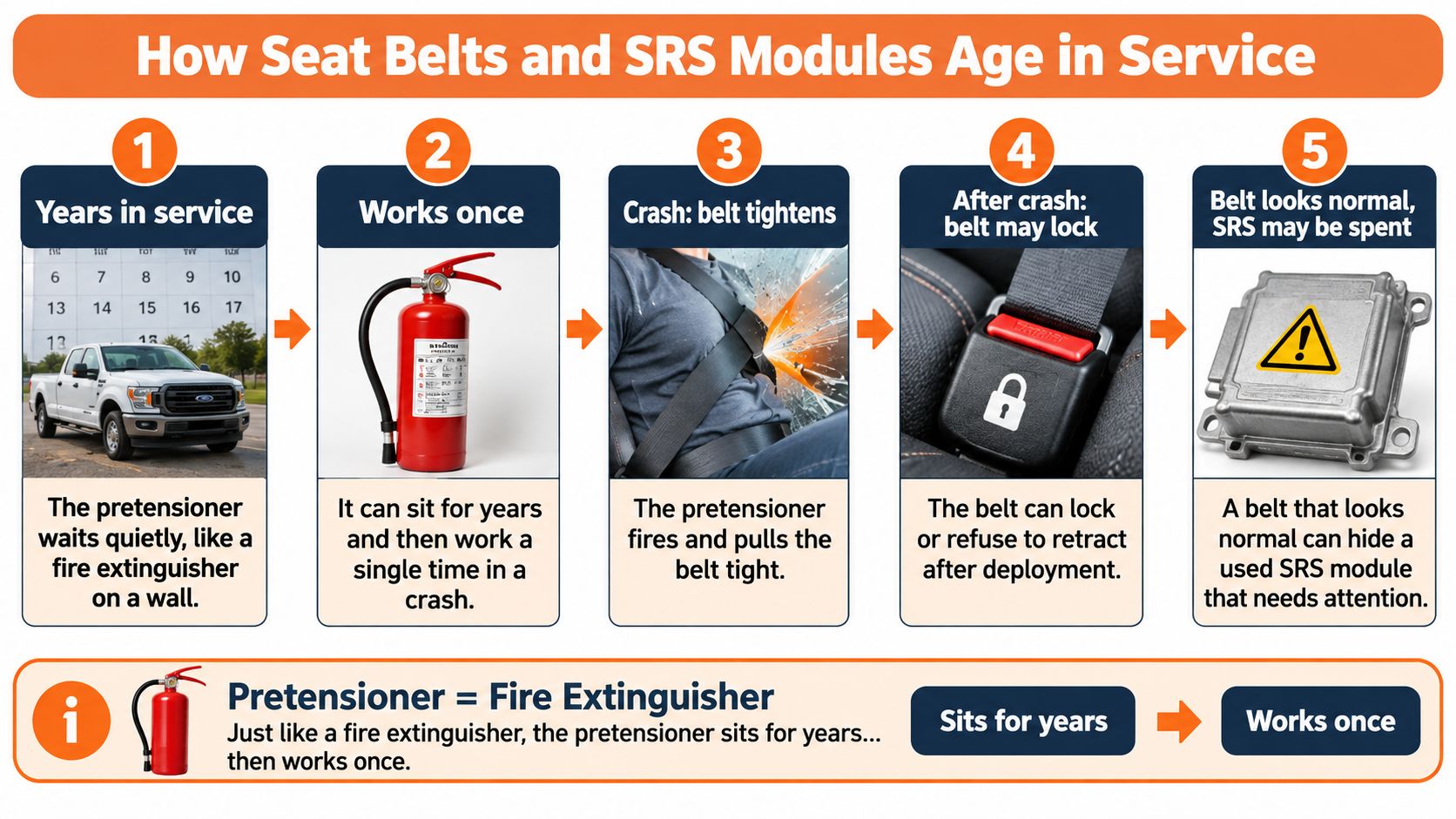
A route van can take a parking-lot hit, never turn on the SRS lamp, and still leave the fleet guessing about what happened inside the restraint system. Belts and modules age on two clocks: slow wear from use, dirt, weather and sun exposure, and a single crash event that can fire a pretensioner or write crash data to the module. That is why they belong on the safety schedule as assets, not as trim.
Inspect the belt in place
The inspection routine already covers webbing condition and latch function. This check adds a different question: can the system still do its one violent job after years of sitting ready? Pull the belt out and let it retract; smooth travel and a firm latch tell you the assembly moves, not whether the pretensioner has already deployed or whether the module is holding a fault.
Outdoor use speeds the visible side of aging. A golf cart, ATV, UTV or shuttle can fade and abrade faster than a highway van, so a cart with sound retractors and mounting hardware may only need golf-cart webbing replacement and color change rather than a different restraint setup.
Treat a collision as a system event
During a collision, a pretensioner tightens the belt to help restrain the occupant. After deployment, the belt may lock, stop retracting, or look normal while the SRS module still stores crash data and the warning lamp stays on. A quiet lamp does not clear the system by itself, and a clean-looking belt does not prove the charge is still intact.
The work path should cover belt and module together. A mail-in safety specialist can rebuild and recharge a deployed pretensioner, replace damaged webbing, reset the SRS module to factory specifications, use OEM parts aligned with FMVSS and manufacturer specifications, and test repaired components before shipment; the functional testing requirements describe the checks to ask for before the part returns.
For shops training a technician on removal and packaging, this walkthrough gives the handling context before parts go in a box:
A dealer may supply a new assembly and handle programming. A specialist may repair the original assembly and reset the module while the local shop removes and reinstalls it. Routine checks stay in the fleet bay; collision deployment, a locked retractor or a persistent SRS lamp goes to the specialist bench before the vehicle returns to service.
In-House Dealer or Mail-In Repair
| Option | Best jobs | Typical speed | Cost pattern | Limit |
|---|---|---|---|---|
| In-house shop | Oil, brakes, tires, inspections | Hours if parts are stocked | Lowest on routine work | Not for deployed pretensioners |
| Dealer | New OEM assemblies and programming | Days to weeks if backordered | Highest parts and labor | Replacement is the default |
| Mail-in safety specialist | Belts, webbing, SRS module reset | About 24 hours after receipt plus shipping | Lower than new assemblies | Customer or local shop reinstalls |
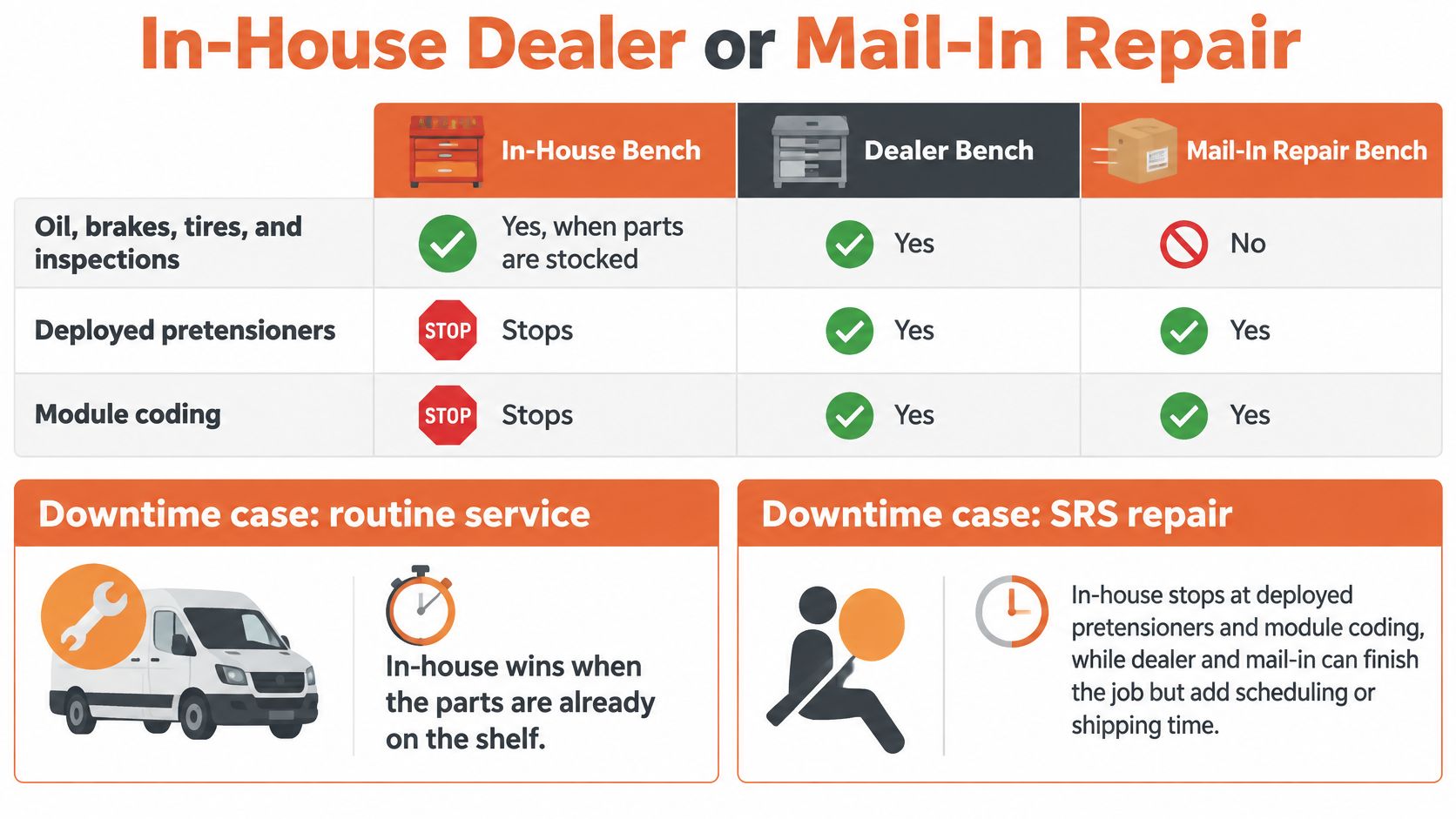
The decision rule is part type first, downtime second. Routine wear items stay on the in-house bench. Deployed or locked restraint components go to whichever outside route returns the unit sooner, so compare the dealer's quoted lead time on a new assembly against the round-trip shipping window before committing. Whichever path wins, the fleet shop still owns removal and reinstallation, so factor that labor into both options.
Apply the choice to a route van
Say Unit 14 in a 25-van company has a soft tire and an SRS lamp after a parking-lot bump. The in-house shop can address the tire and inspect the vehicle, but it shouldn't treat the deployed or locked restraint parts as an ordinary repair. If the shop removes and mails the affected parts promptly, the van's downtime is tied to shipping and return rather than an uncertain dealer backorder.
For a mail-in retractor repair, remove the faulty or locked retractor from the vehicle and package it securely. Include the vehicle's year, make, and model, your contact information, and a copy of the order receipt. Repaired parts are functionally tested before they ship back, and the local shop then reinstalls them and completes its checks before release.
Keep the handoff on the work order
A clear work order prevents removed parts from becoming anonymous packages. Record the unit number, mileage, symptom, parts removed, vendor, ship date, and return-to-service date. If the SRS module is also sent, list it separately so the technician knows which components went out and which came back.
Repair also keeps the original component on the original vehicle. A new dealer assembly arrives as a fresh part that may still need programming, while a rebuilt retractor or reset module goes back into the same unit it came from. For a small fleet watching both downtime and parts spend, that difference belongs in the same comparison as the expected days off the road.
Faded golf-cart or side-by-side lap belts call for a different decision from a crash-deployed automotive pretensioner. When the original retractors and mounting hardware remain suitable, webbing replacement can address weathered or damaged webbing without stocking a complete assembly for every cart.
Score Downtime Before the Next Vendor
Start with the morning dispatch count. Divide the number of units available to dispatch by the number of units on the fleet roster, and hold that ratio as your daily availability figure. Keep the same definition of "available" each day. A van with an unresolved safety defect does not count as ready just because the engine starts.
For every sidelined unit, record the calendar days it is down, the routes it missed, whether a spare or rental covered the work, and whether a driver was left idle. These details show what the repair delay changed for the operation. A vehicle waiting on a part while a spare covers its route is a smaller problem than one that leaves both the route and its driver without work, and your vendor scoring should reflect that difference.
Apply the date log from the earlier Unit 14 repair to every safety component that leaves the building: ship date, return date, back-in-service date, set beside the dealer's expected assembly arrival. That gives you a per-unit record instead of a guess about what a backorder costs in lost days.
A missed belt check or an unresolved SRS warning can also fail a roadside inspection and keep the vehicle and driver off the route. Record that event in the same availability log. Safety defects count as downtime even when the engine and tires are otherwise ready.
When you compare vendors, judge them on downtime rather than unit price. In-house work is generally the lower-cost path for routine oil, brake, and tire jobs when the shop has the parts. For restraint components, weigh the dealer's expected assembly arrival against the mail-in ship-and-return dates in your log. The cheaper line item loses the comparison if it keeps a unit parked longer, because the route coverage and idle driver cost more than the part.
Close the month with one page that names the owner for each interval, marks each stock item as shelf, buy-as-needed, or send-out, and records who received the last locked belt. If the log cannot show where a safety component went or when the vehicle returned to service, tighten the handoff before adding another vendor.
Seat Belt Repair handles seat belt repair, webbing replacement, and SRS airbag module resets through a mail-in service. Repaired parts are tested before they are shipped back, and your shop or a local facility handles reinstallation.



Laisser un commentaire
Ce site est protégé par hCaptcha, et la Politique de confidentialité et les Conditions de service de hCaptcha s’appliquent.