
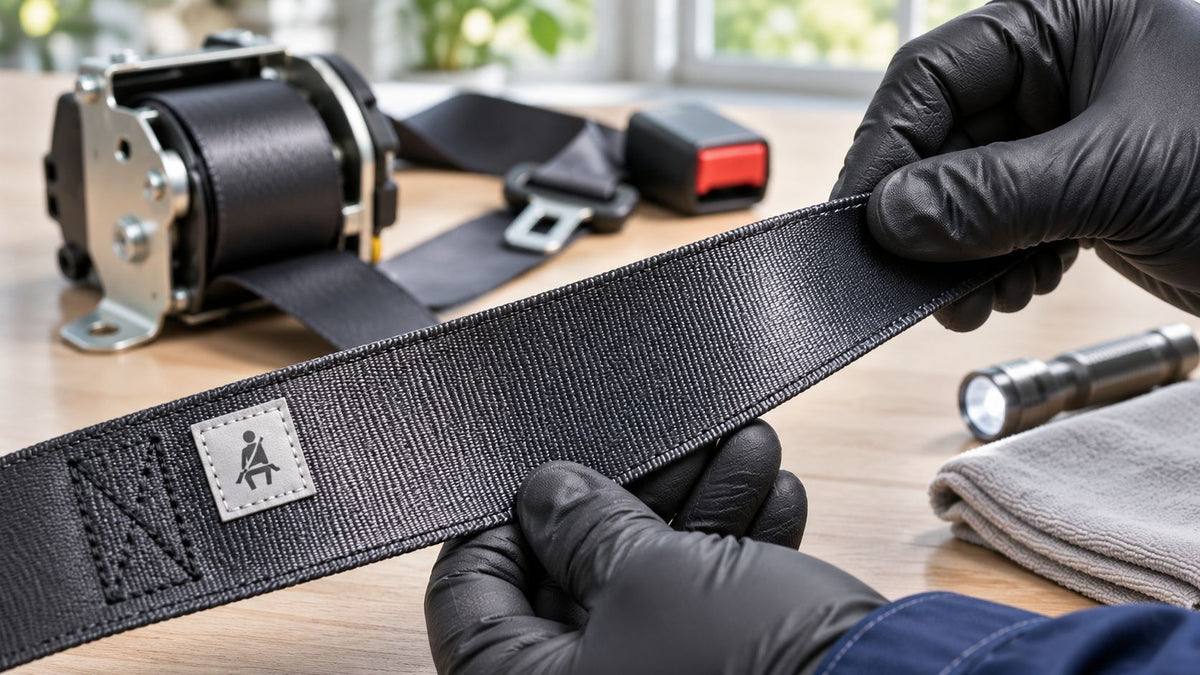
A dog chews the edge of your shoulder belt, or a belt that looks fine from the driver's seat comes back from a minor collision locked tight. The dealer quotes a complete assembly, and you're left wondering whether the strap is the problem or the whole restraint needs replacing.
Automotive seat belt webbing is the woven, load-bearing strap. It's separate from the retractor that stores the belt, the tongue and buckle that latch it, and any pretensioner that pulls it tight. In a crash, those parts guide, lock, or tighten the restraint; the webbing carries the load that holds your pelvis and chest in place.
For a useful picture, think of a cargo strap made for a person. The broad surface spreads force over the body rather than concentrating it on a narrow line. The key questions are whether the fibers and label are intact, whether the hardware still works, and whether rewebbing the original assembly makes more sense than replacing the whole unit. Here's a checklist you can use on the belt in your car today.
Table of Contents
- The Strap That Actually Holds You
- How Webbing Is Woven and Labeled
- Damage That Ends a Webbing's Life
- Rules a Safe Belt Still Has to Meet
- Original Hardware, New Assemblies, and Real Cases
- Send the Belt for Webbing Replacement
The Strap That Actually Holds You
Say a dog has chewed the belt near the door, leaving a rough patch on the edge. The buckle still clicks and the strap still retracts, but the dealer's quote is for a complete seat belt assembly. That quote may be the right answer if the hardware is damaged, but a bad strap doesn't automatically make every other component unusable.
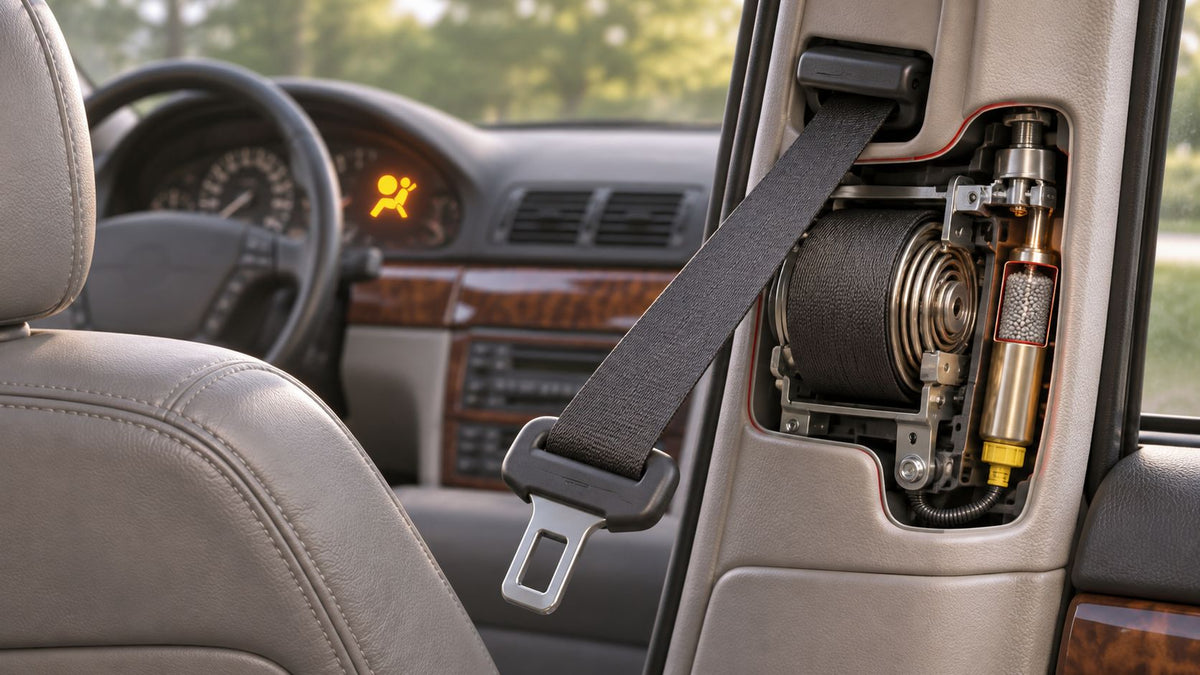
The webbing is the flat, woven part that runs from the retractor through the guides and across your body. The retractor stores and releases it; the tongue and buckle connect it around you. A pretensioner, when fitted, tightens the belt during a collision. These parts work together, but they don't do the webbing's job of carrying the restraint load.
A cut or badly worn strap is not safe just because the buckle works. And a belt that locked after a crash may have a mechanism problem even if the strap looks sound. The first decision is to locate the fault: fabric, hardware, or both.
The rest of the decision follows from that distinction. Check how the strap is made and what its label identifies, then inspect for damage that rules out continued use. If only the webbing has failed and the original hardware is serviceable, replacing the strap may preserve the vehicle-specific assembly without buying a complete new one.
How Webbing Is Woven and Labeled
| Feature | Usual factory practice | Why it matters |
|---|---|---|
| Fiber | High-tenacity polyester; nylon on some older belts | Low stretch, wet strength, and sunlight resistance |
| Width | Broad automotive webbing matched to the original belt's width | Spreads crash load across chest and pelvis |
| Weave | Tight twill, often 2x2, with a woven selvage | Helps keep the edge from unraveling under load |
| Color | Yarn-dyed black, gray, tan, or a factory accent | Face fading isn't the same as fiber failure |
| Label | Maker, part or date code, and compliance marks sewn to the strap | Identifies the belt; should be restitched if webbing is replaced |
| Edges | Selvage edge formed during weaving | A cut or frayed edge means load-carrying fibers are gone |
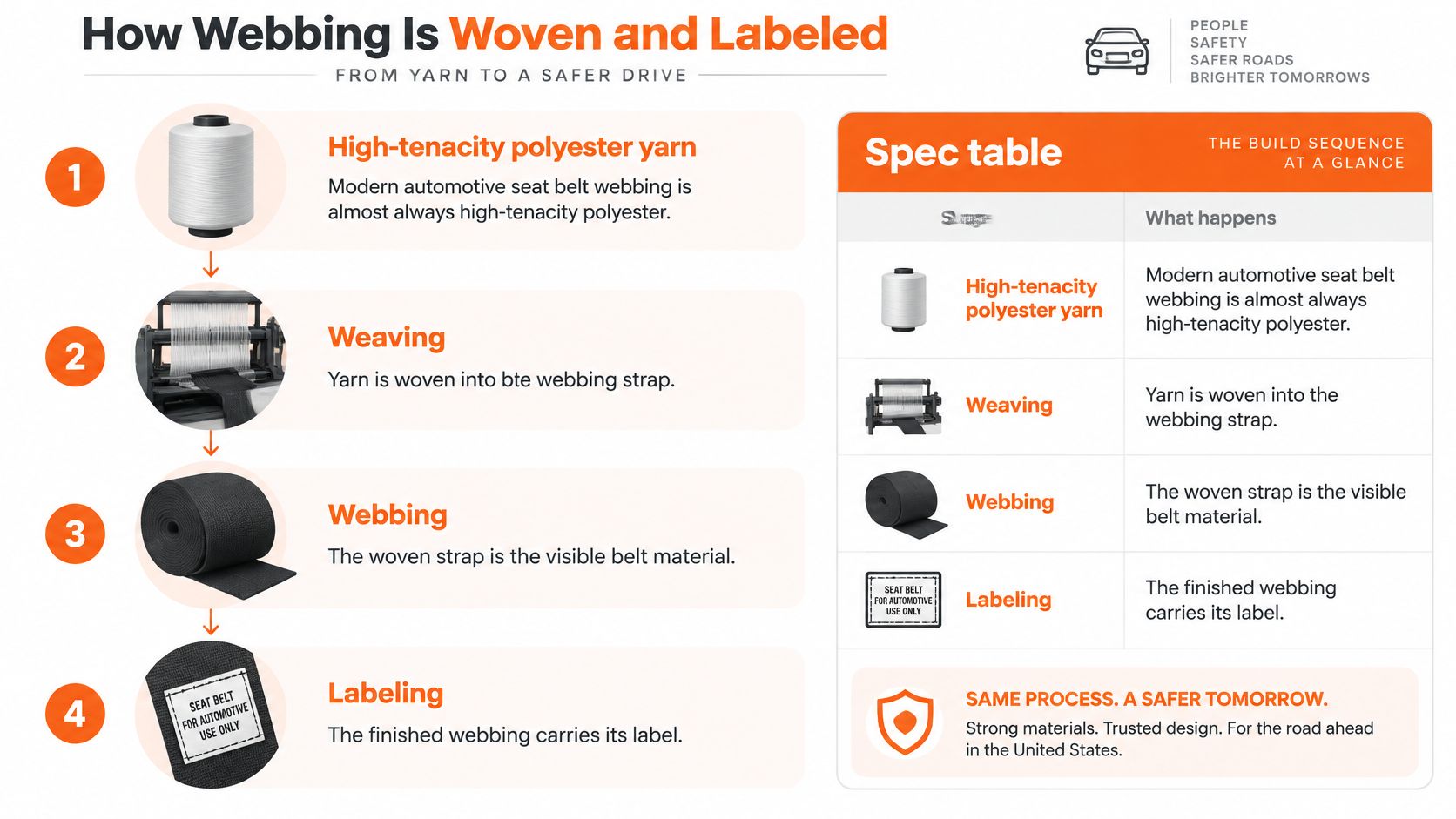
From yarn to strap
Modern automotive webbing is woven from high-tenacity polyester yarn. On the loom, parallel warp yarns run the full length of the strap and carry the tensile load, while a single weft yarn shuttles back and forth across them. At each edge the weft loops around the outermost warp yarn and heads back, forming a woven selvage that holds the strap together through years of movement across the belt guides. In a 2x2 twill each weft passes over two warp yarns, then under two, which keeps the strap flexible without letting the yarns shift.
Some older belts use nylon. Nylon behaves differently from polyester, including stretching more and absorbing more water, so matching a vintage belt isn't a matter of choosing a strap that looks similar. Replacing an original material without considering its behavior can change how the belt works.
Color is usually yarn-dyed: the yarn is colored before weaving, so the shade runs through the strap. An evenly faded face points to dye leaving the surface, which is an appearance issue. A strap that feels stiff, chalky, or brittle is a different concern, because texture and flexibility can signal fiber deterioration even when the color still looks fairly even.
The label is part of the identification
The sewn label may carry the maker, part or date codes, and compliance marks. When a technician rewebs a belt, preserving and restitching the original label, whenever it survives, keeps that identification attached to the assembly. A fresh strap can look right while losing useful information if the tag is discarded.
Before ordering, photograph both sides of the label, the belt's color, and its width. Those details tell the repairer what has to match: fiber, width, dye, and the tag that identifies the assembly. Keep the tag on the belt.
Damage That Ends a Webbing's Life
| What you see | What it usually means | What to do |
|---|---|---|
| Clean cut, slice, or missing chunk | Yarns that carry crash load are gone | Replace the webbing; don't sew the cut |
| Dog chew or pulled loops | Repeated fiber loss along an edge or face | Replace the webbing and match color and width |
| Frayed or fuzzy edges | The selvage is breaking down | Replace the webbing before it unravels further |
| Bleach, acid, fuel, or solvent stains | Chemical attack can be hidden inside the yarn | Replace the webbing even if it feels intact |
| Stiff, chalky, or cracking from sun | Possible ultraviolet breakdown, not ordinary fade | Replace the webbing |
| Even fade with a soft, flexible strap | Dye loss without obvious fiber failure | Monitor; replace if it stiffens or frays |
| Creases from normal retraction | Folding, not necessarily structural damage | Keep using it and recheck the edges |
| Locked, tight, or non-retracting after a crash, strap intact | Pretensioner or retractor issue | Repair the mechanism; replace webbing only if the strap is also damaged |
Separate damage from normal wear
Pull the belt out fully and inspect the whole length, including the part that normally stays inside the retractor. Look at both faces and both edges in good light. A dog-chewed patch, a slice, missing yarns, or a frayed edge is a reason to replace the strap. Sewing a cut or trimming loose fibers doesn't restore the load path.
Chemical damage can be harder to judge by appearance. Bleach, acid, fuel, and solvents may affect the fibers without leaving a dramatic hole or a clear change in color. If one of those substances has contacted the belt, replace the webbing rather than trusting a quick look or feel.
Sun exposure calls for a different judgment. Even fading alone on a soft, flexible strap doesn't prove failure, but stiffness, chalkiness, or cracking is a warning. Ordinary creases from the belt folding during use aren't the same as structural damage; check that the fibers remain smooth and the edges intact.
Don't confuse a mechanism fault with a strap fault
A belt that stays tight, won't retract, or locked after a collision may have a retractor or pretensioner problem. If the strap itself is intact, replacing the webbing alone won't fix that fault. Have the mechanism assessed, and replace the strap too if it's cut, glazed, or otherwise damaged.
For pet-chewed webbing, the practical rule is simple: replace it, don't patch it. A dog may remove only a small section, but those missing fibers were part of the strap's load-bearing structure. For more on identifying contamination and related concerns, see mold on seat belt webbing.
One-minute check: Extend the belt fully, then examine both faces and both edges in daylight. If you find a cut, fraying, pet damage, chemical exposure, or stiff, cracked webbing, stop using that seating position until the belt is repaired.
Rules a Safe Belt Still Has to Meet
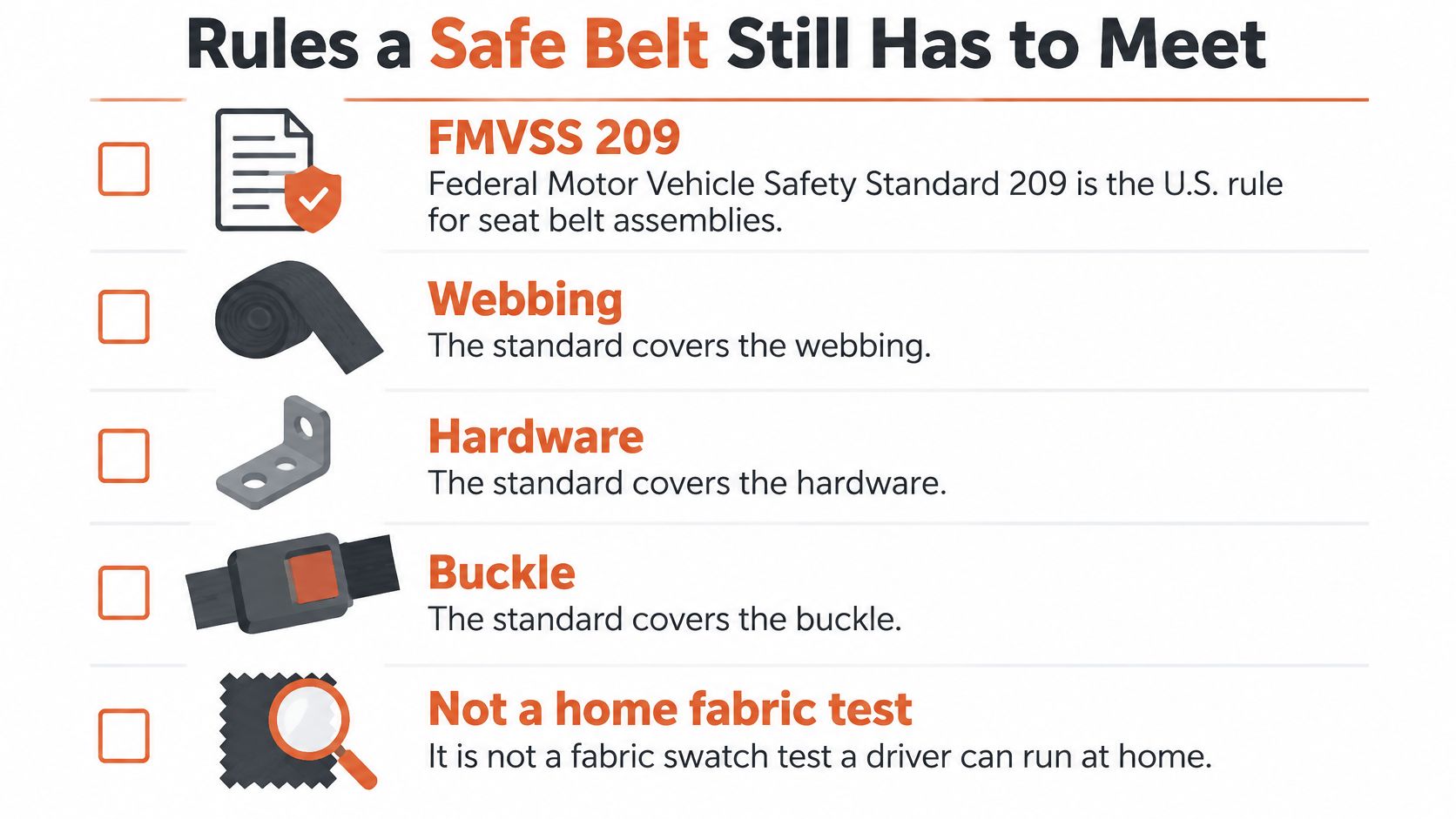
In the United States, Federal Motor Vehicle Safety Standard 209 (FMVSS 209) applies to seat belt assemblies, so the strap is judged as part of a restraint that includes the buckle, tongue, retractor, pretensioner, anchors, and stitching. A replacement piece of webbing has to behave inside that system: strength and controlled stretch matter, and so do latching, release, routing, and retraction.
Color and width are only the starting point. OEM-grade or OEM-certified webbing can match the original color or carry a custom color, but the finished belt still has to feed smoothly, lock under load, release cleanly, and retract without dragging through the original hardware.
A neat home stitch is still a bad repair
A household sewing machine can close a cut cosmetically, yet it cannot restore removed yarns or prove a stitch pattern under load. Glue, trimming, melting, and iron-on patches share the same flaw: they alter material without returning the strap to a tested load path. A proper webbing replacement removes the failed strap, installs OEM-quality material, restitches with reinforced stitching, and preserves manufacturer tags whenever possible.
Keep the tag rule in mind here too: losing the label can make a sound-looking belt hard to identify later.
For the shop-side version of that check, use this overview of functional testing requirements. For a driver, the practical filter is straightforward: avoid craft straps, generic substitutes with no vehicle identity, and any proposal that asks you to stitch load-bearing webbing yourself.
A fresh black strap can come back looking perfect and still be rejected at intake if the manufacturer tag is gone and the buckle will not release cleanly after the first pull; the webbing passed the mirror, while the assembly failed the rules.
Original Hardware, New Assemblies, and Real Cases
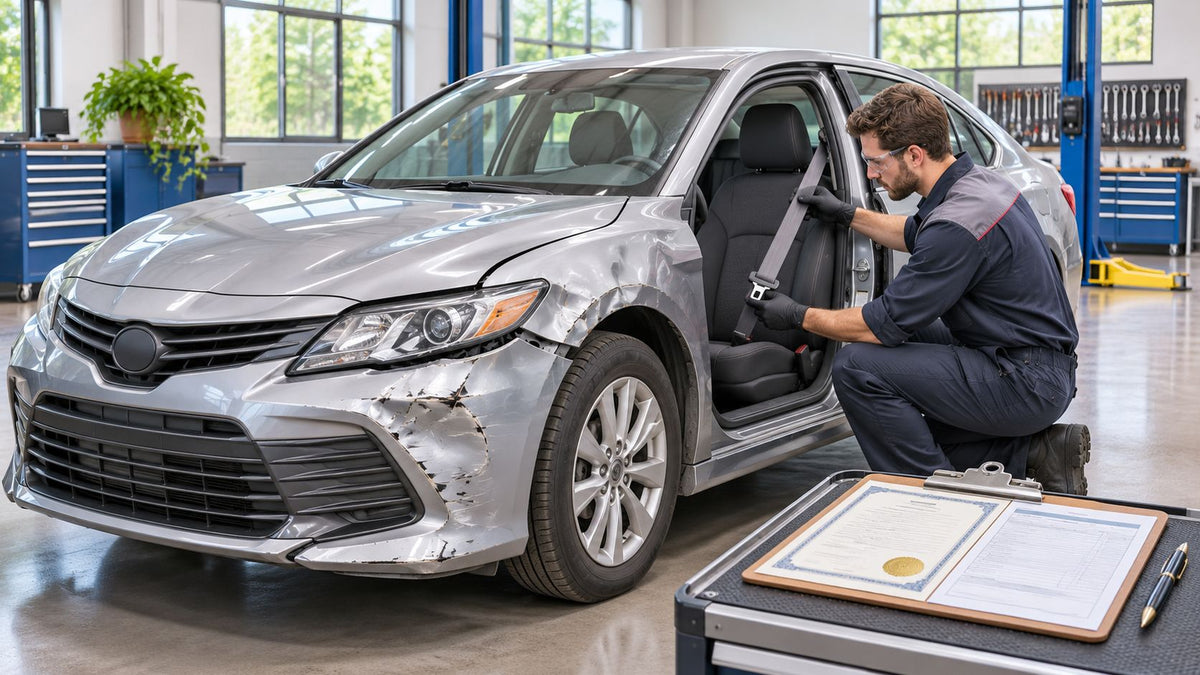
A customer brings in a belt with a chewed strap and a retractor that still winds perfectly. The hardware is worth keeping. Rewebbing preserves the vehicle-specific retractor, buckle, tongue, and pretensioner while replacing only the damaged load path. When the hardware itself is broken, or a collision has fired the mechanism, a complete OEM assembly becomes the more appropriate path. A universal belt is a poor substitute in a modern car because the geometry, pretensioner connections, and identification rarely match.
| Path | What you keep | Best when | Watch-out |
|---|---|---|---|
| Reweb the original belt | Retractor, pretensioner, buckle, and tongue | Webbing is cut, frayed, sun-ruined, or chewed and the hardware still works | A fired or broken mechanism still needs its own repair |
| New OEM assembly from a dealer | Nothing; the whole unit is new | The buckle, retractor, or pretensioner housing is damaged or unavailable as a repair | Parts, labor, and programming can cost far more than the strap alone |
| Generic universal belt | Little of the original restraint | Almost never on a modern road car | Geometry, pretensioner compatibility, and traceability may be wrong |
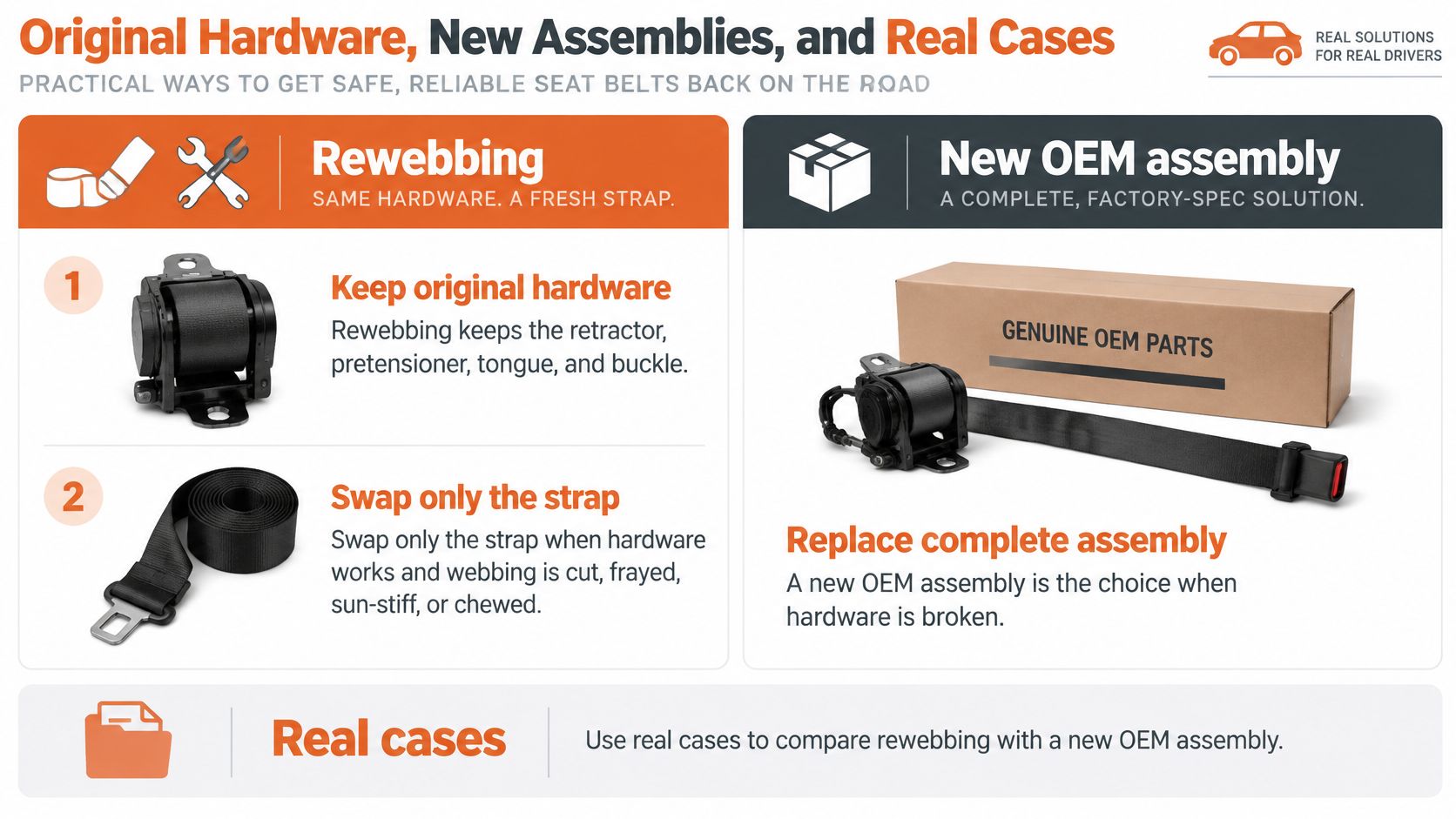
Choose by the failed part
A new OEM assembly is a sensible choice when the retractor is damaged, the buckle won't latch or release, the pretensioner housing is cracked, or a stalk is bent. Rewebbing won't correct those faults. Buying a complete assembly solely because the fabric is chewed or cut can replace hardware that still works.
A universal belt may seem like a quick fix, yet it can miss the vehicle's restraint geometry and pretensioner connections, and it carries no identifying link to the original assembly. Latching only proves the tongue engages the buckle. Fit, geometry, and traceability determine whether the belt belongs in the car.
Choose color for the interior and webbing material for the load. Matching the original black, gray, or tan keeps an interior understated; a custom color such as performance yellow can suit a restoration or modified interior. Either way, a bright, clean strap can still be unsafe if its construction or attachment is wrong. Preserve and restitch the original label whenever possible.
Four bench-side decisions
A glass-cut strap with working hardware: A cut from broken side glass means the strap has lost fibers. If the retractor, buckle, and other hardware remain serviceable, replacing only the webbing can preserve the original assembly. Match the color and keep the label with the belt.
A puppy-chewed edge: Missing or pulled yarns aren't a surface blemish. Replace the webbing, and match its width and color rather than trying to hide the damage with a stitch.
A sun-brittle collector belt: A faded strap can be cosmetic, but one that feels dry, stiff, or cracked shouldn't stay in service. A correctly made replacement can retain the original buckle and label while restoring a factory-style or custom color.
Yellow webbing on a black interior: A custom color is an appearance choice, not evidence of greater strength. The replacement still needs suitable automotive webbing and proper attachment.
For more on the trade-offs among a complete unit, a used part, and repair, read the comparison of new, used, and repaired seat belt assemblies.
The decision comes down to the failed part. Sound hardware with damaged fabric points toward rewebbing; damaged hardware points toward a repair or replacement that addresses the mechanism too. A tidy-looking strap proves nothing about the restraint behind it.
Send the Belt for Webbing Replacement
The Seat Belt ReWebbing Service in any custom color costs $89.97 per seat belt. Each quantity is one belt, not a pair or a vehicle set. Choose a color that matches the original interior, or request a custom match if a close factory-style color is not suitable.
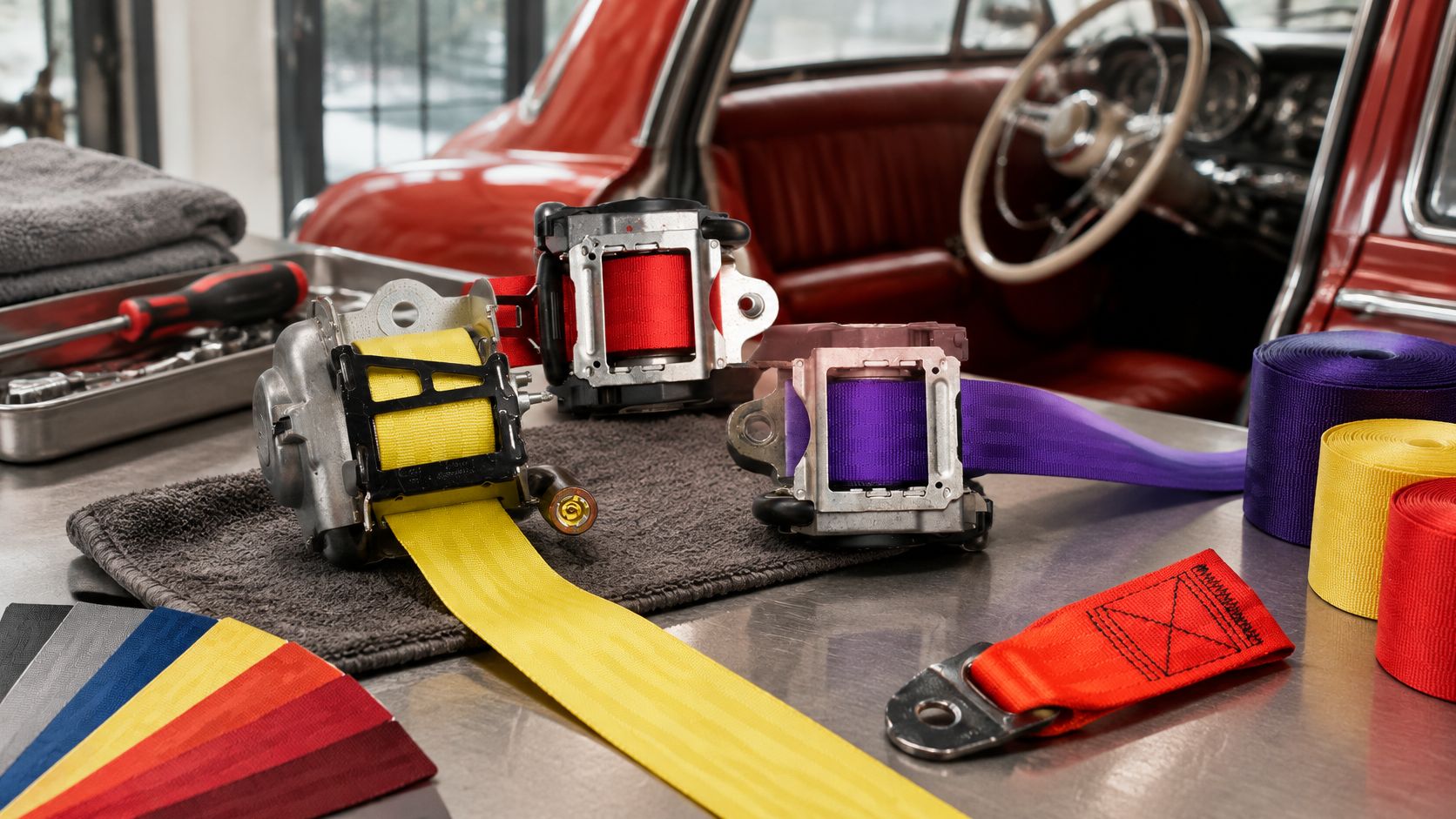
Seat Belt Repair works mail-in only. You or a local shop remove the assembly and reinstall it after it is returned; installation is not part of the service. Each belt is disassembled, rewebbed, and restitched with reinforced stitching, and original manufacturer tags are preserved whenever possible.
For a vintage or collector car, the Classic Car Seat Belt Webbing Restoration & Custom Color Replacement service restores original-looking webbing while retaining the original hardware and preserving tags when possible.
Prepare the right belt
First, identify what you are sending. Count the electrical connectors on the pretensioner to determine whether the belt is single, dual, or triple stage, and record the vehicle year, make, and model. That information decides which service fits the assembly before anything ships.
Next, photograph the label. The tag carries the part identification the new webbing has to match, and it is restitched onto the finished belt.
Then, order and ship. Select a color match or request a custom color, counting one belt per quantity. Send the removed assembly to Seat Belt Repair at 40 Main St., Westfield, MA 01085, and plan for reinstallation by you or a local shop when it returns. Repairs typically turn around within 24 hours of receipt.
Shops and salvage rebuilders handling several belts can plan removals and shipments together. If a belt has both a locked pretensioner and damaged webbing, the order should cover both faults rather than sending in only the strap.
Seat Belt Repair replaces damaged automotive seat belt webbing while preserving original hardware and restitching manufacturer tags whenever possible. If the strap is damaged and the rest of the assembly needs a careful assessment, visit Seat Belt Repair to review the mail-in options.

Laisser un commentaire
Ce site est protégé par hCaptcha, et la Politique de confidentialité et les Conditions de service de hCaptcha s’appliquent.