
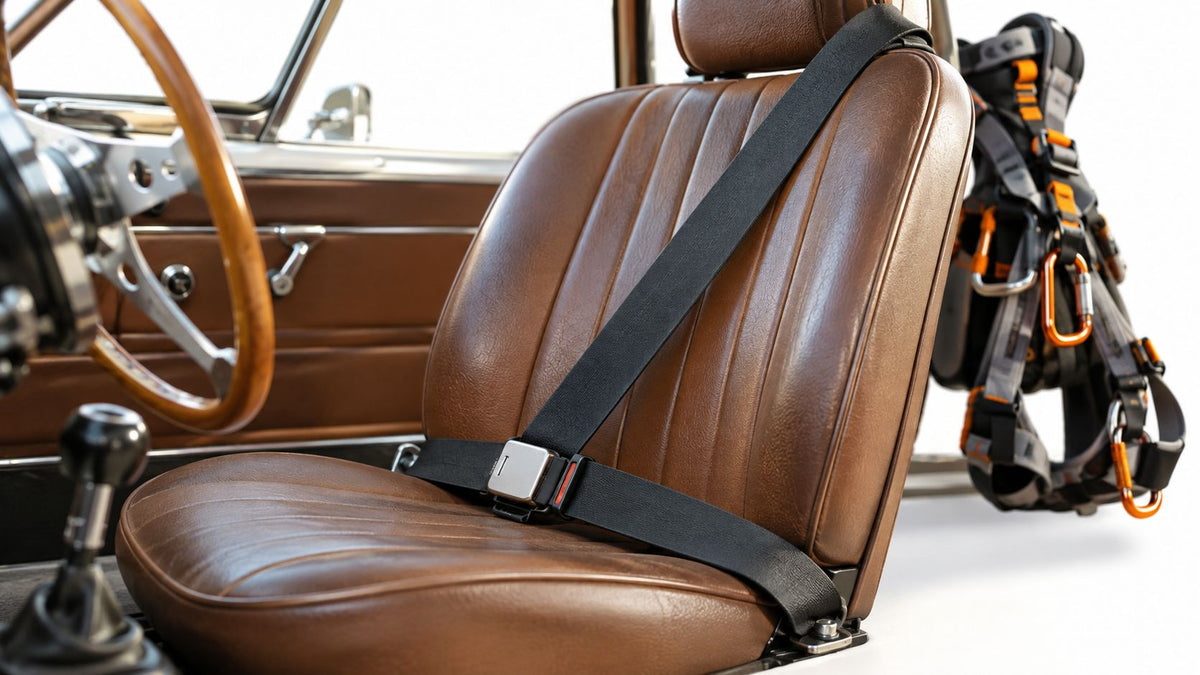
You slide into an older sedan, reach beside the seat, and pull one strap across your hips. The buckle clicks low near the floorboard. There's no shoulder belt, no diagonal webbing across your chest, and no visible connection to the upper part of your body. That familiar arrangement is a two point seat belt, also called a lap belt.
Lap belts were an important step in automotive safety. They give the pelvis a restraint point instead of leaving the occupant completely unprotected. But they work differently from the three-point belts found in most modern passenger cars, and that difference matters whenever you're choosing, restoring, inspecting, or using a vehicle.
The right question is not just whether a lap belt is “safe” or “unsafe.” You need to ask where it's installed, how it fits, who is wearing it, and what condition the hardware is in. A vintage car, a rear-center seat, an aircraft seat, and a child passenger can present very different restraint problems.
Table of Contents
- A Familiar Buckle and What It Really Does
- How a Two Point Seat Belt Is Built and Where It Sits
- Two Point vs Three Point Seat Belts
- Injury Patterns That Come With Lap Only Restraints
- Where Two Point Seat Belts Are Still Found Today
- When a Lap Belt Is Acceptable and When It Is Not
- Inspecting Repairing and Replacing a Two Point Belt
A Familiar Buckle and What It Really Does
A two point seat belt is anchored at two locations and crosses the occupant's lap. The belt usually runs from one side of the seat or vehicle body, across the hips, to a buckle on the opposite side. It holds the lower body in place, but it doesn't include a shoulder section to control the chest, neck, or head.
Think of it as a cinched gym strap around your waist. It can stop your hips from moving freely, but your upper body can still bend forward. A three-point belt is closer to a full climbing harness, because it connects the pelvis and upper torso to the vehicle through a coordinated restraint path.
That distinction becomes obvious in a frontal crash. The lap portion catches the pelvis, while the torso continues moving forward until the belt, the vehicle interior, or another restraint interrupts that motion. The belt's position therefore matters more than its appearance. A strap lying low across the strong bones of the pelvis behaves differently from one riding upward over the abdomen.
Practical rule: A lap belt should sit low and snug across the upper thighs or pelvic bones, never across the soft middle of the abdomen.
Historically, two-point restraints were widely adopted before modern three-point systems became the normal design. This seat-belt history timeline records Volvo marketing a two-point cross-chest diagonal belt accessory in 1956, providing front-seat anchors for two-point diagonal belts in 1957, and Saab making lap belts standard by 1958.
The design still appears in older cars, specialized seating positions, and vehicles built around different packaging requirements. If you're working on an older vehicle, inspect the belt as carefully as you would any other safety-critical component. Even a buckle that looks familiar may hide worn webbing, a weak retractor, or damaged mounting hardware. Understanding how a car seat-belt buckle works can help you identify the parts before deciding whether the assembly needs service.
How a Two Point Seat Belt Is Built and Where It Sits
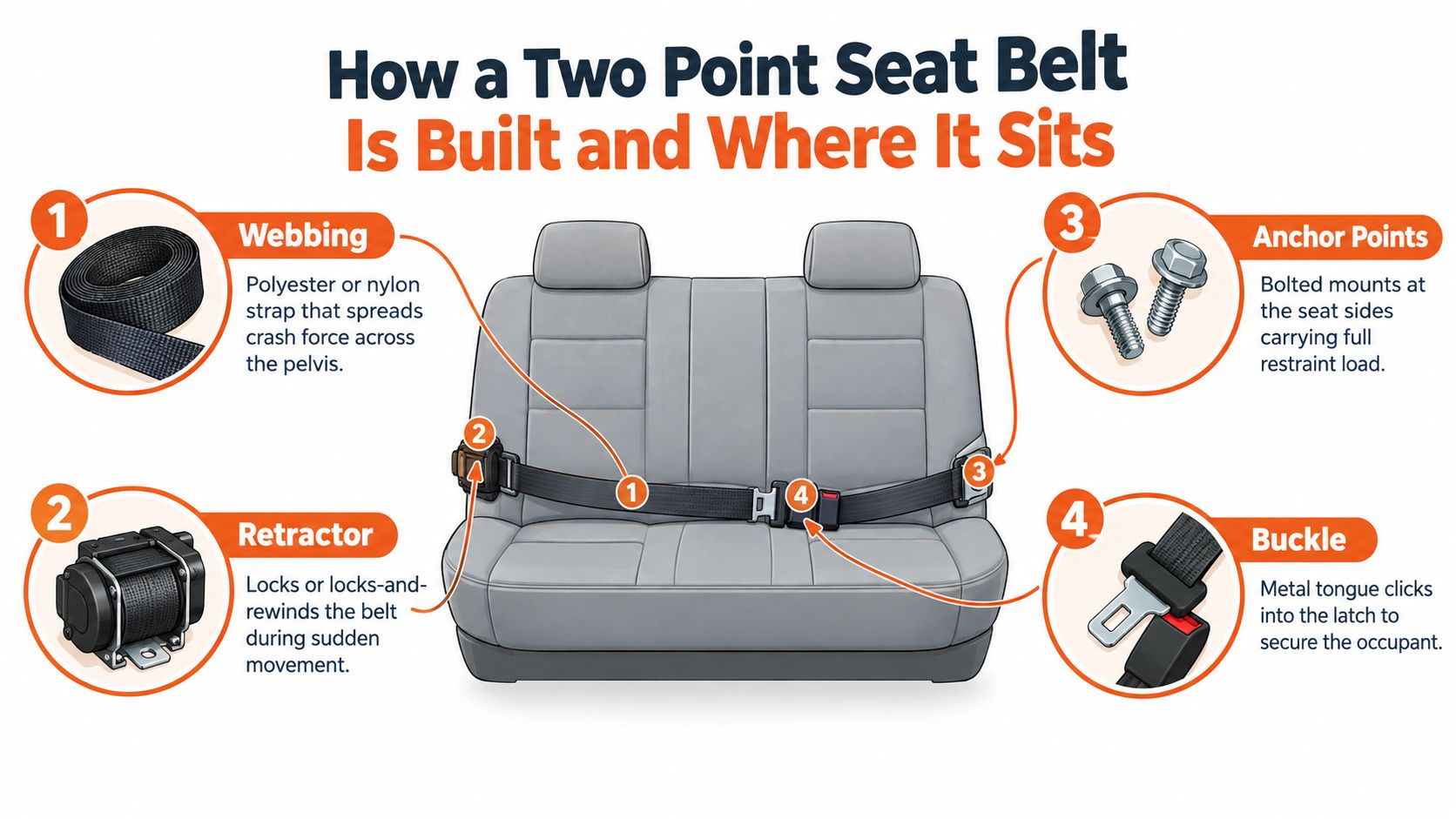
A lap belt looks simple, but several components must work together during a crash. Start with the webbing, the woven strap that spreads restraint force across the occupant. Automotive belts commonly use polyester or nylon, materials selected for strength, controlled stretch, and resistance to everyday wear.
The belt may be fixed at both ends, or one end may feed through a retractor. A retractor stores excess webbing on a spring-loaded spool. During normal driving, it lets you lean and adjust your position. During sudden movement or deceleration, a locking mechanism stops the spool from paying out.
The parts that carry the load
- Webbing: The fabric strap crosses the lap and must remain flat, untwisted, and securely stitched.
- Retractor: A mechanical spool may lock through vehicle deceleration or through rapid webbing movement. Some systems use vehicle-sensitive locking, while others respond directly to webbing extraction.
- Latch plate: The metal tongue slides into the buckle. Its shape and position must match the original buckle.
- Buckle stalk: This may be mounted to the floor, seat frame, or a short flexible stalk beside the occupant.
- Anchor points: The bolts and reinforced mounting locations connect the belt to the vehicle structure.
A two-point diagonal belt follows a different path from a lap-only belt. It crosses the chest from the shoulder toward the opposite side, but it still has only two anchor points. That gives the upper body some directional restraint, yet it doesn't provide the same pelvis, chest, and shoulder connection as a three-point system.
Anchor geometry is part of the safety design, not an installation detail you can improvise. FMVSS 210 addresses seat-belt assembly anchorage, including the strength that vehicle mounting points must withstand. A replacement belt can be the correct length and still be wrong if its anchor spacing, bolt arrangement, or retractor position changes how the webbing loads the occupant.
If you're replacing a damaged buckle or belt assembly, match the latch and mounting configuration rather than relying on appearance. A guide to latch seat belts explains why the buckle and tongue must be treated as a matched part of the restraint system.
Two Point vs Three Point Seat Belts
The basic difference is body control. A two point belt restrains the pelvis, while the chest and head remain free to move forward or sideways. A three-point belt adds a shoulder path, so crash forces can spread across the pelvis, chest, and shoulder instead of concentrating the restraint action at the lap.
A large U.S. effectiveness study covering 40,000 vehicle occupants from 1971 to 1972 found that 18% wore lap belts, 80% were unrestrained, and 2% wore three-point belts. Compared with unrestrained occupants, lap-belt users had a 73% lower fatality rate, a 53% lower serious-injury rate, and a 38% lower injury rate, according to the seat-belt evidence summarized here.
Those findings show why two-point belts mattered. A lap belt was substantially better than no restraint. They don't mean a lap belt performs like a modern three-point belt.
The movement difference
In a frontal impact, the pelvis tends to move forward with the seat while the upper torso continues toward the dashboard. A lap belt catches the lower body, but the torso can fold over the belt, slide beneath it, or rotate toward the vehicle interior. A shoulder belt adds a second restraint path that helps keep the chest aligned with the seat and reduces forward rotation.
A major review found that, compared with being unrestrained, lap belts reduced injury rates by 23% in frontal impacts and 40% in side impacts. Three-point belts reduced injury rates by 53% in frontal impacts and 59% in side impacts. The same Road Safety Observatory review estimated lap belts were about 57% effective at reducing serious injuries in rear-seat use, with overall fatal-injury reduction estimated at 32%, within a likely range of 23% to 40%.
| Factor | Two Point Lap Belt | Three Point Belt |
|---|---|---|
| Main contact area | Pelvis and upper thighs | Pelvis, chest, and shoulder |
| Upper-body control | Limited | Substantially greater |
| Frontal-crash movement | Torso can rotate forward | Shoulder section limits forward rotation |
| Side-crash protection | Lower than a three-point system | Broader restraint of the torso |
| Best interpretation | Better than no restraint, but limited | Preferred system where properly installed |
The practical conclusion is straightforward. A two point seat belt offers real protection, but a three-point belt offers a wider protection margin, especially in frontal crashes where upper-body movement drives the injury pattern.
Injury Patterns That Come With Lap Only Restraints
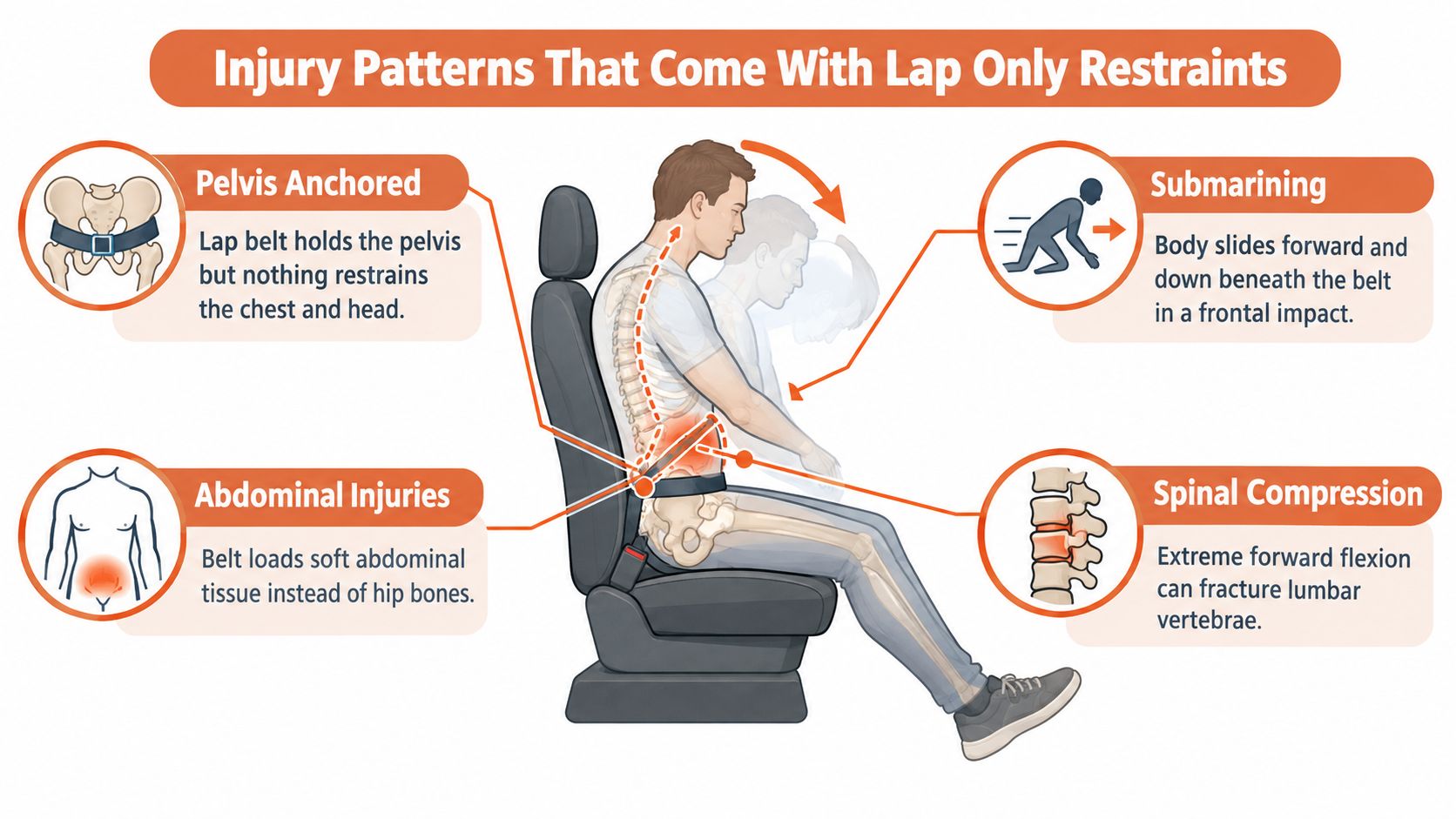
A lap-only belt can hold the pelvis while allowing the torso to fold forward. That creates a motion often called submarining, where the occupant slides forward and downward beneath the belt. The belt may then move from the hip bones onto the abdomen, placing force on tissues that aren't designed to carry the primary restraint load.
The resulting injuries can involve the abdominal organs and lower spine. Independent injury literature has linked lap-only restraints with increased abdominal and lumbar-spine injury in frontal crashes. A comparative study reported significantly more AIS 2 liver injuries in occupants using two-point belt and knee-bolster systems than in occupants using three-point belts, while NASS data suggested liver injuries represented roughly 60% of abdominal injuries in two-point-belt cases. The comparative injury analysis explains why belt position and occupant posture deserve close attention.
Why belt fit changes the outcome
A properly positioned lap belt loads the pelvis, which is a stronger structure than the abdomen. A loose belt, a flat cushion, or a reclined seating position can let the hips move forward before the belt engages. The occupant then meets the belt higher on the body, increasing abdominal loading and forward flexion.
This pattern is associated with seat belt syndrome, a cluster that can include abdominal bruising, internal abdominal injury, and lumbar-spine fractures. Children face a particular concern because their developing pelvis may not provide the same stable belt path as an adult pelvis. The child passenger safety material on lap belts emphasizes that lap-only restraints can produce serious abdominal and spinal injury when the belt rides over the abdomen.
The buckle can latch correctly while the belt still fits incorrectly.
Side impacts and rollovers create another problem. The upper body can pivot over a lap belt, and the occupant may move toward an opening or strike interior structures. A lap belt doesn't provide the shoulder guidance that helps keep the torso within the seat area.
This doesn't make every lap-belt installation identical. Seat design, anchor geometry, belt tension, occupant size, and crash direction all influence the result. It does mean that a working buckle alone isn't enough to judge the system.
Where Two Point Seat Belts Are Still Found Today
A two point seat belt remains relevant because not every restraint position has the space, structure, or original hardware needed for a shoulder belt. In a vintage car, the lap belt may be the factory arrangement. In an aircraft, the seat and cabin are designed around a lap belt. In a rear-center position, the manufacturer may use a lap belt where routing a shoulder belt would require additional structure.
Common applications
Vintage cars and older trucks often retain lap belts because the body and seat frame were designed before three-point systems became common. Owners restoring these vehicles may want to preserve the original appearance, but originality doesn't change the belt's limited upper-body control.
Rear-center seats can still use lap belts in some vehicles, particularly where the center seat lacks a suitable shoulder anchor. Packaging a shoulder belt across a bench, foldable seat, or third-row area can require reinforcement in the roof, pillar, seatback, or floor.
Buses and coaches use restraint approaches that vary by vehicle type, seating layout, and applicable rules. Some school and transit designs have historically relied on lap belts, while others used compartmentalization or operated without individual belts. Requirements can change, so owners and fleet managers should verify the rules for the exact vehicle and jurisdiction rather than generalizing from an older bus.
Airline economy seats use lap belts because the belt must secure passengers within a compact seat and allow quick release. That setting has different seating, cabin, and evacuation conditions from a road vehicle.
Commercial fleets can include older delivery vans, work trucks, and utility vehicles with legacy seating. Replacement decisions should account for the vehicle's original anchor structure, not just the availability of a newer-looking belt.
| Application | Typical Use Today | Reason for Two Point Design |
|---|---|---|
| Vintage car | Original or replacement restraint | Existing body and seat structure may support only lap-belt geometry |
| Rear-center seat | Center seating in some vehicles | Limited shoulder-anchor packaging |
| Aircraft seat | Passenger seating | Compact restraint and rapid release |
| Bus or coach | Varies by vehicle and regulation | Seat layout and compartmentalization design |
| Older work vehicle | Legacy fleet seating | Original restraint architecture may be lap-only |
Child seating needs separate attention. A booster seat generally depends on the vehicle belt to position the child, and a lap-only belt can't provide the upper-body restraint expected from a three-point system. Don't assume that placing a booster on a lap-belt-only seat makes the arrangement equivalent to a modern belt position.
When a Lap Belt Is Acceptable and When It Is Not
A lap belt should be judged by the complete situation, not by a universal label. A properly installed belt in a low-speed utility vehicle may be a reasonable improvement over no restraint. The same belt can be a poor choice for a child, a reclined passenger, or an outboard seat where a three-point belt is available.
Conditions that improve the arrangement
A lap belt has its strongest practical case when the occupant sits upright, the belt lies low across the pelvis, and the seat cushion helps keep the hips from sliding forward. A rear-center position with factory-installed anchors may also be preferable to using a lap belt in an outboard position where a three-point system is available.
Check the fit before driving:
- Low pelvic position: The webbing should cross the upper thighs and hip bones, not the abdomen.
- Minimal slack: Pull the belt snug so the pelvis doesn't have room to travel before engagement.
- Stable anchor geometry: The anchor points should track the hips and remain firmly attached to the reinforced vehicle structure.
- Upright posture: Avoid reclining, slouching, or sitting forward on the cushion.
- Correct occupant match: Confirm that the belt and seat are appropriate for the passenger's size and restraint needs.
Situations that call for a different restraint
High-speed travel increases the consequences of every restraint limitation. A lap belt doesn't control the chest and head the way a three-point belt does, so use a three-point position whenever the vehicle provides one.
Children require particular care. Their body proportions and developing pelvic structure can allow a lap belt to ride upward, exposing the abdomen and spine to concentrated loads. Use a child restraint approved for the vehicle and the child's size, and follow the manufacturer's instructions rather than adapting a booster to a lap-only position.
Pregnancy also requires careful belt placement and professional guidance. The belt should never be placed across the abdomen. A pronounced recline creates another red flag because it makes it easier for the pelvis to slide forward beneath the belt.
The IRCobi discussion of two-point restraint performance reflects why broad statements can mislead. Results vary with vehicle type, belt geometry, and occupant positioning. Treat a lap belt as a limited-use restraint, then choose the safest compatible seating position and restraint available.
Inspecting Repairing and Replacing a Two Point Belt
Treat a two point seat belt as a serviceable safety component, not as permanent trim. You can perform a basic inspection quickly, but any sign of crash exposure, damaged webbing, failed locking, or questionable anchorage deserves professional evaluation.
Start with the belt itself
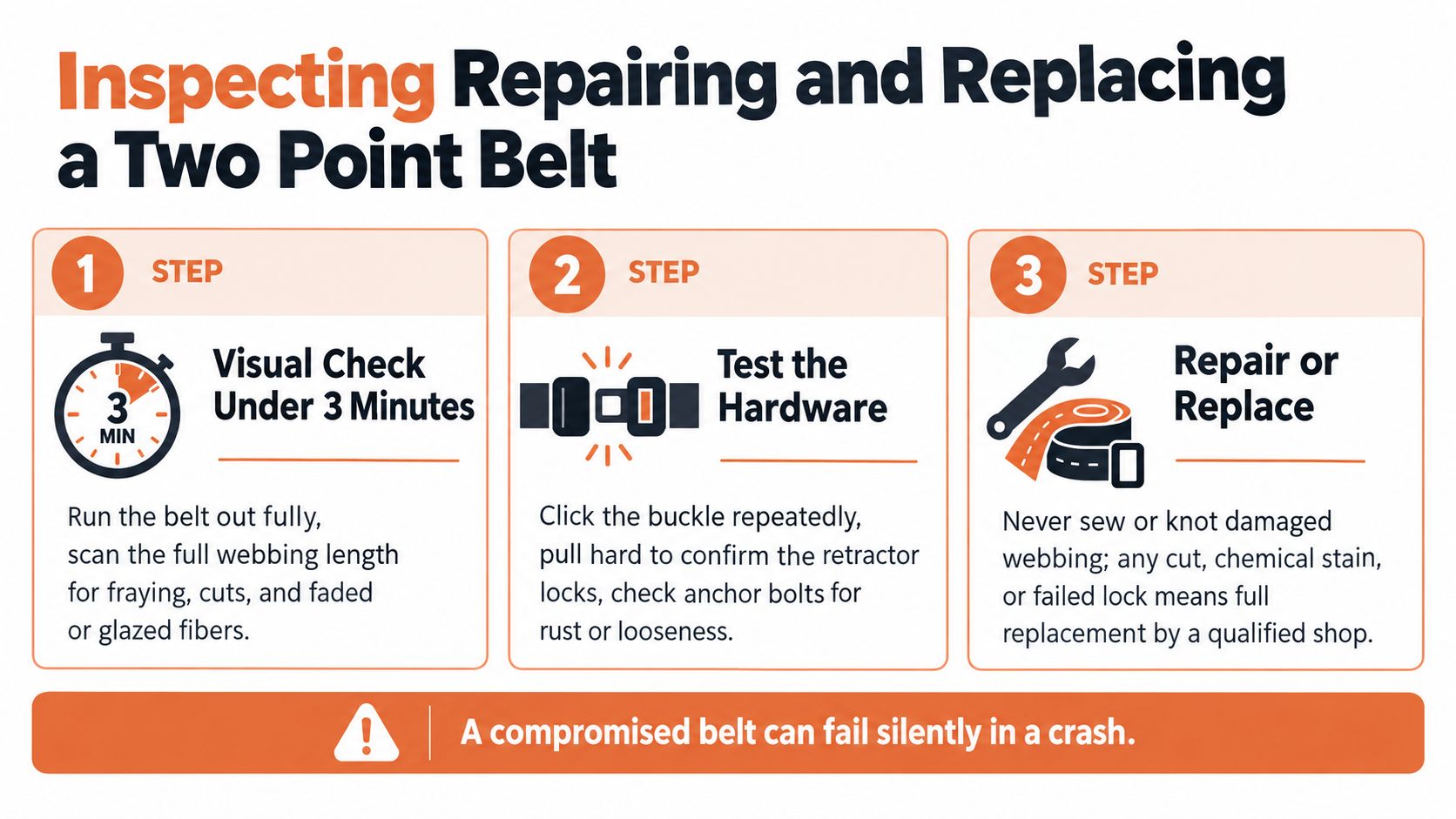
Pull the webbing out slowly and inspect its full length under good lighting. Look for cuts, fraying, pulled stitching, chemical stains, melted fibers, severe fading, glazing, or stiffness. Run your fingers over the strap. A belt that feels unusually hard or rough may have suffered heat, contamination, or age-related deterioration.
Next, operate the buckle several times. The tongue should enter cleanly, latch positively, and release when you press the release button. Check that the retractor allows controlled extension and locks when the belt is pulled sharply. Inspect the anchor bolts for rust, looseness, distorted washers, or damage around the mounting area.
Know which work belongs in a shop
Don't sew, knot, staple, or patch damaged webbing. Don't substitute a generic buckle because its tongue happens to fit. Restraint webbing, stitching, retractor calibration, and anchor hardware must work as a matched system.
Owner-level care includes cleaning ordinary spills with an appropriate mild method, keeping the belt away from sharp edges, and recording the belt's identification label. Shop-level work includes webbing replacement, retractor rebuilding, pretensioner service, and any repair after a crash.
Replacement rule: If the webbing is cut or chemically damaged, the locking mechanism fails, or the anchor structure is compromised, replacement is safer than cosmetic repair.
When sourcing a replacement, record the belt width, webbing length, buckle style, anchor spacing, retractor orientation, label information, and vehicle application. A correct replacement must fit the original mounting points and maintain the intended belt path. For a broader vehicle evaluation, use a structured used-car safety inspection checklist and include every restraint position, not only the driver's seat.
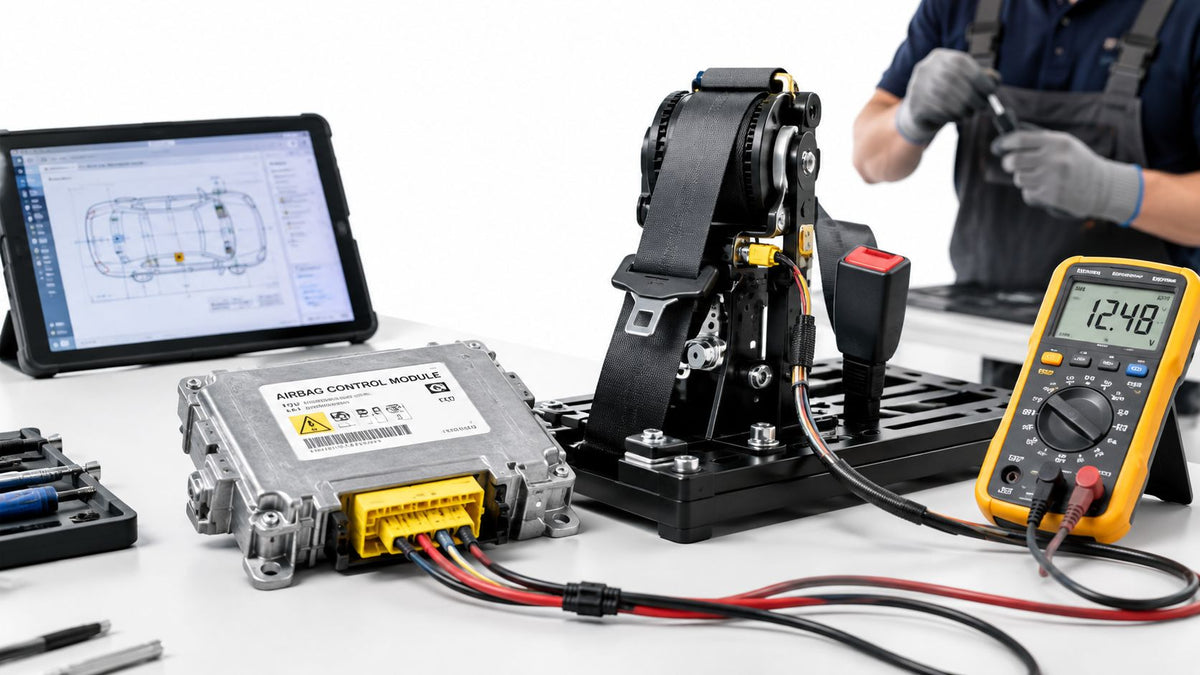
If a belt has locked after a collision or the vehicle's SRS system has stored crash data, the belt and related electronics need a compatible repair path. Seat Belt Repair handles mail-in pretensioner repair, webbing replacement, and SRS module resets using OEM components, with customers or local repair facilities completing reinstallation.
For a vintage car, older work truck, or post-collision restraint, photograph the belt label and mounting points, inspect the webbing and buckle, and confirm the correct replacement specification before ordering parts. Visit Seat Belt Repair to review mail-in options for damaged webbing, locked pretensioners, and SRS control modules, then send the component to a qualified service provider for testing and reinstallation.

Laisser un commentaire
Ce site est protégé par hCaptcha, et la Politique de confidentialité et les Conditions de service de hCaptcha s’appliquent.