
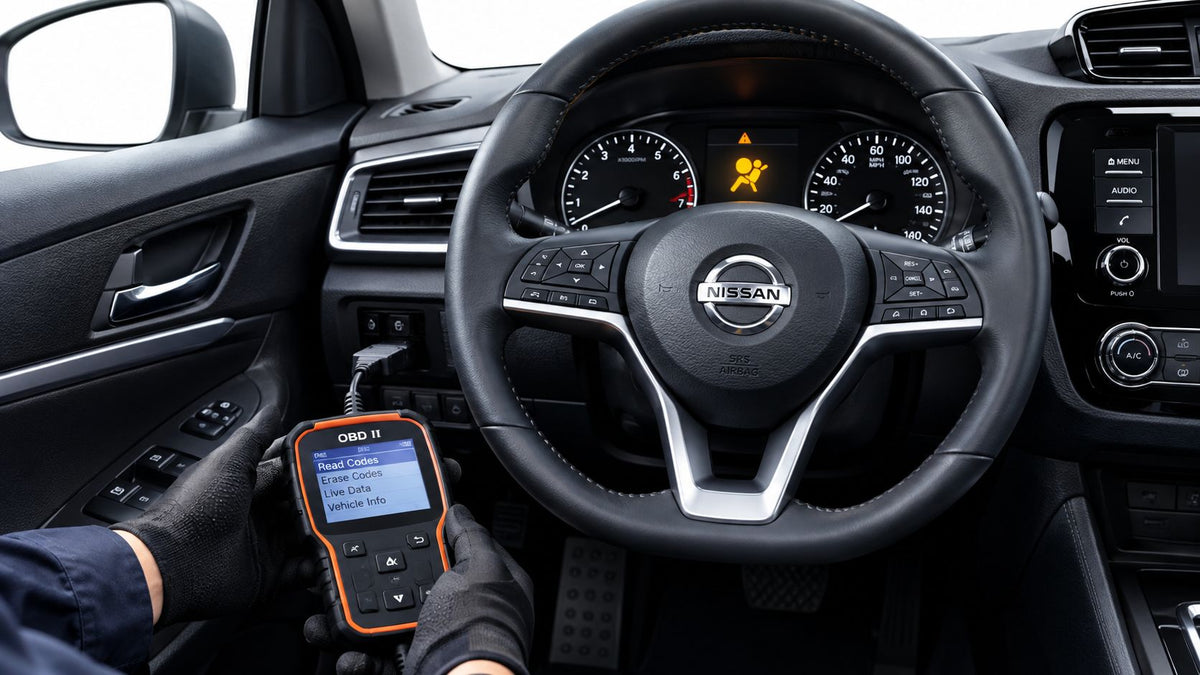
You turn the key after a minor collision, battery replacement, or salvage rebuild and wait for the red airbag symbol to disappear. The other warning lights may clear, but the Nissan SRS light stays on, leaving you to choose between a cheap forum trick, a diagnostic appointment, or a replacement module.
The right choice depends on what the SRS control unit has stored and whether the restraint system has been repaired. A battery disconnect is not a dependable reset, and clearing a code isn't the same as making the airbags and seat-belt pretensioners safe. Use Nissan's startup behavior and self-diagnosis sequence to narrow down the fault, then choose the least expensive method that addresses the problem.
Table of Contents
- Why Your Nissan Airbag Light Will Not Clear with a Battery Disconnect
- What the Nissan Airbag Light Is Supposed to Do at Startup
- Running the Nissan Factory Self-Diagnosis Sequence
- The Four Faults Behind a Persistent SRS Light
- OBD-II Scanners vs SRS Diagnostics vs Mail-In Module Reset
- Why Clearing Crash Data Is Not the Same as a Safe Repair
- Your Reset Decision Checklist and Common Questions
Why Your Nissan Airbag Light Will Not Clear with a Battery Disconnect
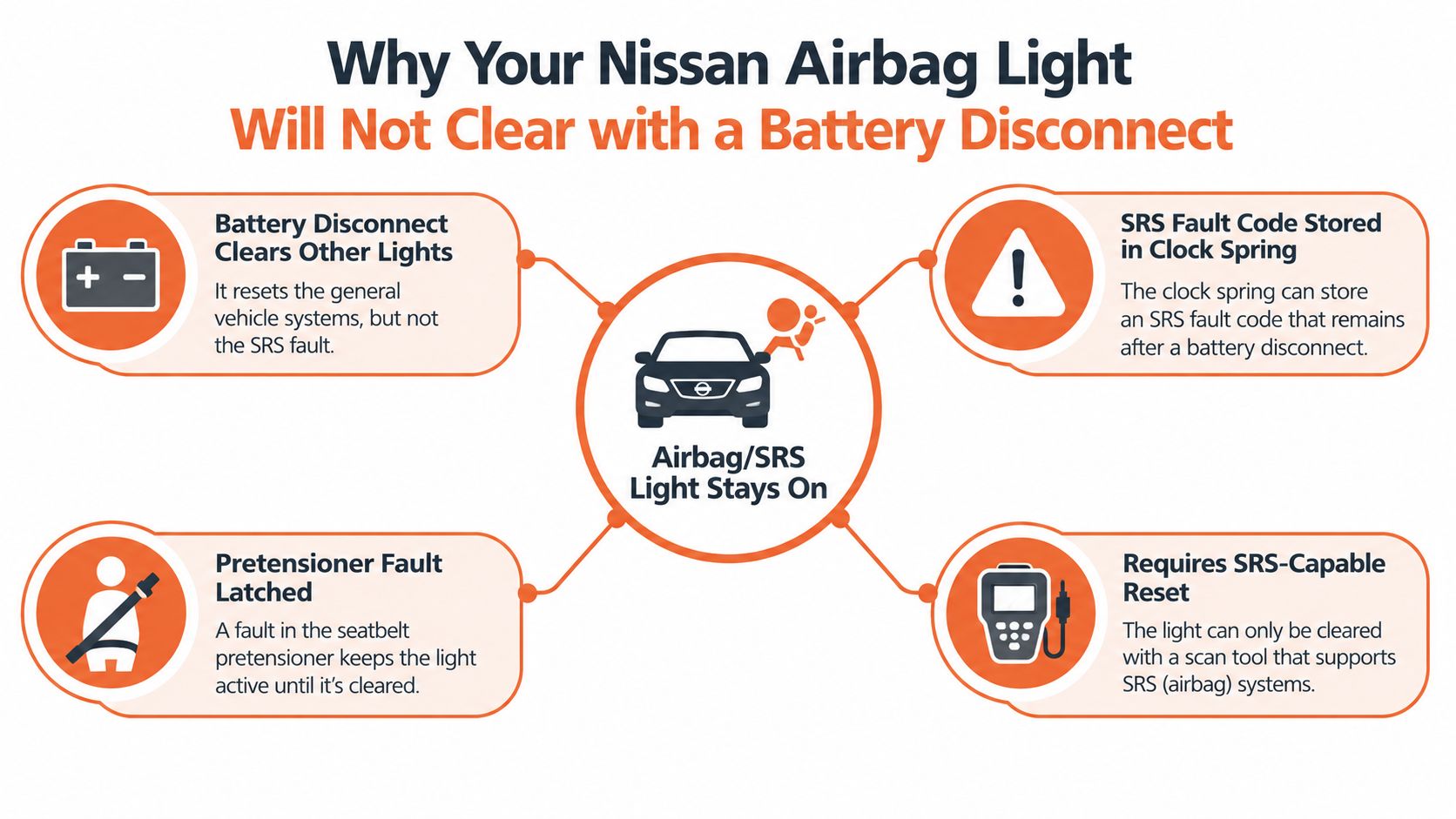
A Nissan owner may disconnect the negative battery cable after a fender-bender, wait, reconnect it, and expect the airbag lamp to reset. That approach can clear some temporary electrical warnings, but it doesn't reliably erase SRS crash data or hard faults stored in the airbag control system.
Nissan's own service information treats a persistent SRS lamp as a fault that needs inspection and repair. If the lamp remains illuminated after its startup check, the SRS or seat-belt pretensioner system may not operate properly. The practical conclusion is simple: disconnecting the battery isn't a repair for a light that stays on. Nissan service guidance describes the expected startup check and the need to inspect a persistent warning.
What the battery trick can and cannot do
The SRS module stores important information separately from the engine computer. A power interruption may change the module's operating state, but it doesn't prove that crash data, a deployment record, or an internal fault has been erased. Nissan technical material also indicates that a battery disconnect isn't a reliable fix for a stored crash event.
That matters after a collision. A deployed pretensioner, damaged wiring circuit, or airbag control unit fault can bring the warning lamp back as soon as the module performs another check. Repeating the disconnect only delays diagnosis and can leave the vehicle with a restraint system that isn't ready to protect occupants.
Practical rule: If the airbag lamp returns immediately after power is restored, stop treating the battery as the reset tool. Treat the lamp as a request for SRS diagnosis.
The money decision is also straightforward. A free shortcut is only cheaper if it works and doesn't hide a damaged component. If the light remains on, repeated battery experiments waste time while the actual fault continues to sit in the SRS system. Scan the airbag module, inspect the restraint components, and reserve a reset service for a module that has been properly evaluated.
What the Nissan Airbag Light Is Supposed to Do at Startup
The SRS warning light is designed to perform a self-check when you switch the ignition on. On Nissan vehicles covered by the referenced owner and service information, the lamp illuminates briefly, then goes out when the system passes its initial check. One Nissan manual describes the light turning off after about 7 seconds, while Nissan service guidance describes a startup illumination of roughly 6 seconds. The Nissan owner-manual guidance explains what the SRS lamp means when it stays on, flashes, or fails to illuminate.
Use the light's behavior as your first clue, not as a complete diagnosis. A lamp that stays on indicates that the system has detected a condition requiring attention. A lamp that doesn't illuminate at all is not reassuring, because the warning circuit itself may need inspection.
| Light Pattern | What It Means | First Action |
|---|---|---|
| Illuminates briefly, then goes out | The startup self-check has completed without detecting the relevant fault | Continue normal operation, but investigate any other restraint warning |
| Stays illuminated | Nissan indicates that an SRS or pretensioner system may not operate properly | Arrange SRS-capable diagnosis before relying on the restraint system |
| Flashes or behaves abnormally | The system has detected a warning condition or the lamp circuit may have a fault | Record the pattern and have the SRS module checked |
| Never illuminates | The warning lamp or its circuit may not be functioning as intended | Have the warning system inspected rather than assuming the SRS is healthy |
A steady lamp after the startup check is the most common situation owners describe as “the Nissan airbag light won't reset.” Don't interpret that as a harmless reminder. Nissan documentation warns that the airbag, pretensioner, and occupant-classification systems may not operate properly while the warning remains active.
The light also can't identify the failed component by itself. You need SRS-capable diagnostics, a careful inspection, or both. The startup check tells you that the module has not accepted the system as ready. It doesn't tell you whether the cause is crash data, a pretensioner, an occupant-classification circuit, the module, or the warning circuit.
Running the Nissan Factory Self-Diagnosis Sequence
Nissan provides a factory-style ignition sequence that can move the SRS system into a self-diagnosis mode. It isn't a magic eraser. Its value is that it can help confirm whether the module is communicating and can expose a stored fault through the warning lamp.
Start with the vehicle stationary and the ignition off. Keep your timing consistent, because the sequence is sensitive to the point at which the lamp turns off.
- Switch the ignition on and watch the SRS lamp illuminate during its startup check.
- After the lamp has been illuminated for its approximately 7-second check period, switch the ignition off within 1 second after the lamp turns off.
- Wait more than 3 seconds.
- Repeat the same ignition-on and ignition-off pattern two more times, for 3 cycles total.
- Observe the SRS lamp and record what it does. If the lamp enters a diagnostic display, document the pattern before attempting any further action.
The timing and three-cycle requirement come from Nissan SRS technical guidance, which describes this as a transition into self-diagnosis rather than a repair procedure. The Nissan SRS technical reference details the ignition sequence and explains why clearing the lamp depends on resolving the active fault first.
If you miss the timing, start again rather than improvising. Don't turn this into a test of how quickly you can cycle the key. The SRS module needs the correct ignition transitions to recognize the command.
For a broader diagnostic walkthrough, this airbag-light diagnostic guide can help you organize the inspection before you clear anything.
This sequence may help with a valid stored code or an intermittent condition. It won't repair a deployed pretensioner, damaged harness, failed occupant-classification component, or internal module fault. Crash data and hard codes remain until the correct diagnostic and reset workflow removes them or the module is repaired and reset.
The sensible verdict is to use the factory sequence as triage. If the light clears and stays out after the underlying issue has been addressed, you may have avoided unnecessary parts replacement. If it returns, stop repeating the sequence and move to an SRS-capable scan.
The Four Faults Behind a Persistent SRS Light
A persistent Nissan SRS light usually points to one of four fault categories. The light alone won't identify which category applies, but the event that preceded it can narrow the search.
Pretensioner faults
Seat-belt pretensioners can become part of the fault picture after a collision. A pretensioner deployment or a circuit problem can leave the warning active even when the belt still appears to buckle and retract normally.
Inspect the belt assemblies and their connectors for evidence of deployment, damage, or an unplugged connection. Don't substitute normal belt movement for an SRS test. The pretensioner is a restraint component, not merely a retractor.
Occupant-classification faults
The passenger-seat occupant-classification system helps the vehicle determine how to manage restraint deployment. A connector disturbance, seat work, or damaged sensor circuit can create an SRS fault without an obvious external collision.
Avoid probing airbag circuits casually with test equipment. The correct diagnosis requires the appropriate procedure and SRS-capable equipment. If the warning began after a seat was removed or disturbed, inspect the seat-related connectors and wiring before condemning the control module.
Airbag control unit faults
The airbag control unit, sometimes called the ACU or SRS sensor unit, monitors the restraint circuits and performs its own checks. An internal fault, power-supply problem, or warning-lamp circuit issue can keep the lamp on even when the visible airbags look intact.
A fault that appears without a collision or recent seat work deserves a module and wiring investigation. Don't assume that an apparently clean interior means the control unit is healthy.
Crash-data events
A collision can leave crash data stored in the SRS sensor unit. Nissan technical material identifies deployment-related conditions and stored crash events as issues that a simple battery disconnect won't reliably remove.
The event history gives you the strongest shortcut:
| Fault Category | Typical Trigger | Required Fix |
|---|---|---|
| Pretensioner fault | Collision, damaged restraint, or circuit interruption | Inspect and repair or replace the affected restraint component, then clear the related SRS fault |
| Occupant-classification fault | Seat disturbance, connector issue, or sensor circuit problem | Diagnose the passenger-seat system and repair the confirmed cause |
| ACU fault | Internal module, power-supply, or warning-circuit problem | Test the module and wiring, then repair or replace the failed part |
| Crash-data event | Recorded collision or deployment event | Restore the vehicle's safety components, then use the correct module reset or replacement process |
An intermittent warning can point toward a connector or wiring concern, while a fault that returns immediately after clearing suggests that the module still sees an active problem. Those are diagnostic clues, not permission to guess at parts.
OBD-II Scanners vs SRS Diagnostics vs Mail-In Module Reset
The cheapest tool is often the wrong tool. A generic OBD-II reader may communicate with the engine computer while ignoring the Nissan SRS module entirely. If it reports no engine fault, that tells you little about an airbag warning lamp.
An SRS-capable diagnostic tool is the correct first equipment choice when you need to identify the stored restraint fault. It can access the relevant module, display fault information, and sometimes clear codes after the cause has been repaired. It still may not erase crash data or resolve an internal hard fault, because those conditions can require module servicing.
A mail-in module reset is a different option. It applies when the vehicle has been restored, the relevant components have been addressed, and the SRS control unit retains crash data or a hard code that normal in-vehicle clearing cannot remove. The module must be removed and sent to a service that can evaluate and reset it, then the owner or a local workshop reinstalls it.
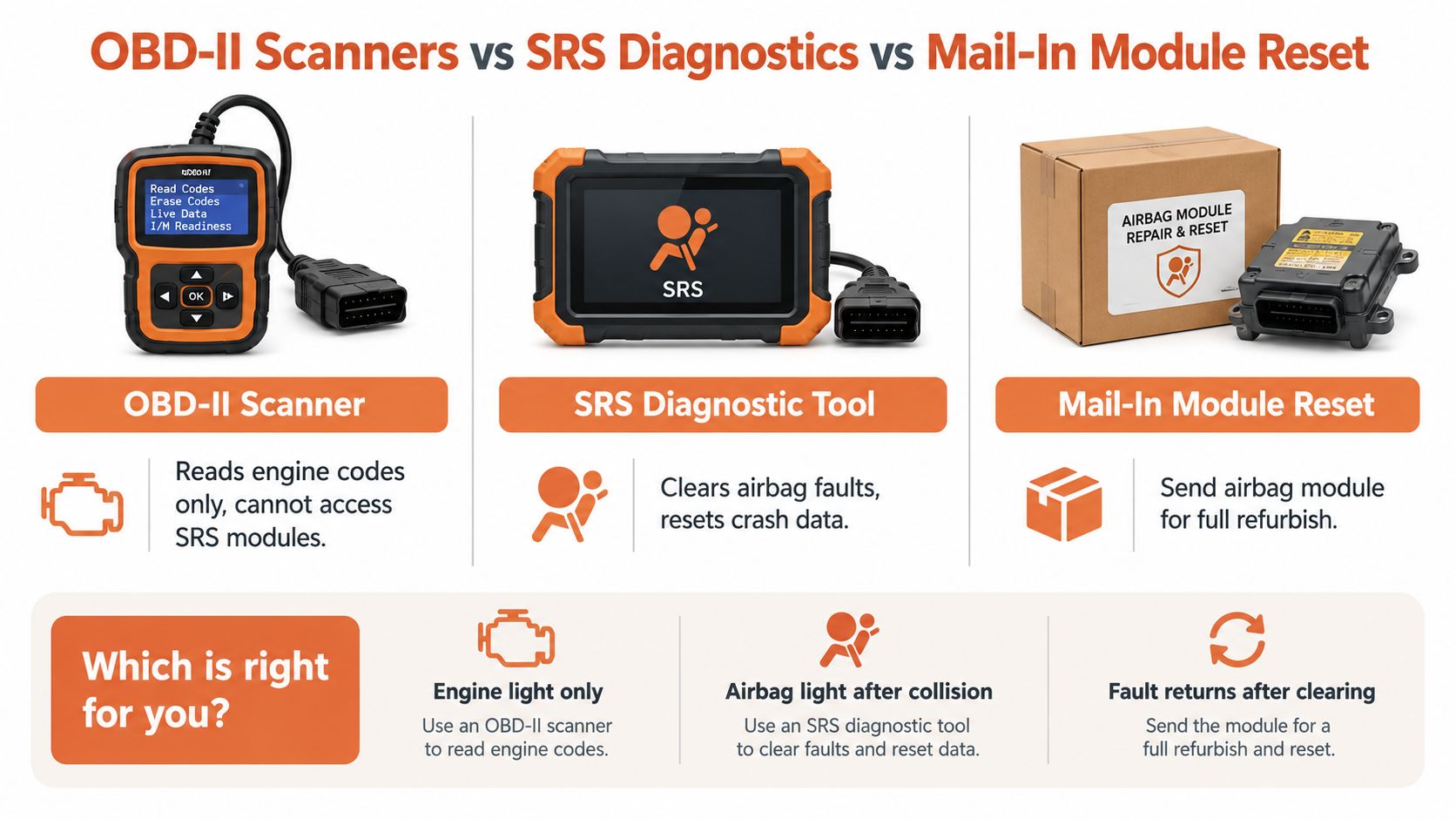
Use this decision rule:
- Engine-code reader: Choose this for engine and emissions diagnosis, not for a Nissan airbag lamp.
- SRS-capable scanner: Choose this when the cause is unknown, the light appeared without a collision, or you need to identify the active circuit.
- Module reset service: Choose this only after collision repairs and restraint-component checks, when the module is holding crash data or a hard internal code.
- Replacement module: Consider this when the original unit cannot be repaired or when a qualified technician determines replacement is appropriate.
A scanner that clears a code without fixing the cause gives you a temporary result at best. If the airbag light returns during the next self-check, the module is still detecting the problem.
For owners who already know the vehicle was repaired and need the module handled, Seat Belt Repair's mail-in SRS airbag module reset service is one available service route. The important distinction is sequence: diagnose first, repair the vehicle, then reset the module.
Why Clearing Crash Data Is Not the Same as a Safe Repair
Crash data is a record of a significant event inside the SRS system. Removing that record can return the module to a ready state, but it doesn't replace a fired pretensioner, repair damaged wiring, restore an airbag, or correct a passenger-seat sensor fault.
That distinction is where many salvage rebuilds go wrong. The warning light is treated as a nuisance indicator, so someone clears the stored event before checking the components that were involved in the collision. The lamp may go out, but the vehicle may still lack a functioning restraint device.
A cleared light proves that the module accepted the reset. It doesn't prove that every restraint component is installed, connected, and operational.
A responsible reset follows a repair sequence:
- Identify which airbags and pretensioners were involved in the event.
- Inspect the SRS wiring, connectors, sensors, and module.
- Replace or repair confirmed damaged components.
- Verify that the vehicle's power supply and warning circuit are sound.
- Reset the module only after the physical restoration is complete.
- Reinstall the module and perform an SRS-capable check.
This approach protects both safety and money. Resetting too early can force you to repeat the work when the module detects a component that was never repaired. Installing an unrelated used module can create compatibility, configuration, or programming questions that a specialist must resolve before the vehicle is considered ready.
The legal and insurance consequences also depend on what was repaired, not merely whether the red lamp disappeared. Keep records of the parts replaced, the diagnostic results, and the module service. If you're unsure what a collision damaged, this guide to what needs replacement versus what can be reset after a crash offers a useful way to separate physical restoration from electronic reset work.
A mail-in reset is responsible when it is the finishing step on a properly repaired vehicle. It is irresponsible when it's used to conceal a deployed belt, missing airbag, damaged sensor, or unresolved wiring fault.
Your Reset Decision Checklist and Common Questions
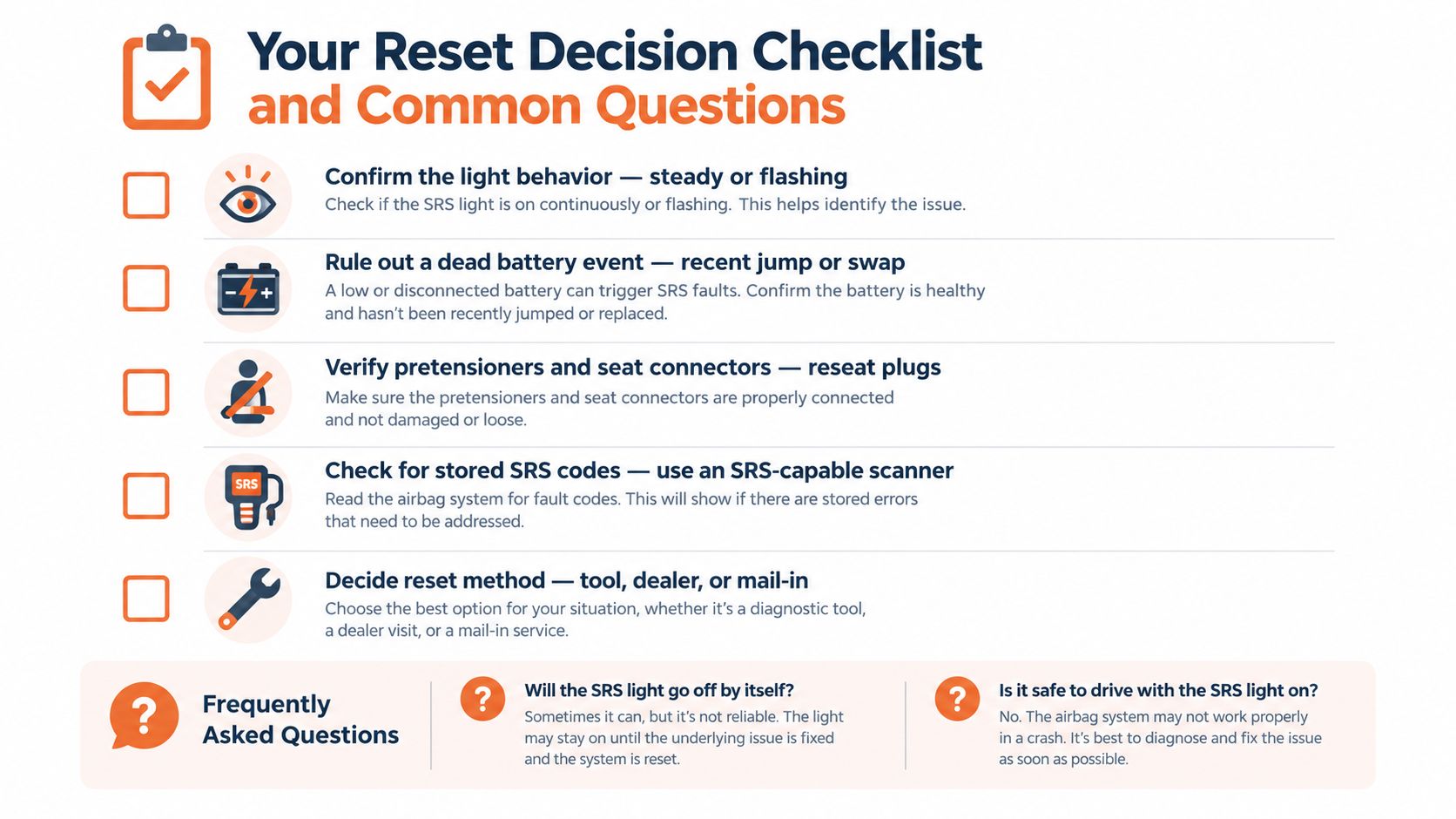
Work through the problem in order. Don't start by buying a replacement module.
- Confirm the lamp behavior: Note whether it goes out after the startup check, stays steady, flashes, or never illuminates.
- Review the recent event: A collision, jump-start, battery swap, or seat removal changes the likely fault path.
- Inspect restraint connections: Check for damaged components and disturbed seat or pretensioner connectors, but don't probe airbag circuits carelessly.
- Run the factory sequence: Use Nissan's timed ignition procedure as a triage step, not as proof that the system is repaired.
- Scan the SRS module: Use equipment that can communicate with the airbag system, not only the engine computer.
- Repair before clearing: Address the confirmed component or wiring fault before attempting a reset.
- Escalate appropriately: Use a module reset service when the vehicle is restored but crash data or an internal hard code remains.
Is a Nissan dealer likely to reset the light for free?
Don't count on a free reset. A dealer normally needs to diagnose the SRS system, identify the cause, and determine whether parts or module work are required. Ask what the diagnostic charge covers before authorizing work.
Is it safe to drive with the SRS light on?
Treat it as unsafe to rely on the restraint system until a qualified workshop checks it. Nissan states that the airbag and pretensioner systems may not operate properly while the warning remains active.
What does a mail-in module reset cost compared with dealer diagnosis?
The price depends on the module, the vehicle, shipping, and the work needed on the car. Compare the total with diagnostic and replacement options, but don't choose solely by price. A cheaper reset is poor value if the underlying restraint fault remains.
Can a used airbag module be programmed to another VIN?
Sometimes compatibility and programming depend on the exact module and vehicle configuration. Have the part number and vehicle identification details checked by an SRS specialist before buying a used unit.
If your Nissan has already been repaired after a collision and the remaining problem is stored SRS data, send the correct module to Seat Belt Repair for mail-in SRS module reset and related seat-belt pretensioner service. Confirm the fault first, remove the component safely, and use the reset as the final step, not a substitute for restoring the vehicle.

Laisser un commentaire
Ce site est protégé par hCaptcha, et la Politique de confidentialité et les Conditions de service de hCaptcha s’appliquent.