
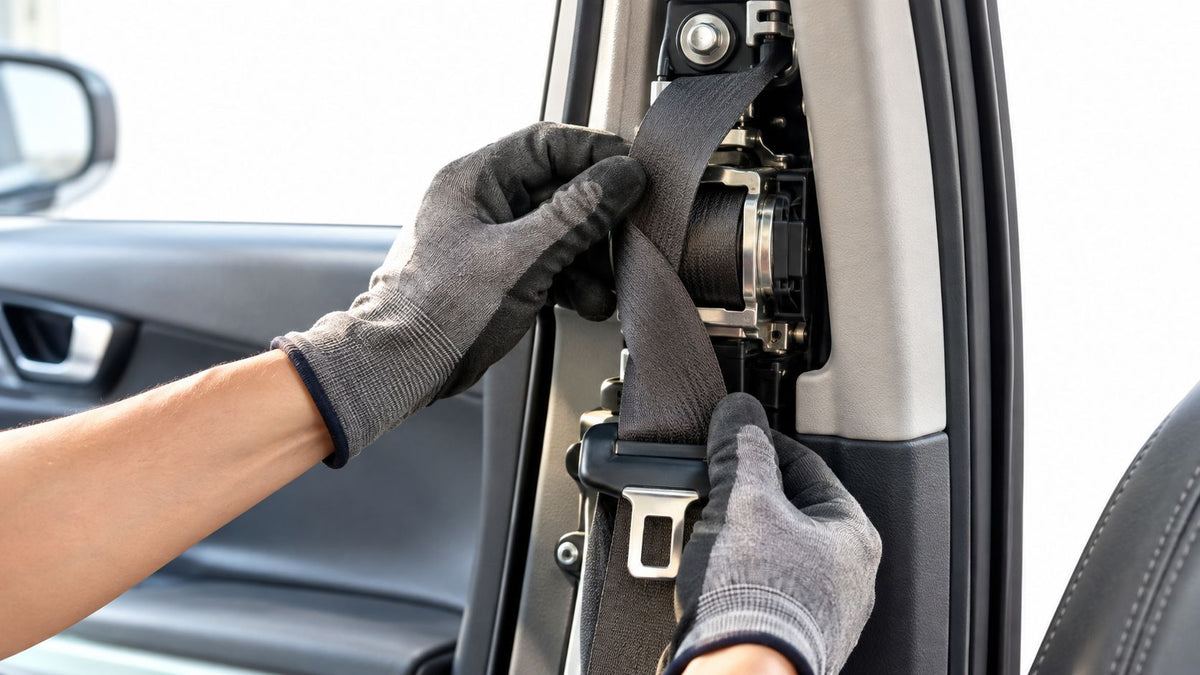
You're probably standing next to the car right now, tugging on a belt that won't move, and trying not to make it worse. Stop yanking it. A seatbelt that's stuck can be a twisted webbing problem, or it can be a fired pretensioner, and those are not the same job at all.
The quickest way to fix a seatbelt that is stuck is to identify which one you've got before you touch anything else. If it's dirt, a fold, a trapped latch plate, or a child-seat locking mode, you can usually sort it out with patience. If it locked after a crash, or the SRS light is on, forcing it is the fast way to turn a repairable restraint into a replacement-only problem.
Table of Contents
- Why your seatbelt is really stuck
- Safe DIY checks before you touch the retractor
- What a pretensioner actually does and why it locks
- Component-level inspection checklist
- Why mail-in repair beats dealer replacement
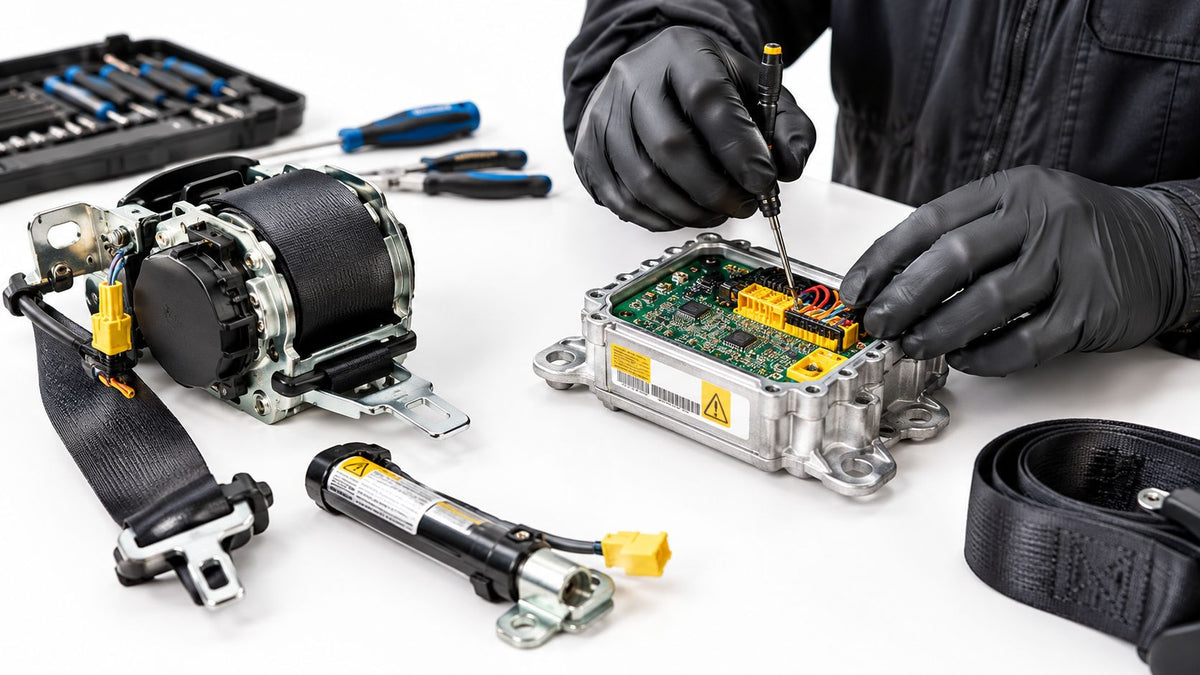
- The seatbelt and SRS module connection
- The one rule that decides everything
Why your seatbelt is really stuck
A stuck belt usually comes from one of two problems. The first is mechanical, a twist, a pinch point, a buckle issue, or the belt left in Automatic Locking Retractor mode. The second is a crash event, where the pretensioner has fired and the belt is locked because the system did exactly what it was built to do.
Start with the question that matters
Ask when the belt became stuck. If it has been acting up for weeks, the webbing is probably bunched, dirty, or trapped in the upper guide. If it turned immovable right after a collision or airbag event, treat it as a restraint component that has already deployed. A belt that is completely jammed after a crash may be a spent pyrotechnic device, not a simple snag.
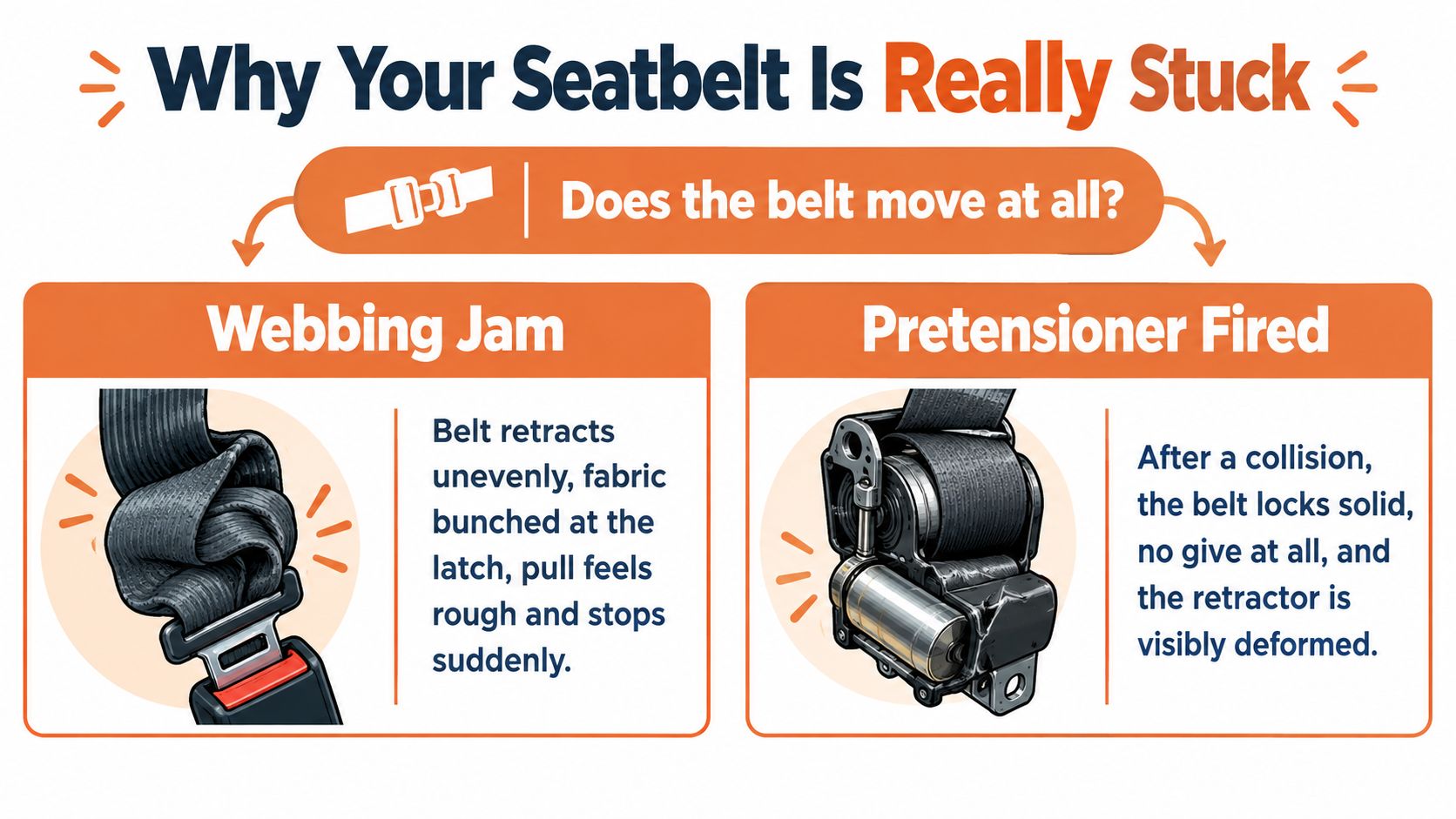
Practical rule: if the belt still moves, even awkwardly, you may be dealing with a webbing or routing issue. If it is locked solid after a crash, with the warning lamp on, stop treating it like a normal jam.
Look at the clues around the belt, not just the belt itself. An airbag warning light, visible deformation around the pillar, or crash history shifts the diagnosis toward the restraint system. In that case, the right move is a recall check and a component inspection before anyone pulls harder.
The recall angle matters because some vehicles were built with known retractor pretensioner problems. In a 2024 Ford safety recall, 57,031 2019-model-year Expedition vehicles were identified with front retractor pretensioners that could deploy inadvertently, and NHTSA said that deployment could lock the belt so it could neither retract nor extend (NHTSA recall report). That is the kind of failure that looks like a jam to the driver and a deployed restraint to the technician.
Safe DIY checks before you touch the retractor
If the belt didn't lock in a crash, start with the simple stuff and stay disciplined. Park on level ground, keep the webbing aligned, and let it move slowly under its own tension. Don't yank it. A sharp pull only makes a twisted or pinched belt bind harder.
Work the obvious causes first
Check the webbing from latch plate to shoulder guide. Look for a fold, a twist, contamination, or a section that's bunched up near the buckle. Then confirm the buckle isn't trapping the latch plate and the upper guide isn't pinching the belt edge. If a child restraint was installed, make sure the retractor isn't in a locked mode from being fully extended.
For contamination and interior buildup, a clean belt path matters more than people think. If the trim is packed with dust, spilled drinks, pet hair, or grime, clean it first and make sure the belt can glide without drag. A good reference for cabin cleanup habits is SwiftJet's guide on complete car interior cleaning tips, especially if the belt path has obvious dirt or sticky residue.
Know when to stop
If the belt suddenly locks while you're feeding it back in, stop. If it won't extend at all after you've straightened the webbing and cleared the guides, stop. If the SRS lamp is on, stop treating it like a simple retraction problem.
If a belt only locks after full extension and then releases when the latch is unbuckled, that can be normal ALR behavior. If it went dead after a collision, don't force it.
Do not open the retractor housing, spray lubricant into it, drill it, or defeat the connector. Those parts are calibrated restraint hardware, not garage-fix hardware. If it still won't move after alignment checks, the unit needs to be handled as a safety component, not a sticky reel.
What a pretensioner actually does and why it locks
A pretensioner is the part that takes slack out of the belt during a crash. It uses a pyrotechnic charge or other trigger mechanism to pull the belt tight fast enough to hold the occupant in position before the rest of the crash sequence plays out. Once it fires, that unit has already done its job.
Why the belt feels dead after a crash
When a pretensioner deploys, the retractor can lock so hard that the belt won't retract or extend normally. That isn't a mechanical annoyance, it's the aftermath of a one-shot restraint event. In practical terms, the belt is no longer serviceable just because it can be made to move by force.
Modern belts can use different stage counts depending on the vehicle. Some are single-stage, some dual-stage, and some triple-stage. The connector count and the vehicle-specific service information matter because they tell you what you're dealing with before any rebuild or replacement starts.
For a plain-language technical walkthrough, see seat belt pretensioner explained. It's the right background if you're trying to understand why a crashed belt behaves nothing like a dirty one.
What not to do
Don't pry open the housing, don't lubricate it, and don't assume the spool spring is the whole problem. A fired pretensioner is a restraint event, not a reel issue. If you disturb it the wrong way, you can make a bench-repairable unit into a parts-only loss.
The repair logic also follows the standards. FMVSS 209 covers the restraint assembly as a system, including retractors, webbing, buckles, and hardware, and technical documentation tied to it reports minimum breaking strengths of 2,270 kilograms for pelvic-restraint webbing and 1,810 kilograms for upper-torso webbing in a Type 2 belt assembly (49 CFR § 571.209). That's exactly why improvised fixes don't belong anywhere near a belt.
Component-level inspection checklist
Once you know the belt is not locked from a deployed pretensioner, inspect the parts one by one. Don't guess. A seatbelt system can fail at the webbing, the latch plate, the buckle, the upper guide, or the retractor, and each part has its own pass-or-fail line.
Check each piece for a clear yes or no
| Component | What to inspect | Pass or fail rule |
|---|---|---|
| Webbing | Twists, folds, cuts, frays, contamination, chew marks, bad stitching | Pass if the webbing is smooth, clean, and intact. Fail if fibers are separated, cut, or snagging. |
| Latch plate | Cracks, corrosion, deformation, sticky movement | Pass if it slides and locks cleanly. Fail if it binds or looks damaged. |
| Buckle | Release button feel, internal corrosion, broken housing | Pass if it releases crisply. Fail if it sticks or won't release normally. |
| Upper guide | Pinch points, trim interference, misalignment | Pass if the belt tracks freely. Fail if the guide traps the webbing edge. |
| Retractor | Locking response, smooth payout, return tension | Pass if it locks and retracts as designed. Fail if it won't extend, retract, or lock correctly. |
| Pretensioner connector | Deployment residue, damage, harness condition | Pass if there's no sign of firing. Fail if there's evidence of activation or crash damage. |
A good locking test is simple. Remove the retractor, change its angle carefully, and see whether it locks the way it should. Vehicle-sensitive units should lock before roughly 45 degrees of inclination, and a belt that fails that repeated check belongs in the repair-or-replace pile, not back in the car. For a plain-language walkthrough of a retractor that will not behave normally, see seat belt retractor not working.
If a recall applies, follow the recall remedy, not a workaround. As noted earlier, the Ford Expedition recall covered in the first section already shows the right response to a pyrotechnic fault, dealer replacement, not force.
That is the part many owners miss. A dirty or twisted belt gives you a mechanical problem. A fired pretensioner gives you a restraint event, and the inspection has to separate those two before anyone starts forcing parts back into service.
Why mail-in repair beats dealer replacement
Dealer replacement sounds tidy because it feels official. In practice, it is often the slowest and least efficient move for a post-collision belt, especially when the assembly can be rebuilt safely. If the belt is repairable, the smarter choice is to restore the original unit with the right parts and test it before it goes back in the car.
The workflow that makes sense
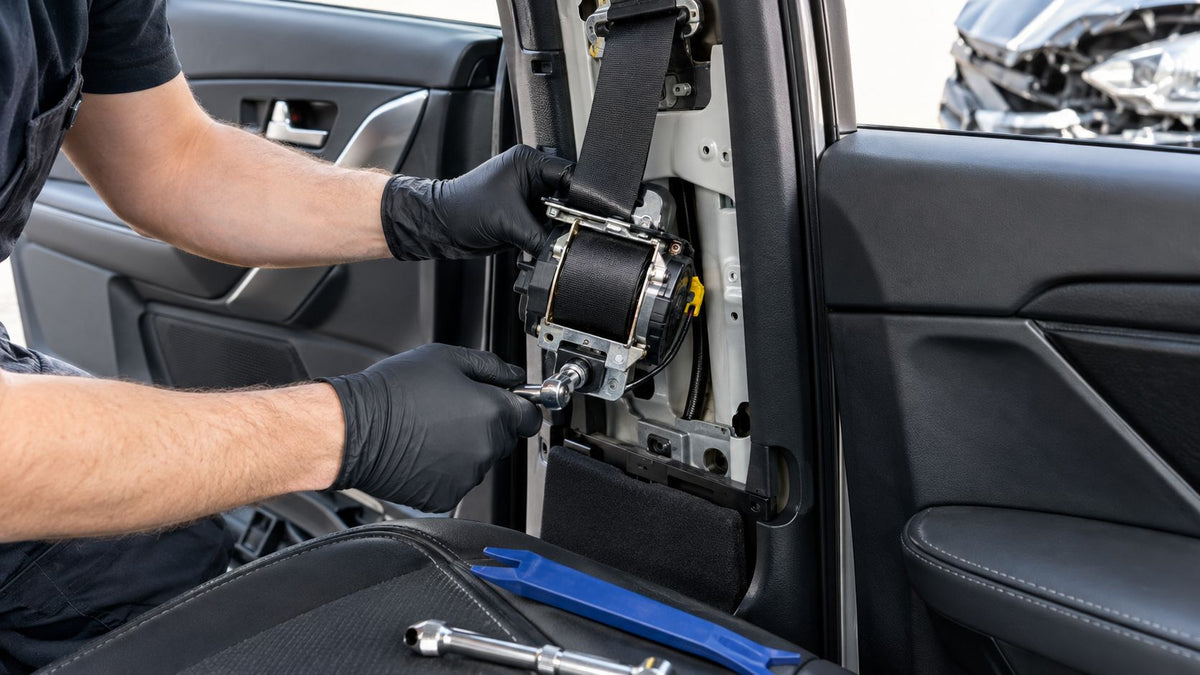
Start with proper removal, using the vehicle's torque spec instead of a pry bar and guesswork. Pack the unit in a rigid box, send it to a specialist, have it disassembled, rebuilt with OEM components, function-tested, and returned ready for reinstall. That keeps the original fitment and avoids the mismatch risk that comes with random used parts.
The manufacturer's pretensioner removal procedure in a NHTSA recall calls for disconnecting the pretensioner harness before removal, installing the replacement fully, torquing the mounting bolt to 39 N·m (29 lb-ft), and reconnecting the connector only after the unit is secured. Another procedure in the same document calls for disconnecting the 12-volt supply before retractor removal and using installation torques of 25 N·m for the D-ring and 5 N·m for the belt guide (the manufacturer's pretensioner removal procedure).
Who this path is built for
This route is built for salvage rebuilders, body shops, dealership reconditioning teams, and owners dealing with total-loss or post-collision cars. It also fits anyone who wants to keep the original assembly instead of gambling on a used one. A repaired belt that is function-tested and reinstalled to spec is a real restraint again.
A belt that goes back in without torque discipline is not repaired, it's just installed.
If the webbing itself is damaged, retractor work alone is not enough. Seat Belt Repair also offers Golf Cart Seat Belt Repair Webbing Replacement Color Change for golf cart belts with worn or damaged webbing, which is a useful example of how webbing service and retractor service solve different problems.
The point is simple. Once you are past a basic webbing jam, mail-in repair is the straightest route back to a belt that matches the vehicle's original restraint setup.
The seatbelt and SRS module connection
A locked belt after a collision usually isn't the only thing the car is complaining about. The same event that fires the pretensioner often leaves the SRS module holding crash data and hard codes, which is why the dash lamp stays on. Fixing just the belt leaves the system incomplete.
Why the warning light matters
The SRS module stores crash information after deployment, and that data doesn't disappear because the belt gets repaired. Clearing a light with a scan tool isn't the same thing as restoring the module to a ready state. If the module still has crash data, the restraint system still isn't ready.
A proper post-crash workflow treats the belt and module as one package. That's why Seat Belt Repair's supplemental restraint system problem guide fits naturally with a belt repair, because the two issues usually travel together.
The questions people ask too late
Check the VIN for an open recall before paying out of pocket. If a recall is active, the manufacturer may already have a prescribed remedy. That can change the whole repair path.
Salvage-title cars need the same discipline, maybe more. If the car came from Copart, IAAI, or a similar auction source, assume the restraint system has already been disturbed and verify every component before reinstalling anything. Rear and center belts matter too, because a nonfunctional restraint anywhere in the car can fail inspection and leave occupants unprotected.
A recent technical bulletin showed that some folded rear belts can be released by correcting the fold and using the proper backlock procedure, but the bulletin still directs further diagnosis if the belt remains locked (NHTSA technical bulletin). That's the right mindset here, fix the obvious mechanical issue when it exists, then stop and inspect when it doesn't.
If the pretensioner has activated, replace or professionally service the affected belt assembly. Activated pretensioners are not reset by wishful thinking, and the belt shouldn't go back into service until it retracts smoothly, locks correctly, and the SRS system reports no unresolved fault.
The one rule that decides everything
Here's the rule I'd use in the bay and in the driveway. If the belt is stuck because of dirt, a twist, a fold, or child-seat lock mode, work it carefully and solve the routing problem. If it got stuck after a collision, or the airbag light is on, treat it like a pyrotechnic restraint event and stop forcing it.
That one decision saves time and prevents bad repairs. It also keeps you from grinding a repairable issue into a failed one. If you're unsure, check the VIN for recalls, inspect the belt and SRS clues, and then decide whether the unit needs cleaning, removal, rebuild, or replacement.
If the assembly is rebuildable, the fastest route back to a safe belt is a specialist mail-in repair with OEM components and a proper post-repair function test. A locked belt is not something to bully back to life. It needs the right diagnosis, the right parts, and the right torque when it goes back in.
If your belt is stuck after a crash, or you've got an SRS light and don't want to guess wrong, send it to Seat Belt Repair. They repair pretensioners, replace webbing, and reset SRS modules by mail, which is exactly the kind of setup this problem calls for. Stop forcing the belt, pull the component, and get the restraint system handled the right way.

Laisser un commentaire
Ce site est protégé par hCaptcha, et la Politique de confidentialité et les Conditions de service de hCaptcha s’appliquent.